
Central Air Conditioning Service
Air Conditioning Installation in Elgin & the Fox Valley
A new air conditioner performs exactly as well as the installation behind it. We size it to the house, not the old label, match the coil, pressure test with nitrogen, pull a deep vacuum, weigh in the charge and commission it with real measurements. Our owner is NATE certified in Air Conditioning Installation, and every install is done the same way.
- NATE certified in Air Conditioning Installation
- Manual J load calculation available on request
- Nitrogen pressure test and vacuum to 500 microns
- Permits filed under our own license where required
Signs You Need a Proper AC Installation
Some of these mean you need a new system. The rest mean the last installation was done wrong, and the next one needs to be done right.
- You’re building or adding on. New construction, a finished basement, a second-floor addition or a converted garage all change the load and need to be sized, not guessed.
- The house has never had central air. Older Fox Valley homes with a furnace and no coil can usually add central AC using the existing ductwork, after we verify it can move the air. Homes without ducts are a fit for ductless mini-splits.
- Your old system is being replaced. Every replacement is an installation. See our AC replacement page for the repair-or-replace side; this page covers how the work itself gets done.
- The current system short cycles and leaves the house humid. The classic sign of an oversized unit, sized from the old label instead of the house.
- Rooms that never cool. Undersized ducts, a blower fighting high static pressure or a system that was never balanced.
- The last install left things undone. No permit, no matched coil, a reused line set that was never flushed, a charge that was ‘about right’. We see these every summer on systems only a few years old.
- Ice on the coil of a new system. Often a charge that was never weighed in or airflow that was never measured.
- The outdoor unit sits in the mud. A sinking, tilted pad strains the line set and the compressor. A good install starts with a level pad on gravel.
- A new furnace is going in. Installing the coil and condenser at the same time gets a matched system and one visit.
What Goes Into a Correct AC Installation
These are the steps that separate a system that lasts 17 years from one that needs a compressor at year six.
Step one
Measuring the house
We measure the house, count and orient the windows, note insulation levels, ceiling heights, infiltration and duct location, and size the equipment to the actual cooling load. Fox Valley split-levels and ranches from the 1960s to 2000s are routinely oversized by a half ton or more. The load, not the old nameplate, sets the size. When the numbers are borderline, a permit or utility program requires it, or you ask for one, we run a full Manual J load calculation (there may be an additional cost).
Right-sized
Sizing and equipment selection
An oversized AC cools the air fast, shuts off before it dehumidifies and short cycles itself to an early death. We select the tonnage the load calls for, then choose single-stage, two-stage or inverter equipment based on your comfort goals and budget. Amana and Daikin are our installed brands.
AHRI matched
Matched indoor coil
The outdoor unit and the indoor evaporator coil are certified together in the AHRI directory. That match is what gives you the rated SEER2 and the manufacturer’s warranty. We install the matched coil on the furnace or air handler every time, with a new TXV where the match calls for one.
Refrigerant lines
Line set flush or replacement
An existing line set is flushed to remove old oil and debris, or replaced when it’s the wrong size, kinked, corroded or was used with R-22 mineral oil. Brazing is done with nitrogen flowing through the lines so no oxide scale forms inside. Insulation on the suction line is replaced where it’s cracked or missing.
Leak-free
Nitrogen pressure test and deep vacuum
Before any refrigerant goes in, we pressurize the system with dry nitrogen and hold it to prove there are no leaks at the brazed joints. Then we pull a vacuum to 500 microns and confirm it holds, which removes air and moisture that would otherwise form acid and kill the compressor.
Weighed in
Charge weighed and verified
The factory charge covers a standard line set length. We add the correct amount for the actual run by weight on a scale, then confirm it with subcooling and superheat measurements once the system is running. ‘Beer-can cold’ is not a charging method.
Electrical and drain
Disconnect, whip, surge and condensate
New weatherproof disconnect and whip, breaker sized to the nameplate, surge protection where you want it, a properly trapped condensate drain with a float switch, and a new pad set level on compacted gravel.
Measured
Commissioning
We measure total external static pressure, temperature split across the coil, supply and return temperatures, compressor and fan amp draws, and refrigerant pressures and temperatures. Those numbers are recorded on the startup sheet and left with you. If any of them are off, we fix it before we leave.
How the Installation Day Goes
Most residential AC installations are done in one day. Here’s the sequence.
- Morning arrival and walkthrough. We confirm the equipment matches the quote, lay down floor protection and review where the new pad, line set and drain will run.
- Recovery and removal. The old refrigerant is recovered into a tank per EPA Section 608 rules. Owner Jeff Kerley holds EPA 608 Universal certification. The old condenser and coil come out.
- Indoor coil. The matched coil is set on the furnace or air handler with a sealed, insulated transition. The TXV and drain are installed and the drain is trapped and tested.
- Outdoor unit. New pad set level, unit placed with clearance for airflow and service, line set routed, brazed with nitrogen flowing and insulated.
- Electrical. Disconnect, whip, low-voltage control wiring and, if chosen, surge protection and a new thermostat.
- Pressure test and vacuum. Nitrogen test, then vacuum to 500 microns with a micron gauge, then a decay test to prove it holds.
- Charge and startup. Charge weighed in for the line length, system started, and full commissioning measurements taken and recorded.
- Walkthrough and cleanup. We show you the thermostat, filter, disconnect and drain, leave the startup sheet and warranty paperwork, and haul everything away.
A furnace-and-AC changeout, a new line set through finished space or an electrical upgrade can stretch the job into a second day. We’ll tell you at the quote, not on the morning of.
Permits, Inspections and Warranty Registration
The paperwork is part of the installation.
Many Fox Valley municipalities require a mechanical permit for a new or replacement air conditioner, and some require an electrical permit for the disconnect and circuit. We file permits under our own license where required and meet the inspector. We’re municipally licensed in Elgin, Aurora, Bartlett, Huntley and Streamwood, and we’re licensed, insured and bonded everywhere we work. A permit protects you: it puts a second set of eyes on the work, and it matters when you sell the house.
After the installation we register the equipment warranty in your name with the manufacturer. Registration has a deadline and it’s what activates the manufacturer’s full coverage, so we handle it rather than leaving it to you. You get a copy for your records. Keep it with the startup sheet and your annual tune-up reports; together they’re your proof of a correct installation and proper maintenance if you ever need a warranty claim.
What a Bad AC Installation Looks Like
We repair a lot of systems that were installed badly. These are the shortcuts we find most.
- Sized from the old unit. Not sized to the house, so the new system is as oversized as the one it replaced and short cycles just the same.
- Old coil left in place. Saves a few hours. Loses the efficiency rating, the AHRI match and often the warranty.
- Line set never flushed. Old oil and debris from an R-22 system end up in a new compressor.
- No nitrogen while brazing. Black oxide flakes form inside the copper and plug the TXV or metering device a year later.
- No vacuum, or a vacuum measured by time instead of microns. Moisture stays in the system, forms acid and eats the compressor windings.
- Charge by gauge pressure alone. Off by a pound either way, the system runs inefficiently and the coil ices or the compressor floods.
- No commissioning numbers. Nobody measured static pressure or the temperature split, so nobody knows the ductwork is choking the blower until you call about weak airflow.
- No permit. No inspection, no record, and a problem when you sell.
None of this shows up on installation day. It shows up in year two as a frozen coil, in year four as a bad TXV or in year six as a dead compressor. If your system is young and already in trouble, our AC repair team can tell you whether the installation is the cause.
What AC Installation Costs
Quotes are free, written and specific to your home.
We quote in person, because the price depends on the size the house needs, the equipment tier you choose, whether the line set can be reused, the electrical, and whether a furnace or air handler is part of the job. A first-time installation in a home that has never had central air adds a line set run, an electrical circuit and sometimes duct modifications. Every quote is a flat price that includes the matched coil, the pad, the permit, startup and disposal, and any ComEd discount is already subtracted if you choose a heat pump.
You can prequalify for financing in about 2 minutes with no impact to your credit score, and on-bill financing is available on qualifying equipment. Request a free quote and we’ll schedule a visit.
Installed by a NATE-Certified Team
Credentials that apply to this exact job.
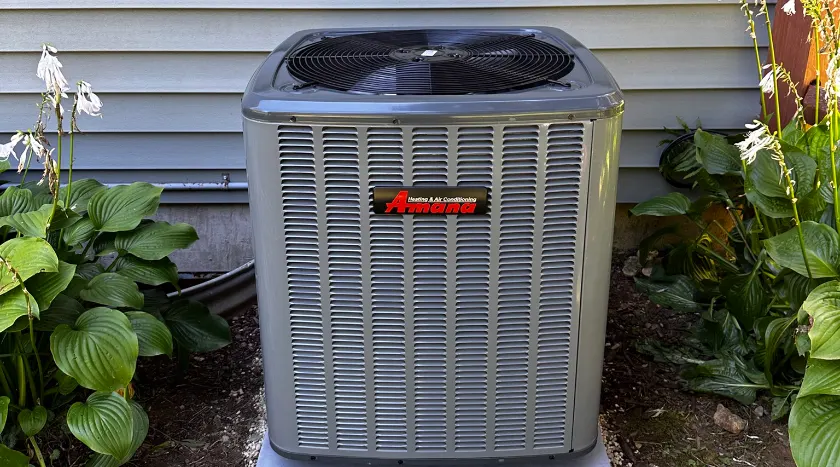
An Amana central air conditioner installed by our team, with the line set insulated, the pad level and the disconnect within reach.
- Owner Jeff Kerley holds NATE certification in Air Conditioning Installation and Gas Heating Installation
- EPA 608 Universal certified for refrigerant handling
- NCI airflow trained, so ductwork and static pressure are measured, not assumed
- Daikin and Amana factory training, including S-Series inverter systems
- Amana Champions Club 2024 and 2025, Daikin Inverter Champion 2024
- BBB of Chicago and Northern Illinois Complaint Free Award 2024 and 2025
- Municipally licensed in Elgin, Aurora, Bartlett, Huntley and Streamwood
Want the same care on an older system? See AC maintenance. Installing a heat pump instead? See heat pump installation.
Installing New AC? Consider a Heat Pump.
A cold-climate heat pump installs exactly like the air conditioner on this page, with the same coil, line set, vacuum and commissioning, and it also heats. Modern inverter models keep heating well below zero, and most Fox Valley homes keep the gas furnace as backup in a dual-fuel setup. As a ComEd Heat Pump-Trained Contractor, we take the ComEd instant discount off your invoice: $900 to $2,000 on a qualifying ducted heat pump depending on efficiency tier and heating capacity, up to $2,000 on a ducted heat pump of 2.5 heating tons or more, plus $75 for a qualifying ENERGY STAR smart thermostat we install. No application, no waiting. See ComEd instant discounts.
The discount requires AHRI-matched equipment and a refrigerant of 700 GWP or less, which R-32 meets. St. Charles, Geneva and Batavia run their own electric utilities, so ComEd discounts aren’t available there. See heat pumps or the Amana S-Series R-32 inverter models.
Air Conditioning Installation Across the Fox Valley
Based in Elgin, we serve homes throughout Kane, McHenry, DuPage and DeKalb counties.
- Elgin
- South Elgin
- St. Charles
- Aurora
- Bartlett
- Streamwood
- Huntley
- Plato Center
- Sycamore
- Carpentersville
- West Dundee
- East Dundee
- Algonquin
- Gilberts
- Hampshire
- Pingree Grove
- Campton Hills
- Geneva
- Batavia
- Barrington
- Hoffman Estates
- Schaumburg
- Burlington
- Marengo
- Wayne
- Sleepy Hollow
Don’t see your town? Call (847) 224-2420. View all service areas.
Air Conditioning Installation FAQs
What is a Manual J load calculation and why does it matter?
Manual J is the ACCA method for calculating how much cooling a house actually needs, based on square footage, insulation, windows, orientation, infiltration and ductwork. A Manual J load calculation is available as needed, on request, or where a municipality or utility program requires one, and to verify sizing on a borderline house; it may carry an additional cost. Oversized systems short cycle and leave the house humid.
What size air conditioner does my house need?
Whatever the house actually needs. Many Fox Valley homes need less than what’s installed now. Rules of thumb like ‘one ton per 500 square feet’ are how systems end up oversized. We size every job individually.
What does AHRI matched mean?
The Air-Conditioning, Heating and Refrigeration Institute certifies specific outdoor unit and indoor coil combinations and publishes their tested efficiency. Installing a matched pair is what gets you the rated SEER2, and manufacturers require it for the full warranty.
Do I need a new indoor coil with a new air conditioner?
Yes. The old coil isn’t matched to the new condenser, may be sized for a different refrigerant and often has years of dirt and corrosion. We install the matched coil on every job.
Can you reuse the existing refrigerant lines?
Often, if they’re the right size and in good condition. We flush them to remove old oil and debris. If they were used with R-22, are kinked, corroded or undersized, we replace them.
Why do you pressure test with nitrogen and pull a vacuum to 500 microns?
The nitrogen test proves the brazed joints don’t leak before any refrigerant goes in. The vacuum removes air and moisture. Moisture left in a system forms acid and destroys the compressor. Five hundred microns, held, is the industry standard for a dry system.
How is the refrigerant charge set?
By weight, on a scale, adjusted for the actual line set length, then verified by measuring subcooling and superheat with the system running. Charging by gauge pressure alone is how systems end up over- or undercharged.
What is commissioning?
Measuring and recording the system’s performance at startup: static pressure, temperature split, amp draws, pressures and refrigerant temperatures. It proves the installation is right and gives you a baseline for future tune-ups.
How long does an air conditioning installation take?
Most residential installations are done in one day. A furnace-and-AC changeout, a first-time installation with a new line set and circuit, or duct modifications can take a second day.
Do I need a permit to install an air conditioner in Elgin?
Most Fox Valley municipalities, including Elgin, require a mechanical permit for a new or replacement air conditioner, and some require an electrical permit. We file permits under our own license where required and meet the inspector.
Can you add central air to a house that has never had it?
Usually, if the home has a forced-air furnace and ductwork. We check that the ducts can move enough air, install a coil on the furnace, run a line set and a new electrical circuit, and set the outdoor unit. Homes without ducts are a good fit for a ductless mini-split.
Do you install air conditioning in new construction and additions?
Yes. We size to the plans, coordinate with the builder on duct layout and electrical, and commission the system before occupancy. Additions are sized for the new load, not tacked onto the existing system without checking.
What does NATE certification mean?
NATE, North American Technician Excellence, is the leading independent certification for HVAC technicians. Owner Jeff Kerley holds the Air Conditioning Installation and Gas Heating Installation certifications, which test the specific knowledge on this page.
What brands do you install?
Amana and Daikin, including Amana S-Series R-32 inverter heat pumps and Daikin ductless systems. We register the equipment warranty for you after installation.
Do you register the warranty?
Yes. We register the equipment in your name after installation and give you a copy. Registration has a deadline, and the extended parts coverage depends on it, so we don’t leave it to chance.
Should I install a heat pump instead of an air conditioner?
Often, yes. A heat pump installs the same way, cools the same and also heats in spring and fall for less than gas. ComEd’s instant discount of up to $2,000 on a ducted heat pump often covers most of the price difference. St. Charles, Geneva and Batavia are outside ComEd territory.
How much does AC installation cost?
It depends on size, equipment tier, line set and electrical needs, and whether a furnace is part of the job, so we quote in person. Quotes are free, written and include the coil, pad, permit, startup, disposal and any discount. Financing prequalification takes about 2 minutes.
Ready for an AC Installation Done Right?
Request a free written quote online or call to schedule an in-home visit.
Request a free quote, see financing options or explore all air conditioning services.
Discount amounts reflect the 2026 ComEd Energy Efficiency Program for qualifying equipment and are subject to change or cancellation due to funding limits. Rest Assured HVAC LLC is an independent contractor and is not affiliated with or endorsed by ComEd.
