
Heat Pump Indoor Unit Service
Air Handler Maintenance in Elgin & the Fox Valley
An air handler runs in both seasons, so it needs a real tune-up, not a filter swap. We clean the coil and blower, measure static pressure, test every heat strip and clear the drain, on every major brand. Our $240 maintenance plan covers the spring heat pump visit and the fall air handler visit for homes in Kane, McHenry, DuPage and DeKalb counties.
- Spring and fall tune-ups, up to $390 in services for $240
- All brands serviced
- NATE Ready-to-Work and Amana S-Series trained team
- Priority scheduling and 5% off repairs for plan members
Comprehensive Air Handler Maintenance & Repair in Elgin
Your air handler is the heart of your heat pump or split system. Our detailed Elgin air handler maintenance ensures clean coils, proper airflow, and optimal blower motor calibration. Regular tune-ups lower your utility bills and prevent emergency breakdowns when you need your system most.
What an Air Handler Is, and Why It Needs a Tune-Up
If you have a heat pump and no gas furnace, the cabinet in your basement, closet or attic is an air handler.
An air handler is the indoor unit of a heat pump system. It holds the blower that moves air through your ducts, the evaporator coil that heats or cools that air, a set of electric heat strips for backup heat on the coldest nights, a filter rack and a condensate drain. There’s no burner and no gas line. The outdoor heat pump makes the heat or removes it; the air handler delivers it.
Because it runs in both seasons, an air handler never gets a break. The coil dehumidifies all summer and collects dust and biological growth while it does. The blower runs more hours than a furnace blower. The heat strips sit idle for eight months, then get asked for full output on a January night near 0°F. A twice-a-year tune-up is how you catch what that workload does to the equipment before it becomes a repair.
Signs Your Air Handler Is Overdue for Maintenance
None of these means something is broken yet. All of them mean it’s time for a tune-up.
- You can’t remember the last tune-up. If it’s been more than a year, the coil and drain haven’t been looked at since before last cooling season.
- The filter looks gray and bowed. A loaded filter drops airflow across the coil, which raises static pressure, cuts capacity and can freeze the coil in summer.
- Airflow at the registers feels weaker than it used to. A dusty blower wheel and a dirty coil each take a bite out of airflow. Together they can cut it by a third.
- A musty smell when the blower starts. Standing water in the drain pan or growth on the coil. A cleaning fixes it.
- Electric bills creeping up each winter. Heat strips that stage in too early, or run when the heat pump should be carrying the load, show up on the bill long before anything fails.
- Water stains near the cabinet. A drain that’s starting to clog overflows a little before it overflows a lot.
- The system runs longer to hit the setpoint. Reduced airflow and a dirty coil make the heat pump work harder for the same result.
- Ice on the coil last summer. It thawed and the system came back, but the cause is still there.
- Rooms that are humid in summer or slow to warm in winter. Airflow and staging problems show up in the far rooms first.
Most of what we find on a tune-up costs little to fix on the spot. Most of what we find on a January repair call is the same list, six months later and after it took the heat down. If something already isn’t working, book air handler repair instead.
What Our Air Handler Tune-Up Includes
This is a real service visit, not a filter swap and a glance. Here’s what we do inside the cabinet.
Airflow
Coil and blower cleaning
We inspect the evaporator coil and clean it when it’s loaded with dust or growth. We check the blower wheel for buildup on the blades, which throws it out of balance and steals airflow, and clean it when it needs it. Clean coil, clean wheel, full airflow.
Measured
Static pressure
We measure total external static pressure across the air handler with a manometer and compare it to the rating on the data plate. High static tells us the filter, the coil or the ductwork is choking the system. It’s the single best number for how hard your blower is working.
Winter
Heat-strip amp draw
Each electric heat element should pull a specific current. We put a clamp meter on every strip, confirm the sequencer stages them in order, and catch a burned element or a stuck relay before the first cold snap does.
Water
Condensate drain and pump
We flush the drain line, clean the pan, test the float switch and run the condensate pump if you have one. Clogged drains are the most common cause of a heat pump shutting down in July.
Every visit
Filter
We check the filter, replace it if you’ve left one for us or you’re on our plan, and confirm it’s the right size and rating for the rack. A filter that’s too restrictive is as bad as one that’s too dirty.
Electrical
Motor, capacitor and connections
Blower amp draw, run capacitor on PSC motors, ECM module operation, tightness of the high-voltage lugs at the strip kit and the low-voltage connections at the board. Loose lugs on a heat strip circuit are a fire risk, not just a nuisance.
Controls
Thermostat and staging check
We confirm the thermostat calls the heat pump first and the strips second, that emergency heat isn’t left on, and that the balance point and aux lockout are set sensibly for our climate. This is where a lot of high winter electric bills come from.
On the spring visit we also check the outdoor heat pump: refrigerant pressures, coil, fan and defrost operation. See heat pump maintenance for that side. Together the two visits cover the whole system.
What to Expect on the Visit
A tune-up takes about an hour, sometimes a little more if the coil needs a real cleaning.
- Book a time that suits you. Spring visits go from April into early June before the heat sets in. Fall visits run September through November before the strips are needed. Plan members get priority scheduling.
- We start with a conversation. Any rooms that don’t keep up, noises you’ve noticed, how the bills have looked. That points us at what to check first.
- We run the system and take readings. Temperature split across the coil, static pressure, blower and strip amp draw, drain flow. Numbers first, then opinions.
- We clean and adjust. Coil, blower wheel, drain and pan, filter, tightening connections, thermostat staging. If something is failing, we show you and quote a flat-rate price before touching it.
- You get a written report. What we measured, what we did, and what to keep an eye on. If we think a part has a season left in it, we’ll say so rather than replace it early.
No tune-up ends with a surprise bill. If we find a part that needs replacing, you approve the price first, and plan members get 5% off. If nothing needs replacing, we tell you that too.
What Air Handler Maintenance Costs
Simple pricing, and a plan that covers both seasons.
A single air handler or heat pump tune-up is a flat fee. Most homeowners with a heat pump do better on our semi-annual maintenance plan: $240 a year covers a spring heat pump tune-up and a fall air handler tune-up, each up to a $130 value, plus one free business-hours service call, priority scheduling in the busy months and 5% off any repairs. That’s up to $390 in services for $240.
| Single tune-up | Maintenance plan | |
|---|---|---|
| Spring heat pump tune-up | Flat fee | Included (up to $130 value) |
| Fall air handler tune-up | Flat fee | Included (up to $130 value) |
| Business-hours service call | Diagnostic fee | One free per year |
| Repair discount | None | 5% off |
| Scheduling | First available | Priority |
| Annual cost | Two flat fees | $240 |
Small parts we find on a tune-up, such as a filter, a capacitor or a float switch, are quoted flat-rate on the spot, and you approve the price before we replace anything.
Maintenance, Repair or Replacement?
A tune-up keeps a good air handler good. It doesn’t turn a worn-out one into a new one.
Regular maintenance is the difference between an air handler that lasts 12 years and one that lasts 17. A clean coil and full airflow keep the compressor outside from working harder than it should, and a checked heat-strip circuit means the backup heat is there when you need it. That’s what you’re paying for.
- Maintain when the equipment is under about 12 years old, the coil isn’t leaking and the last few visits found nothing major. This is most air handlers.
- Repair when a specific part has failed and the rest of the unit is sound. Most repairs are worth making on a unit under 12 years old.
- Replace when the coil is leaking, a repair would cost more than half of a new matched system, or the outdoor heat pump is also near the end. Replacing the pair as an AHRI-matched system is what qualifies for the CY2026 ComEd heat pump discount.
We’ll tell you which one you’re looking at, in writing. See air handler replacement for the repair-vs-replace math, or how we install a new one.
Why a Tune-Up Matters More on a Heat Pump System
An air handler paired with a heat pump does two jobs a furnace never has to.
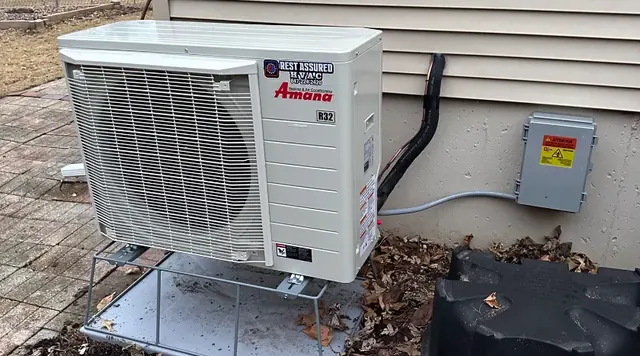
An Amana S-Series R-32 heat pump installed by our team. The air handler indoors is its matched partner, and both need a yearly look.
- Coil dehumidifies all summer, so it collects more growth than a furnace coil
- Blower runs in both seasons and racks up more hours
- Electric heat strips draw high current and need their connections checked
- Staging and balance point settings decide your winter electric bill
- Static pressure check catches duct and filter problems early
- Drain and float switch prevent the most common summer shutdown
- Clean airflow protects the compressor outside
Our team holds NATE Ready-to-Work and Amana S-Series training, and every tune-up is done by a technician who works on these systems every week. Learn more about heat pumps and the Amana S-Series.
Two Tune-Ups, One Free Service Call, 5% Off: $240 a Year
Our semi-annual maintenance plan covers the whole system: a spring heat pump tune-up and a fall air handler tune-up (each up to a $130 value), one free business-hours service call, priority scheduling and 5% off repairs. That’s up to $390 in services for $240. See the maintenance plan.
Dry winter air or dusty ducts? An air handler is a good place to add an AprilAire humidifier or media air cleaner. See indoor air quality.
Air Handler Maintenance Across the Fox Valley
Based in Elgin, we serve homes throughout Kane, McHenry, DuPage and DeKalb counties.
- Elgin
- South Elgin
- St. Charles
- Aurora
- Bartlett
- Streamwood
- Huntley
- Plato Center
- Sycamore
- Carpentersville
- West Dundee
- East Dundee
- Algonquin
- Gilberts
- Hampshire
- Pingree Grove
- Campton Hills
- Geneva
- Batavia
- Barrington
- Hoffman Estates
- Schaumburg
- Burlington
- Marengo
- Wayne
- Sleepy Hollow
Don’t see your town? Call (847) 224-2420. View all service areas.
Air Handler Maintenance FAQs
What is an air handler?
An air handler is the indoor unit of a heat pump system in a home without a gas furnace. It holds the blower, the evaporator coil, electric backup heat strips, a filter rack and a condensate drain. The heat pump outside makes or removes the heat; the air handler moves it through your ducts.
How often should an air handler be serviced?
Twice a year: once in spring before cooling season and once in fall before the heat strips are needed. Because it runs year-round, an air handler collects more dust and growth than a furnace and benefits from both visits.
What does an air handler tune-up include?
Coil and blower inspection and cleaning, static pressure measurement, amp draw on every heat strip, sequencer staging, drain flush and float switch test, filter check, capacitor and electrical connection check, and a thermostat staging review. You get a written report of what we measured.
How much does air handler maintenance cost in Elgin?
A single tune-up is a flat fee. Our maintenance plan is $240 a year and includes a spring heat pump tune-up and a fall air handler tune-up, each up to a $130 value, plus a free business-hours service call, priority scheduling and 5% off repairs.
Is the maintenance plan worth it for a heat pump system?
Usually yes. A heat pump system needs both a spring and a fall visit, and the plan covers both for $240 along with a free service call and 5% off repairs, which adds up to $390 in services. Priority scheduling matters most in July and January.
How often should I change the filter in my air handler?
Check it monthly and replace it when it looks loaded. For most homes with a standard one-inch filter that’s every one to three months; thicker media filters last longer. We check and replace it at every visit.
What is static pressure and why do you measure it?
Static pressure is the resistance your blower works against to push air through the filter, coil and ducts. High static means reduced airflow, higher bills and a shorter blower life. Measuring it tells us whether the filter, the coil or the ductwork is the problem.
Why do you check the heat strips in the fall?
The electric heat strips sit idle all summer and then get asked for full output on the first cold night. We measure the amp draw on each element and confirm the sequencer stages them correctly so you’re not finding out about a failed strip at midnight in January.
Why does my house feel humid even though the heat pump is running?
A dirty coil or low airflow reduces how much moisture the coil removes. Oversizing and short cycling do the same. A tune-up restores airflow and checks the coil; if the house has always been humid, we’ll talk about the system itself.
Can a tune-up lower my electric bill?
Often. Clean coils and full airflow let the heat pump do its job with less run time, and correcting thermostat staging keeps the heat strips from running when the heat pump should be. The strips are the most expensive way to heat a home.
When is the best time to schedule air handler maintenance?
Spring, from April into early June, for the cooling check, and fall, September through November, for the heating and heat-strip check. Plan members get priority scheduling.
Do you service air handlers you didn’t install?
Yes. We maintain and repair air handlers and heat pumps of every major brand, no matter who installed them.
Does a tune-up include the outdoor heat pump?
The spring visit does. We check refrigerant pressures, the outdoor coil, fan and defrost operation along with the indoor coil and drain. The fall visit focuses on the air handler, blower and heat strips.
Will you try to sell me a new system during a tune-up?
No. If a part is failing we’ll show you and quote it. If the unit is near the end of its life we’ll say so and you can request a free quote separately. Most tune-ups end with a clean bill of health.
Can maintenance keep my heat pump warranty valid?
Most manufacturers expect regular maintenance by a qualified contractor, and our written report gives you a record of each visit. Check your warranty terms for specifics.
What should I do between tune-ups?
Change the filter on schedule, keep supply registers open, keep the area around the air handler clear, and call if you see water near the cabinet, hear new noises or notice the bills climbing.
Book Your Air Handler Tune-Up
Call or book online for a single tune-up, or join the maintenance plan and we’ll schedule both visits for you.
Something already not working? See air handler repair. Explore all heat pump services.
