
24/7 Emergency Air Conditioning Service
Emergency AC Repair in Elgin & the Fox Valley — 24/7 No-Cool Service
AC not cooling in the middle of a heat wave? Call (847) 224-2420 any hour. We diagnose and repair central air conditioners and heat pumps of every major brand, with a flat-rate price approved before any work begins. Serving Kane, McHenry, DuPage and DeKalb counties, days, nights, weekends and holidays.
- 24/7 emergency air conditioner repair
- All brands repaired
- Common heat-wave parts on the truck
- Flat-rate price approved before work starts
Emergency Air Conditioner Repair: What Counts as an Emergency
Some no-cool calls can’t wait. Some can, and we’ll tell you which is which when you call.
Call us any hour if any of these apply. We take emergency calls 24/7 at (847) 224-2420.
- AC not cooling during a heat wave. When it’s over 90°F outside and the house is climbing past 85°F inside, that’s an emergency, especially with infants, older adults, anyone with a health condition or pets in the home.
- Burning smell or smoke from the indoor unit or the outdoor unit. Shut the system off at the breaker and call. A seized blower motor or a shorted wire can start a fire.
- Breaker trips and trips again. Reset it once. If it trips again, leave it off. A shorted compressor or fan motor is pulling too much current, and every reset risks more damage.
- Water pouring from the air handler or through a ceiling. A clogged condensate drain or a cracked pan over a finished space. Shut the system off to stop the water and call.
- Loud grinding, screeching or banging from the outdoor unit. Fan bearings or a compressor on its way out. Turn it off. Running it can turn a motor repair into a compressor replacement.
- Ice on the outdoor unit, the copper line or the indoor coil. Switch to fan-only to thaw it and call. Running a compressor on an iced coil can flood it with liquid refrigerant.
These can usually wait until morning, and a same-day AC repair appointment is the better path: the house is warm but under about 80°F and it’s a mild day, the system is running but cooling slowly, a register is weak, or the thermostat screen is blank but the house is comfortable. Not sure? Call. We’ll help you decide.
AC Not Cooling? What to Do Right Now
While you wait for us, these steps keep the house livable and keep the damage from getting worse.
- If there’s ice anywhere, switch the thermostat to fan-only. Set the system to OFF and the fan to ON. The blower will melt the ice off the coil in an hour or two. Put a towel under the air handler; melting ice can overflow the pan. Don’t run the compressor again until the ice is gone and the cause is found.
- Don’t keep resetting a tripped breaker. One reset is fine. A second trip means something is shorted or seized. Every restart hammers the compressor windings. Leave it off.
- Close the blinds and curtains on the sunny side. Direct sun through windows is the biggest heat load in most Fox Valley homes. Blocking it can keep the house several degrees cooler until the AC is back.
- Keep doors and windows shut during the day. Outside air in July is hotter and more humid than the air already in the house. Open up at night only if it’s cooler outside.
- Run fans, not the oven. Ceiling fans and box fans make the air feel cooler. Skip the oven and the dryer until the system is fixed.
- Move to the lowest level. Basements in our split-levels and ranches stay noticeably cooler than upstairs. Sleep there if you have to.
- Check on anyone at risk. Older adults, infants and anyone with a heart or breathing condition should get to somewhere cool if the house is over 85°F and it’s going to be a while.
Smell gas at any point? That’s a different emergency. Leave the house right away, call 911 from outside, and call your gas utility’s emergency line from outside before calling us.
Emergency Air Conditioning Repair: What to Check Before You Call
A surprising number of no-cool calls are something you can fix in two minutes. Check these first. If it’s still not cooling, call.
- Thermostat mode and setpoint. Make sure it says COOL, not HEAT or OFF, and the setpoint is below the room temperature. If the screen is blank, replace the batteries.
- The breakers. There are usually two: one for the air handler or furnace, one for the outdoor unit. Look for one sitting in the middle. Reset it once.
- The outdoor disconnect. The gray box on the wall near the outdoor unit. A pull-out or a switch inside can get knocked out by a lawn mower or a curious kid. Make sure it’s in.
- The filter. A filter that’s collapsed or packed with dust will freeze the coil and stop the cooling. Pull it out and run without it until we arrive if it’s that bad.
- The condensate float switch. Many systems shut off when the drain pan fills. Look for water in the pan under the coil or in the drain line’s overflow tee. If there’s water, the system did its job and the drain needs clearing.
- The furnace door. On a furnace with an AC coil, the blower won’t run if the panel isn’t fully seated against the door switch.
- The outdoor unit itself. Is the fan spinning? Is it buried in cottonwood fluff or grass clippings? Is there ice on the copper line? Tell us what you see; it helps us bring the right parts.
Elgin summers run humid from May into September, and the first stretch of 90°F days in June or July brings a rush of no-cool calls. Most of them are capacitors and clogged drains that a spring tune-up would have caught. Plan members get priority scheduling when that rush hits.
What the Technician Does When We Arrive
An emergency call gets the same full diagnostic as a daytime one. We fix the cause, not just the symptom.
- We check in with you first. When it stopped, what you noticed, what you’ve already tried. Then we look at the thermostat and the indoor unit.
- Indoor first. Filter, blower, evaporator coil, condensate drain and float switch, low-voltage fuse and control board. If the coil is still iced we’ll finish thawing it while we go outside.
- Then the outdoor unit. Power at the disconnect, contactor, run capacitor tested under load, condenser fan motor, compressor amp draw, and refrigerant pressures with superheat and subcooling.
- You get a flat-rate price before any work. We show you what failed and why. The repair is quoted flat-rate, and you approve that price before any work. If more than one thing needs attention, you get options.
- We make the repair. Our trucks carry the parts that fail most in a heat wave: capacitors, contactors, fan motors, fuses, float switches. Most emergency air conditioner repairs are finished on the first visit. If a part has to be ordered, we’ll tell you when it will be in and how to stay comfortable until then.
- We test it under load. Temperature drop across the coil, amp draws, pressures, drain flowing. You get a summary of what we found.
If the fault is a failed compressor or a large refrigerant leak on an older system, we’ll say so honestly. We can often get you cooling for the short term while you decide whether to fix it or look at AC replacement. Nobody makes a good replacement decision at 11 p.m., and we won’t ask you to.
The Most Common No-Cool Failures We See
In a heat wave, a few parts account for most of the calls.
Most common
Failed run capacitor
Heat kills capacitors, and the hottest week of the year is when the weak ones let go. The outdoor fan won’t spin, or the compressor hums and clicks off. A quick test and a correctly rated replacement, usually done on the spot.
Quick fix
Burned contactor or blown fuse
The contactor sends power to the outdoor unit. Pitted contacts, a stuck armature or ants inside stop it cold. A blown low-voltage fuse at the control board does the same. Both are fast repairs.
Water
Clogged condensate drain
On a humid day the coil pulls gallons of water out of the air. Algae clogs the drain, the pan fills, the float switch shuts the system down. We clear the line and test the switch.
Airflow
Frozen coil
A dirty filter, a failing blower or a low charge lets the coil ice over and the cooling stops. We thaw it and find the cause, because ice that’s just melted comes right back.
Outdoor unit
Condenser fan motor
When the fan quits, the compressor overheats and shuts down on its safety. Grinding or a fan that won’t spin without a push is the tell. Motor, capacitor and blade check.
Bigger job
Refrigerant leak or compressor
Low refrigerant means a leak. We can add refrigerant to get you through a heat wave, but we’ll find the leak first so you know what you’re dealing with. R-410A prices are rising through the phase-down; new equipment uses R-32.
For the full breakdown of each repair and what it typically costs, see our AC repair page. Heat pump owners: the outdoor unit works the same in summer, and emergency heat pump repair covers the differences.
What Emergency AC Repair Costs
How our pricing works after hours, in plain terms.
Every call starts with a flat diagnostic fee that covers the full system check above. During office hours (8 a.m. to 5 p.m., Monday through Friday) the service call is $130; weekday evenings after 5 p.m. it is $180, and nights, weekends and holidays are $260. Each includes 30 minutes of travel and 30 minutes of diagnostics, and parts are extra. The repair is quoted flat-rate, and you approve that price before any work. Repairs are priced flat-rate, not by the hour, and you see the price before we start. After-hours, weekend and holiday service calls are priced higher than business-hours calls. We tell you the after-hours rate before we dispatch, so there are no surprises when we arrive.
In our area, capacitors, contactors and fan motors commonly run $300 to $1,400. Refrigerant leak repair and compressor replacement can run into the thousands, which is where the repair-vs-replace conversation starts. Members of our maintenance plan get one free business-hours service call a year, 5% off repairs and priority scheduling in the summer rush. Larger repairs can be financed; you can prequalify in about 2 minutes with no impact to your credit score.
What Every Emergency Call Includes
Same standard at midnight as at noon.
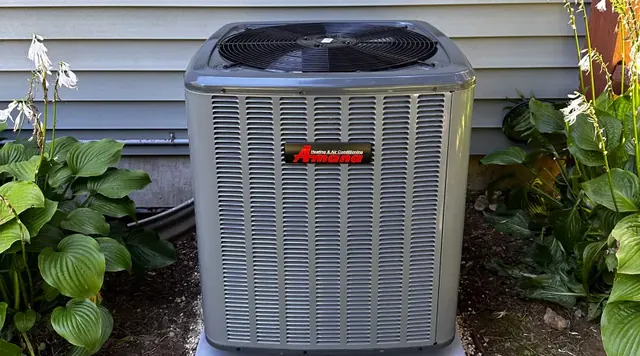
An Amana central air conditioner installed by our team. We repair every major brand, whoever installed it, any hour.
- Emergency calls taken 24/7, including weekends and holidays
- Help deciding whether it can wait until morning
- Full-system diagnostic, indoor and outdoor
- Written flat-rate price before any work starts
- Common heat-wave parts on the truck
- Refrigerant handled by an EPA 608 Universal certified technician
- Clear notes on what we found and what to watch for
Want to skip next summer’s emergency? A spring AC tune-up catches most of what’s on this page. Explore all air conditioning services.
Skip the Next Emergency for $240 a Year
Most no-cool calls in a heat wave are a weak capacitor, a dirty coil or a slow drain, and a spring tune-up catches them. Our semi-annual maintenance plan includes a spring AC or heat pump tune-up and a fall furnace or air handler tune-up (each up to a $130 value), one free business-hours service call, priority scheduling when the rush hits and 5% off repairs. That’s up to $390 in services for $240. See the maintenance plan.
Old system on its last legs? A new heat pump qualifies for CY2026 ComEd discounts of $900 to $2,000 off the invoice. See ComEd instant discounts.
Emergency AC Repair Across the Fox Valley
Based in Elgin, we serve homes throughout Kane, McHenry, DuPage and DeKalb counties.
- Elgin
- South Elgin
- St. Charles
- Aurora
- Bartlett
- Streamwood
- Huntley
- Plato Center
- Sycamore
- Carpentersville
- West Dundee
- East Dundee
- Algonquin
- Gilberts
- Hampshire
- Pingree Grove
- Campton Hills
- Geneva
- Batavia
- Barrington
- Hoffman Estates
- Schaumburg
- Burlington
- Marengo
- Wayne
- Sleepy Hollow
Don’t see your town? Call (847) 224-2420. View all service areas.
Related Guides
Plain-English reading from our blog on this topic.
- AC Not Cooling? 7 Things to Check Before You Call — Seven things to check when the AC runs but the house will not cool, which ones you can fix yourself in June, and the point where it becomes a repair call.
Emergency AC Repair FAQs
Do you offer 24/7 emergency AC repair in Elgin?
Yes. We answer no-cool calls 24 hours a day, seven days a week, at (847) 224-2420, for homes in Kane, McHenry, DuPage and DeKalb counties.
My AC is not cooling. What should I check first?
Confirm the thermostat is on COOL and set below room temperature, replace its batteries, check both breakers, make sure the outdoor disconnect is in, and look at the filter. If the outdoor unit still won’t run or the air is still warm, call us.
Is an AC not cooling an emergency?
During a heat wave, yes, especially with infants, older adults, anyone with a health condition or pets in the home. On a mild day with the house under about 80°F, a same-day repair appointment is usually the better path. Call and we’ll help you decide.
What does no cool mean on a service call?
It’s the term for a system that runs but doesn’t cool, or won’t run at all. The most common causes are a failed capacitor or contactor, a frozen coil, a clogged condensate drain that tripped the float switch, or a refrigerant leak.
There’s ice on my AC. What do I do?
Turn the system to OFF and the fan to ON. The blower will melt the ice in an hour or two. Put a towel under the indoor unit, and don’t run the compressor again until the ice is gone and the cause has been found.
Can I keep resetting the breaker until the technician arrives?
No. Reset it once. If it trips again, something is shorted or seized, and every restart risks turning a fan motor repair into a compressor replacement. Leave it off and call.
How fast can you get here for emergency air conditioner repair?
It depends on the time and the demand. In a heat wave, calls stack up quickly, and maintenance plan members get priority scheduling. We’ll give you an honest arrival window when you call, not a guess.
Do you charge more for emergency air conditioning repair after hours?
Yes. After-hours, weekend and holiday service calls are priced higher than business-hours calls. We tell you the after-hours rate before we dispatch, and the repair itself is still quoted flat-rate for you to approve.
How much does emergency AC repair cost?
Most common repairs, such as capacitors, contactors and fan motors, typically run $300 to $1,400 in our area. Refrigerant leak repairs and compressor replacements can run into the thousands. You get a flat-rate price before any work.
Why does my AC always fail during a heat wave?
Heat is hard on capacitors and motors, and a part that was weak in May lets go the first week it’s 95°F. The outdoor unit is also working its hardest when it’s hottest. Most heat-wave failures are parts a spring tune-up would have flagged.
Can you fix my AC the same night?
Usually. Our trucks carry the parts that fail most in summer: capacitors, contactors, fan motors, fuses and float switches. If a part has to be ordered, we’ll tell you when it will be in and how to stay comfortable until then.
What if it’s the compressor?
We’ll tell you honestly. A compressor replacement is a big repair, and on a system over 12 years old it’s usually where the repair-vs-replace conversation starts. We can often get you short-term cooling while you decide, and a free written replacement quote is separate from the emergency call.
How do I keep the house cool while I wait?
Close blinds on the sunny side, keep doors and windows shut during the day, run ceiling and box fans, skip the oven and the dryer, and move to the basement if you have one. Check on anyone at risk if the house passes 85°F.
Do you repair air conditioners you didn’t install?
Yes. We repair all major brands of central air conditioners and heat pumps, no matter who installed them.
Is water leaking from my AC an emergency?
If it’s dripping onto a basement floor, shut the system off and it can usually wait until morning. If it’s coming through a ceiling or pooling near electrical equipment, shut it off and call now.
Does the maintenance plan help in an emergency?
Yes. Plan members get one free business-hours service call a year, 5% off repairs and priority scheduling, which matters most in the first heat wave of the summer when calls stack up.
No Cool? Call Now.
We answer 24/7. Call for emergency air conditioning repair, or book a same-day repair online if it can wait until business hours.
Not an emergency? See our AC repair page for the full breakdown. Thinking about replacing? Request a free quote or see financing options.
Want one page that covers every system? See our combined 24/7 emergency HVAC pages for Elgin, Bartlett, Huntley and Campton Hills.
Discount amounts reflect the 2026 ComEd Energy Efficiency Program for qualifying equipment and are subject to change or cancellation due to funding limits. Rest Assured HVAC LLC is an independent contractor and is not affiliated with or endorsed by ComEd.
