
Heat Pump Service
Dual-Fuel Heat Pump & Furnace Systems in Elgin & the Fox Valley
A dual-fuel system pairs a cold-climate heat pump with a high-efficiency gas furnace and lets each one do the part it’s best at. The heat pump cools in summer and heats through most of the winter. The furnace takes over on the coldest nights. It’s the setup we install most in the Fox Valley, and it’s the only one that earns a CY2026 ComEd discount on the heat pump and a Nicor Gas discount on the furnace on the same job.
- ComEd Heat Pump-Trained Contractor
- Nicor Gas Contractor Circle Installing Member
- Balance point set and tuned for your house
- Amana S-Series R-32 inverter heat pumps
How a Dual-Fuel System Works
Two heat sources, one air handler, one thermostat that decides which runs. The deciding number is the balance point.
The equipment. The outdoor unit is a heat pump, which is an air conditioner that can run in reverse. The indoor unit is your gas furnace, with the heat pump’s coil sitting on top of it. In summer the heat pump cools and the furnace blower moves the air. In heating season the heat pump pulls heat out of the outdoor air and delivers it through the same ducts, and the furnace blower still moves the air. The furnace burners only light when the thermostat calls for them.
The balance point. A heat pump’s heating output drops as the outdoor temperature drops, while the house’s heat loss rises. The balance point is the outdoor temperature where the two cross, adjusted for what each fuel costs. Above it, the heat pump heats the house for less than gas would. Below it, the furnace takes over completely. Cold-climate inverter heat pumps push that crossover far lower than older heat pumps could: the Amana S-Series R-32 units we install keep heating well below zero. For most Fox Valley homes the economic balance point lands between 15°F and 30°F, and we tune it after your first winter.
The handoff. A dual-fuel thermostat with an outdoor sensor watches the temperature. Above the balance point it runs the heat pump, staging it up as needed. At the balance point it shuts the heat pump off and lights the furnace. The two never run at the same time through the same coil; the furnace’s heat would cook the heat pump coil. That lockout is the setting other installers get wrong most often.
When Dual-Fuel Beats All-Electric in the Fox Valley
An all-electric heat pump with electric strip backup works in a lot of places. Here’s why dual-fuel usually wins in Kane County.
Climate
Design temperatures near 0°F
Elgin’s winter design temperature sits near 0°F, and January nights go lower. A cold-climate heat pump still heats at those temperatures, but at reduced capacity and higher cost per BTU. A 95%+ furnace makes those hours cheap and easy. Dual-fuel covers the coldest 10% of the winter with the cheaper fuel.
Gas service
You already have the line
Most Fox Valley homes have Nicor Gas service and a furnace in the basement. Dual-fuel uses that infrastructure instead of abandoning it. All-electric makes the most sense in homes with no gas service at all.
Electrical
No 60-amp strip heat circuit
All-electric backup means electric heat strips in an air handler, which can need a 60-amp circuit and sometimes a panel upgrade. A dual-fuel system needs only the outdoor unit circuit because the furnace is the backup. Older panels in 1960s to 1990s homes often can’t spare the amperage.
Timing
Your furnace is due anyway
If your furnace is 15 to 20 years old, or it’s an 80% unit in a 1990s ranch or split-level, you’re buying a furnace soon regardless. Adding a heat pump to that job replaces the AC too, and both discounts land on one invoice.
Rates
Two fuels, two bills, one strategy
Gas and electric prices move independently. A dual-fuel system lets the thermostat favor whichever is cheaper at the balance point you set, and we can move that point if rates change.
Reliability
Two heat sources in a cold snap
During the first cold snap in October or November, or a week below zero in January, the furnace carries the house while the heat pump waits for milder weather. If either one needs a repair, the other keeps you warm.
Is Dual-Fuel Right for Your House?
You’re a good candidate if several of these describe your home.
- You have a gas furnace and ductwork, and the furnace is 12 years old or more, or it’s an 80% AFUE unit.
- Your central AC is near the end of its life, or it’s an older R-22 or R-410A system with a leak.
- You want lower heating cost through the shoulder seasons and mild winter days without giving up gas on the coldest nights.
- Your electrical panel doesn’t have room for a large electric heat strip circuit.
- You want the CY2026 ComEd heat pump discount and the Nicor Gas furnace discount on one job.
- You’re in ComEd territory. St. Charles, Geneva and Batavia run their own electric utilities, so the CY2026 ComEd discount doesn’t apply there, though dual-fuel still works and the Nicor Gas discount still does.
- You’ve been told a heat pump doesn’t work in Illinois. It does, and dual-fuel is how you get the savings without the risk.
- Your ductwork is in decent shape. Dual-fuel uses the furnace blower, so we check static pressure and airflow before we quote.
What a Dual-Fuel Installation Includes
A dual-fuel system is a heat pump installation and, when the furnace is due, a furnace installation, done together and commissioned as one system.
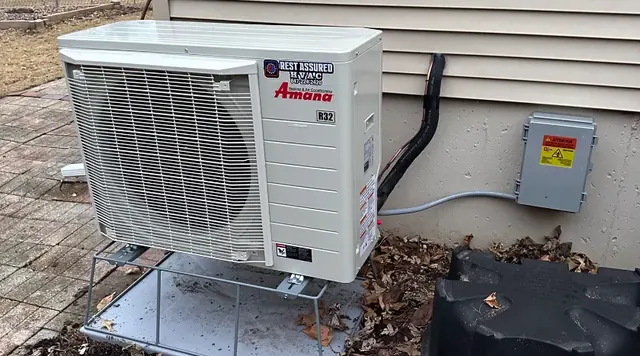
An Amana S-Series R-32 inverter heat pump installed by our team. Paired with a high-efficiency gas furnace, it handles cooling and most of the heating season, with the furnace stepping in below the balance point.
- Heating and cooling sizing to the house; Manual J load calculation available on request
- Cold-climate inverter heat pump sized to the heating load, AHRI-matched to the furnace coil
- New or existing 95%+ AFUE furnace confirmed for airflow and blower settings
- Line set sized for R-32, nitrogen-brazed, pressure tested, vacuumed to 500 microns, charge weighed in
- Dual-fuel thermostat with outdoor sensor, balance point and furnace lockout configured
- Electrical: outdoor unit circuit, disconnect, whip and surge protection
- Permit filed under our own license when a permit is requested and required*
- Commissioned in cooling, heat pump heating and furnace heating with readings recorded
- Old equipment removed, refrigerant recovered, hauled away
- Warranty registered; CY2026 ComEd and Nicor Gas discounts on the invoice
The step-by-step for each half is on heat pump installation and furnace installation. Keeping your current furnace? We confirm it’s in good shape and its blower can move the airflow the heat pump needs. If it isn’t, furnace replacement on the same day is usually cheaper than doing it in two years.
Setting the Balance Point and the Thermostat
The equipment is half the job. The controls are the other half, and they’re where dual-fuel systems go wrong.
Calculating the balance point. We start with the heat pump’s published capacity at 47°F, 17°F and 5°F, the house’s heat loss, and your ComEd and Nicor Gas rates. That gives a thermal balance point, where the heat pump can no longer keep up, and an economic balance point, where gas becomes cheaper per BTU delivered. We set the thermostat to the economic point, which is normally the higher of the two, so you’re never paying more than you need to.
Configuring the thermostat. A dual-fuel thermostat needs an outdoor sensor or a reliable weather feed, the correct reversing valve setting, heat pump staging, and a hard lockout that keeps the furnace off above the balance point and the heat pump off below it. We install and configure Amana communicating thermostats for their own equipment, and qualifying ENERGY STAR smart thermostats such as ecobee, Google Nest and Honeywell Home. A qualifying smart thermostat adds $75 to the CY2026 ComEd discount and, on the same invoice as a Nicor Gas furnace, raises the Nicor discount by $50.
Tuning after the first winter. Your first heating season tells us how the house actually behaves. If the furnace is running on days the heat pump could have handled, or the heat pump is struggling before the furnace takes over, we move the balance point. It’s a thermostat setting, not a service call, and plan members get it done at the fall visit. See smart thermostat installation for more on the controls.
What a Dual-Fuel System Costs
Every quote is free, written, and includes both discounts. We don’t publish installed prices because the honest number depends on whether the furnace is part of the job.
What moves the price: heat pump size and efficiency tier, whether a new furnace is included, line set reuse, electrical work at the panel, and any ductwork changes needed to move the airflow. What comes off the invoice, each on its own equipment:
| Equipment | Program | Instant discount |
|---|---|---|
| Qualifying ducted heat pump | ComEd | $900 to $2,000 depending on efficiency tier and heating capacity; up to $2,000 at 2.5 heating tons or more |
| Qualifying ENERGY STAR smart thermostat with the heat pump | ComEd | Adds $75 |
| Gas furnace, 97%+ AFUE | Nicor Gas | $225; $275 with a qualifying smart thermostat on the same invoice |
| Gas furnace, 95% AFUE | Nicor Gas | $150; $200 with a qualifying smart thermostat on the same invoice |
Both are taken off the invoice with no application. The CY2026 ComEd discount requires AHRI-matched equipment and a refrigerant at or below 700 GWP, which R-32 meets. St. Charles, Geneva and Batavia run their own electric utilities, so the ComEd portion isn’t available there. The rest can be spread out through financing you can prequalify for in about 2 minutes with no impact to your credit score, and on-bill financing is an option for qualifying projects.
Living With a Dual-Fuel System
A few things that surprise first-year owners, and what’s normal.
The air feels different. A heat pump delivers air around 90°F to 100°F instead of the 120°F-plus a furnace puts out. It runs longer and more evenly, and the house holds temperature better. It’s not broken; it’s how a heat pump heats.
Steam from the outdoor unit. In damp cold, the outdoor coil frosts and the unit runs a defrost cycle: the fan stops, steam rises for a few minutes, then heating resumes. Normal. An outdoor unit encased in ice is not, and that’s a heat pump repair call.
Two tune-ups a year. The heat pump needs a spring visit before cooling season and the furnace needs a fall visit before heating season. The $240 maintenance plan covers both, each up to a $130 value, plus priority scheduling and 5% off repairs. See heat pump maintenance and furnace maintenance.
Smell gas? Leave the house right away, call 911 from outside, and call your gas utility’s emergency line from outside before calling us.
Two Discounts, One Invoice
As a ComEd Heat Pump-Trained Contractor and a Nicor Gas Contractor Circle Installing Member, we take both instant discounts off your invoice: $900 to $2,000 on a qualifying ducted heat pump, plus $225 on a 97%+ AFUE furnace or $150 at 95% AFUE, with more for a qualifying smart thermostat. See CY2026 ComEd instant discounts and Nicor Gas instant discounts.
No ducts in part of the house? A ductless heat pump earns $500 or $1,000 from ComEd. See Daikin ductless mini-splits. Want the full heat pump picture first? Start at our heat pumps hub.
Dual-Fuel Systems Across the Fox Valley
Based in Elgin, we install dual-fuel heat pump and furnace systems throughout Kane, McHenry, DuPage and DeKalb counties.
- Elgin
- South Elgin
- St. Charles
- Aurora
- Bartlett
- Streamwood
- Huntley
- Plato Center
- Sycamore
- Carpentersville
- West Dundee
- East Dundee
- Algonquin
- Gilberts
- Hampshire
- Pingree Grove
- Campton Hills
- Geneva
- Batavia
- Barrington
- Hoffman Estates
- Schaumburg
- Burlington
- Marengo
- Wayne
- Sleepy Hollow
Don’t see your town? Call (847) 224-2420. View all service areas.
Related Guides
Plain-English reading from our blog on this topic.
- Dual Fuel Explained: Heat Pump Plus Gas Furnace for Northern Illinois — A dual fuel system lets a heat pump carry most of the Fox Valley heating season and hands off to a gas furnace on the coldest days. Here is how the balance point works and why both utility discounts apply.
- ComEd Heat Pump Instant Discounts 2026: What Fox Valley Homeowners Get — What ComEd’s 2026 heat pump instant discounts are worth, what a system must meet to qualify, which Fox Valley towns are excluded, and how the discount stacks with Nicor Gas and Daikin.
- Nicor Gas Instant Discounts 2026: Furnace, Boiler, Thermostat Savings — The 2026 Nicor Gas instant discount amounts for furnaces, boilers and smart thermostats, what AFUE means, and why spring is the easy time to use them.
Dual-Fuel Heat Pump & Furnace FAQs
What is a dual-fuel HVAC system?
A heat pump paired with a gas furnace on the same ductwork. The heat pump cools in summer and heats through most of the winter; the furnace takes over below a set outdoor temperature called the balance point.
What is the balance point?
The outdoor temperature where the thermostat switches from the heat pump to the furnace. We calculate it from the heat pump’s capacity, the home’s heat loss and your ComEd and Nicor Gas rates. Most Fox Valley homes land between 15°F and 30°F.
Why not just go all-electric with a heat pump?
In our climate, the coldest nights are cheaper on gas, all-electric backup needs a large heat strip circuit many older panels can’t spare, and most homes here already have a gas furnace. Dual-fuel uses what you have and adds the heat pump’s savings.
Does a heat pump really work in an Elgin winter?
Yes. Cold-climate inverter heat pumps keep heating well below zero. In a dual-fuel system the furnace covers the coldest hours, so the heat pump only has to be efficient, not heroic.
Can I keep my existing furnace?
Often, yes. We confirm it’s in good condition and that its blower can move the airflow the heat pump needs. If it’s old or an 80% unit, replacing it on the same job is usually the better value and earns the CY2026 Nicor Gas discount.
Do the furnace and heat pump ever run at the same time?
No. The thermostat locks out the furnace above the balance point and the heat pump below it. Running both through the same coil would overheat the heat pump coil, so the lockout is a required setting, not an option.
Which discounts apply to a dual-fuel system?
The CY2026 ComEd instant discount on the heat pump, $900 to $2,000 depending on tier and capacity, and the Nicor Gas instant discount on the furnace, $225 at 97%+ AFUE or $150 at 95% AFUE. A qualifying smart thermostat adds $75 to ComEd and $50 to Nicor Gas.
Does the CY2026 ComEd discount apply in St. Charles, Geneva or Batavia?
No. Those towns run their own electric utilities, so the CY2026 ComEd discount isn’t available there. Dual-fuel still works, and the Nicor Gas furnace discount still applies.
What thermostat does a dual-fuel system need?
One that supports dual-fuel: an outdoor sensor or weather feed, heat pump staging and a furnace lockout. We configure Amana communicating thermostats and qualifying ENERGY STAR smart thermostats such as ecobee, Google Nest and Honeywell Home.
Will my electrical panel need an upgrade?
Usually not for dual-fuel. The furnace is the backup, so the only new circuit is for the outdoor unit. All-electric systems with heat strips are the ones that often need panel work.
Why does the air from the vents feel cooler than my furnace?
A heat pump delivers air around 90°F to 100°F and runs longer, while a furnace delivers hotter air in short bursts. The house holds temperature more evenly. It’s normal.
How long does a dual-fuel installation take?
One day for the heat pump alone, or a day and a half to two days when a new furnace is part of the job.
Do you pull a permit?
Yes. Many Fox Valley municipalities require a mechanical permit for equipment replacement. We file it under our own license when a permit is requested and required*.
Can I finance a dual-fuel system?
Yes. You can prequalify in about 2 minutes with no impact to your credit score, and both discounts lower the amount you finance. On-bill financing is available for qualifying projects.
What maintenance does a dual-fuel system need?
A spring tune-up for the heat pump and a fall tune-up for the furnace. Our $240 maintenance plan covers both visits, each up to a $130 value, with priority scheduling and 5% off repairs.
What brands do you install?
Amana heat pumps, including the Amana S-Series R-32 inverter heat pump, paired with Amana high-efficiency gas furnaces. We’re a ComEd Heat Pump-Trained Contractor and a Nicor Gas Contractor Circle Installing Member.
Get a Free Dual-Fuel Quote
We’ll measure the house, check the furnace and panel, size the heat pump to the heating load and give you a written price with both discounts included.
Request a free quote, see financing options or learn more about heat pumps.
Discount amounts reflect the 2026 ComEd Energy Efficiency Program for qualifying equipment and are subject to change or cancellation due to funding limits. Rest Assured HVAC LLC is an independent contractor and is not affiliated with or endorsed by ComEd.
Discount amounts reflect the 2026 Nicor Gas Energy Efficiency Program for qualifying equipment installed January 1 through December 31, 2026, and are subject to change or cancellation due to funding limits. Rest Assured HVAC LLC is an independent contractor and is not affiliated with or endorsed by Nicor Gas.
*Pulling a permit is the homeowner’s responsibility. Ask us to, and we’ll file it under our own license wherever the local jurisdiction requires one for the work.
