
Annual Boiler Tune-Up
Boiler Maintenance in Elgin & the Fox Valley
A fall boiler tune-up resets your system pressure, proves every safety control works, cleans and tests the burner and purges the air out of your radiators before you need heat every day. We service all brands of hot-water and steam boilers, and you get every reading in writing.
- Hot-water and steam boilers, all brands
- Combustion tested on every visit
- $240/year plan with priority scheduling
- Licensed, insured and bonded
Why Boilers Need a Fall Tune-Up
A boiler is a sealed system full of water, a flame and a set of safety controls. Most of what goes wrong with it happens slowly, and most of it is invisible until the day it isn’t.
Elgin winters see design temperatures near 0°F, and a boiler in a St. Charles, Sycamore or East Dundee home may run most of the day for five months straight. Over the summer the loop sits idle. Air works into the system, relief valves seize, expansion tanks lose their charge, and the burners collect dust. Then the first cold night in October asks the boiler to run all night without complaint.
A fall tune-up is the cheapest visit we make. It resets the system pressure, proves every safety works, cleans the burner and confirms combustion is safe before you depend on the boiler every day. Here is what tells us a boiler has been skipped for a while.
- Radiators that gurgle or are cold at the top. Air in the loop that was never purged.
- A relief valve discharge pipe with a water stain under it. The valve has been weeping, usually because pressure is too high.
- Pressure reading over 25 psi hot or under 10 psi cold. Expansion tank or fill valve trouble.
- Rumbling from the boiler itself. Kettling from scale on the heat exchanger.
- Soot or rust flakes at the burner or flue collar. Dirty burners or poor draft.
- A boiler that cycles on and off every few minutes. Low flow, a mis-set aquastat or a plugged strainer.
- A circulator that is hot to the touch or humming. A pump near the end of its life.
- Gas bills creeping up year over year. Lost efficiency from scale, dirty burners or wrong settings.
- No service sticker on the jacket. If nobody can remember the last tune-up, it has been too long.
Smell gas? Leave the house right away, call 911 from outside, and call your gas utility’s emergency line from outside before calling us.
What a Boiler Tune-Up Includes
This is the full checklist, not a glance and a sticker. It takes about an hour on a hot-water boiler, a little longer on steam or on a condensing boiler.
Pressure
System pressure and expansion tank
We read the gauge cold and hot, check the expansion tank’s air charge against the system’s fill pressure, and test the automatic fill valve. A tank that has lost its charge or waterlogged is the single most common cause of relief valve discharge, and it is a simple fix caught early.
Safety
Relief valve and low-water cutoff
The relief valve is lifted to confirm it opens and reseats. The low-water cutoff is tested to prove it shuts the burner off when it should. On steam boilers we blow down the cutoff and check the sight glass. These are the controls that keep a boiler failure from becoming a dangerous one.
Combustion
Burners, ignition and combustion test
Burners are pulled and cleaned, the pilot or igniter and flame sensor are checked, and gas pressure is verified. Then we run a combustion analysis at the flue: oxygen, carbon monoxide and stack temperature. The numbers tell us the burner is safe and tuned, not just lit.
Venting
Draft, flue and intake
Atmospheric boilers get a draft check and a flue inspection for rust, gaps and blockage. Condensing boilers get their PVC intake and exhaust checked for slope, screens and obstructions, and the condensate trap and neutralizer are cleaned so the boiler does not lock out on a plugged drain in January.
Circulation
Circulators, zone valves and purge
Each circulator is checked for flow, noise and heat. Zone valves are cycled and their end switches tested. Then we purge air from every zone and bleed radiators or baseboard so the water actually gets around the loop. Cold-at-the-top radiators usually disappear at this step.
Controls
Aquastat, thermostats and settings
We verify the aquastat’s high limit and differential, check the low-limit setting if the boiler makes domestic hot water, confirm the thermostat is calling correctly, and on modern condensing boilers review the outdoor reset curve so the boiler runs at the lowest water temperature that still heats the house.
Leaks
Piping, valves and the boiler body
We look at every fitting, pump flange, valve packing and the boiler jacket for weeping and corrosion, and check the floor around the boiler. Small leaks on a boiler get bigger, and a leak from the sections themselves is something you want to know about before the heating season, not in the middle of it.
You get every reading in writing: pressure, combustion numbers, flue temperature, gas pressure and what we adjusted. If something needs a repair, you get a flat-rate price and the choice, with 5% off for plan members.
What to Expect on a Boiler Maintenance Visit
No surprises. Here is how the visit goes from booking to the sticker on the jacket.
1. Booking. Call (847) 224-2420 or book online. Tell us whether the boiler is hot-water or steam, the brand if you know it, and how many zones you have. September and October fill up, so book early. Plan members get priority scheduling.
2. Walk-through. The technician looks at the whole system with you first: the boiler, the piping, the radiators or baseboard, the thermostats and any problem rooms you have noticed. If a radiator has been cold for two winters, this is where we hear about it.
3. The tune-up. Pressure and expansion tank, safeties, burners and combustion, venting, circulation and purge, controls and a leak check, in that order. On a condensing boiler we add the condensate trap and heat exchanger inspection. On steam we add the blowdown, sight glass, pressuretrol and vents. Plan on about an hour, a little longer for steam or condensing units.
4. Readings and recommendations. You get the numbers: cold and hot pressure, combustion results, stack temperature, gas pressure and what we adjusted. If we found something that needs a part, you get a written flat-rate price and the choice. We do not start a repair without your approval.
5. Clean-up and sticker. We put the jacket back on, leave the area the way we found it, and date the service sticker so the next technician, or the next buyer of your house, knows the boiler has been cared for.
Steam Boilers Get Their Own Checklist
Older homes in Elgin, St. Charles and East Dundee still heat with steam. Steam boilers have parts a hot-water system does not, and they need attention every year.
A steam boiler runs at a fraction of a psi and boils water rather than pumping it. That means water level matters more than pressure, and air has to leave the radiators before steam can enter them. At the fall visit we blow down the low-water cutoff to clear sludge, check the water level at the sight glass and the automatic feeder, test the pressuretrol and the relief valve, inspect the burners and flue, and check every main vent and radiator vent. A radiator with a clogged vent stays cold no matter how well the boiler runs.
We also look for the causes of water hammer, that banging in the pipes on a cold start: radiators pitched the wrong way, sagging return lines and flooded wet returns. Fixing the pitch or a vent is a small job. Living with the banging all winter is how you end up with a cracked radiator valve.
Maintain, Repair or Replace
Maintenance keeps a good boiler good. It does not turn an old boiler young. Here is how we think about the difference.
- Under 15 years and running well: annual maintenance is all it needs. Keep the receipts; they matter for warranty claims.
- 15 to 20 years: maintain it, and use the tune-up readings to watch the trend. Rising stack temperature and falling combustion efficiency mean the heat exchanger is scaling.
- Over 20 years: maintain it as long as it is safe, but start planning. A 20-year-old atmospheric boiler gives up a lot of efficiency to a 95% AFUE condensing or combi boiler, and the CY2026 Nicor Gas discount narrows the gap.
- Any age with a leaking section, a cracked heat exchanger or failed combustion numbers: the tune-up becomes a replacement conversation.
- Needs a repair every winter: the boiler is wearing out as a whole. The 50% rule applies: if one repair costs more than half of a new boiler, replace.
When repair is the right answer, see how a boiler repair visit works. When replacement is, read our boiler replacement and boiler installation pages, or start at the boiler services hub.
Why Fox Valley Homeowners Trust Rest Assured With Their Boiler
We are a local Elgin company. The technician who tunes your boiler is the same team that answers the no-heat call in January.
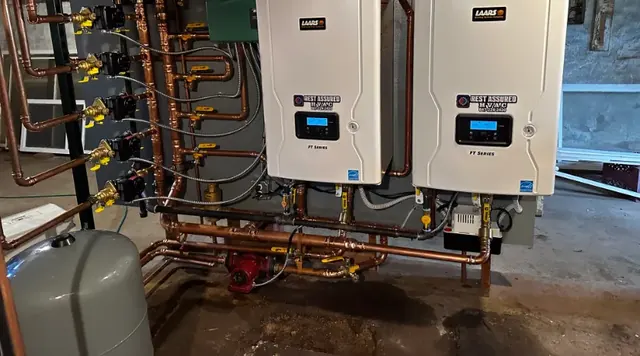
Laars boilers, installed by our team. We maintain every brand.
- Hot-water and steam boilers, radiators and baseboard, all brands maintained
- Combustion analysis and safety testing on every visit, with the readings in writing
- Our qualified and experienced technicians are EPA 608 Universal and NATE certified in gas heating installation
- Licensed, insured and bonded; municipally licensed in Elgin, Aurora, Bartlett, Huntley and Streamwood
- BBB of Chicago & Northern Illinois Complaint Free Award, 2024 and 2025
- Housecall Pro Superpro 2024 through 2026, with online booking any time
- Nicor Gas Contractor Circle Installing Member when replacement makes sense
Boiler home with no cooling? A Daikin ductless mini-split adds AC without ductwork, and the plan’s spring visit covers it. We also maintain furnaces and heat pumps.
The Maintenance Plan: Up to $390 in Services for $240
Our semi-annual maintenance plan is $240 a year. It includes a fall heating tune-up and a spring cooling tune-up, each up to a $130 value, plus one free business-hours service call, priority scheduling and 5% off services. For a boiler home, the fall visit is the boiler, and the spring visit covers your ductless system or AC if you have one.
If the tune-up shows the boiler is at the end of its life, the CY2026 Nicor Gas instant discount comes right off the invoice on a replacement: $350 on a qualifying 95% AFUE heating boiler or $500 on a qualifying combination boiler. See Nicor Gas instant discounts.
Boiler Maintenance Across the Fox Valley
Based in Elgin, we serve homes throughout Kane, McHenry, DuPage and DeKalb counties.
- Elgin
- South Elgin
- St. Charles
- Aurora
- Bartlett
- Streamwood
- Huntley
- Plato Center
- Sycamore
- Carpentersville
- West Dundee
- East Dundee
- Algonquin
- Gilberts
- Hampshire
- Pingree Grove
- Campton Hills
- Geneva
- Batavia
- Barrington
- Hoffman Estates
- Schaumburg
- Burlington
- Marengo
- Wayne
- Sleepy Hollow
Don’t see your town? Call (847) 224-2420. View all service areas.
Boiler Maintenance FAQs
How often should a boiler be serviced?
Once a year, in the fall before the heating season. A boiler in the Fox Valley runs most of the day from November through March, and one annual cleaning and safety check catches the failures that would otherwise show up on the first cold night.
What is included in a boiler tune-up?
We check system pressure and the expansion tank charge, test the relief valve and low-water cutoff, inspect and clean the burners, test combustion and check the venting, verify the circulators and zone valves, confirm the aquastat or control settings, purge air from the loop, look for leaks, and on condensing boilers clean the condensate trap. You get the readings in writing.
How much does a boiler tune-up cost?
A standalone fall boiler tune-up is priced flat and quoted when you book. Most boiler homeowners do better on the semi-annual maintenance plan, which is $240 a year and also includes a free business-hours service call, priority scheduling and 5% off repairs.
Does the maintenance plan work for a boiler home with no AC?
Yes. The fall visit covers the boiler. If you have a ductless mini-split for cooling, the spring visit covers that. If you have no cooling equipment at all, the plan still gives you the fall tune-up, the free service call, priority scheduling and the 5% discount, and we will tell you honestly whether it pencils out for your home.
When is the best time to schedule boiler maintenance?
September or October, before the first cold snap. Once the first freeze hits, no-heat calls fill the schedule and tune-ups get pushed. Plan members get priority scheduling either way.
Do you service steam boilers?
Yes. Steam boilers get their own checklist: blow down the low-water cutoff, check the sight glass and water level, test the pressuretrol, check the main vents and radiator vents, inspect the burners and flue, and check for water hammer causes like sagging return lines.
Why does my boiler need a combustion test?
Because you cannot see combustion quality by looking at the flame. A combustion analyzer reads oxygen, carbon monoxide and flue temperature at the vent. It confirms the burner is safe and efficient and catches a fouled heat exchanger or a venting problem before it becomes a CO hazard.
What pressure should my hot-water boiler run at?
Around 12 to 15 psi when cold, rising a few psi as it heats. If it climbs past 25 psi hot, the expansion tank has likely waterlogged. If it sits below 10 psi, the fill valve may have failed or the system is losing water. We set and verify this at every tune-up.
Do I need to bleed my radiators every year?
On many hot-water systems, yes, especially after the summer off-season. Trapped air makes radiators cold at the top and gurgle. We purge the loop and bleed each radiator or baseboard zone as part of the fall visit, and we can show you how to do a quick bleed between visits.
Will maintenance lower my gas bill?
Usually. A clean burner, correct gas pressure, a properly set aquastat and a loop free of air all let the boiler deliver its rated efficiency. A scaled or dirty boiler burns gas without turning it into heat in the radiators.
What does a tune-up catch that I would miss?
A weeping relief valve, an expansion tank that has lost its charge, a circulator running hot, a flame sensor reading weak, a cracked flue pipe or a low-water cutoff that no longer trips. None of those show up as symptoms until the boiler fails, usually on a cold morning.
Do you maintain boilers you didn’t install?
Yes. We install Laars boilers and maintain every brand of residential hot-water and steam boiler, including Weil-McLain, Burnham, Peerless, Utica, Navien, Lochinvar and Bosch, no matter who installed it.
Does a condensing boiler need different maintenance?
Yes. Condensing boilers add a condensate trap and neutralizer to clean, a heat exchanger that needs inspection for scale and debris, PVC intake and exhaust to check, and a combustion test that matters even more because the burner is modulating. We cover all of it.
Can maintenance fix a boiler that is already kettling?
Sometimes. If kettling is from air or low flow, purging and setting the pump speed helps. If it is from heavy scale on the heat exchanger, a descaling flush may help on a newer boiler, but on an older cast-iron boiler it is usually a sign the boiler is nearing the end. We will tell you which.
What if the tune-up finds a problem?
We show you what we found, explain what it means, and give you a written flat-rate price for the repair. Plan members get 5% off. Nothing is done without your approval. If it is a bigger problem, see our boiler repair page for how that visit works.
Book Your Fall Boiler Tune-Up
Schedule before the first cold snap. Book online or call, and we’ll confirm your arrival window.
Want the whole year covered? See the maintenance plan or contact us with questions.
Discount amounts reflect the 2026 Nicor Gas Energy Efficiency Program for qualifying equipment installed January 1 through December 31, 2026, and are subject to change or cancellation due to funding limits. Rest Assured HVAC LLC is an independent contractor and is not affiliated with or endorsed by Nicor Gas.
