Fall Furnace Tune-Up
Furnace Maintenance & Tune-Ups in Elgin & the Fox Valley
A furnace in Elgin runs hard from November through March. A fall clean-and-check finds the weak igniter, the dirty flame sensor and the cracked heat exchanger before the first cold snap does. We test combustion with instruments, not by eye, and you get the readings in writing.
- Combustion analysis on every tune-up
- Heat exchanger and CO safety check
- All brands serviced
- $240/year plan covers furnace and AC
Signs Your Furnace Is Overdue for Maintenance
Furnaces do not fail on a schedule. They fail after a season or two of small problems nobody looked at. If any of these sound familiar, book a tune-up before you need heat every day.
- It hasn’t been serviced in over a year. Manufacturers ask for annual service, and most parts warranties assume it.
- The filter is gray and you can’t remember changing it. A plugged filter drives up static pressure, overheats the heat exchanger and trips the high limit.
- It takes several tries to light. An igniter that is getting weak or a flame sensor with a film of oxide will keep working right up until it doesn’t.
- The burners look yellow or uneven. Clean burners produce a steady blue flame. Yellow or lifting flames mean dirt, rust flakes or a combustion problem.
- You hear a delayed whump on ignition. Gas building up before it lights, usually from dirty burners or crossover ports. It stresses the heat exchanger every cycle.
- Dust blows out of the registers when it starts. A dirty blower wheel and ducts, and often a filter that was bypassing.
- Some rooms are warm and others never are. Airflow that has drifted out of balance, a blower that has lost speed, or a stage that never engages.
- Your gas bill is higher than last winter with similar weather. A furnace with dirty burners, a slipping blower or a wrong gas pressure burns more to deliver the same heat.
- The last repair was a surprise. An igniter, a capacitor or a pressure switch that quit without warning is exactly what a tune-up is designed to catch.
- It is 10 years or older. Older furnaces need a real heat exchanger inspection every year, not just a filter change.
Smell gas? Leave the house right away, call 911 from outside, and call your gas utility’s emergency line from outside before calling us.
What a Real Furnace Tune-Up Includes
A lot of “tune-ups” are a filter, a vacuum and a look. Ours is a test procedure. Each item below is measured, compared to the manufacturer’s specification, and written on your invoice.
Measured
Combustion analysis
We put a combustion analyzer in the flue and read oxygen, carbon monoxide, flue temperature and efficiency while the furnace runs. High CO in the flue, a rising CO trend during the cycle or an efficiency well below the rating points to dirty burners, a cracked exchanger or a gas pressure problem. You get the printed numbers.
Safety
Heat exchanger inspection
The exchanger is what keeps combustion gases out of your air. We inspect the cells visually and with a camera where the design allows, watch the flames as the blower starts for any disturbance, and cross-check with the flue CO reading. A crack means the furnace comes off line until it is replaced. We show you, we don’t just tell you.
Ignition
Flame sensor and igniter
The flame sensor is cleaned and the flame signal measured in microamps. The hot surface igniter is checked for resistance, cracks and correct voltage. These two parts cause more November no-heat calls than everything else combined, and both give a warning in their readings before they fail.
Fuel
Gas pressure and burners
Manifold gas pressure is measured with a manometer and set to the rating plate. Too high overfires the exchanger; too low starves the burners and drops efficiency. Burners and crossover ports are cleaned so ignition carries smoothly across all of them without a delayed whump.
Airflow
Temperature rise and static pressure
We measure the temperature difference between return and supply air and compare it to the range on the rating plate. Out of range means the blower speed is wrong or the airflow is restricted. Total external static pressure tells us whether your filter, coil and ductwork are choking the furnace. Blower speed and filter recommendations follow from these two numbers, not from guesswork.
Safeties
Limits, pressure switch and rollout
The high limit, the flame rollout switches and the pressure switch are each tested to confirm they open when they should and reset when they should. The inducer motor is checked for draft and bearing noise, and pressure switch hoses and ports are cleared.
Condensing furnaces
Condensate and venting
On 90%+ furnaces we flush the condensate trap and drain, check the neutralizer if present, confirm the pump works, and inspect the PVC intake and exhaust from the furnace out through the rim joist for slope, joints, screens and blockage. A plugged trap is the most common reason a condensing furnace shuts down in January.
Also on every visit: filter replaced or sized correctly, blower wheel and compartment inspected and cleaned as needed, capacitor tested under load, blower motor amperage checked, wiring and connections tightened, thermostat operation and cycle verified, and a carbon monoxide check at the registers and around the furnace. Expect 60 to 90 minutes for a thorough visit.
What to Expect on a Tune-Up Visit
We book tune-ups from September through the first cold weeks of the season, and plan members go first.
1. Scheduling. Book online or call (847) 224-2420. Early fall is ideal, before the October and November rush when the first freeze fills every schedule in the Fox Valley with no-heat calls. Plan members get priority slots.
2. Before we start. The technician asks how the furnace behaved last winter: hard starts, noises, cold rooms, high bills. Those clues shape where we look closest. Clear a few feet in front of the furnace if you can, and make sure we can reach the thermostat.
3. The inspection and testing. The furnace is run through a full cycle while we measure everything listed above. The blower door comes off, the burners come out if they need cleaning, the flame sensor is cleaned, the trap is flushed and the filter is changed. Readings are recorded as we go.
4. The report. You get the numbers: flue CO, efficiency, flame signal, gas pressure, temperature rise, static pressure and capacitor readings, each against the spec. If something is out of range or close to failing, we explain what it means, what it costs to fix, and whether it can wait. Nothing is replaced without your approval.
5. Repairs, if needed. Small items like a weak capacitor or a marginal igniter can be done on the spot with the price approved first, and plan members save 5%. Larger findings get a written quote. If we find a cracked heat exchanger on an old furnace, we shut it down for your safety and walk through replacement options the same day, CY2026 Nicor Gas discount included.
What Furnace Maintenance Costs
One furnace tune-up, or the whole year covered for $240.
A standalone fall furnace tune-up is a flat price, quoted when you book. Most homeowners do better on the semi-annual maintenance plan: $240 a year covers the fall furnace tune-up and the spring air conditioner or heat pump tune-up, each up to a $130 value, plus one free business-hours service call, priority scheduling and 5% off any service. That is up to $390 in services for $240.
| Single tune-up | $240 maintenance plan | |
|---|---|---|
| Fall furnace tune-up | Included | Included (up to $130 value) |
| Spring AC or heat pump tune-up | Booked separately | Included (up to $130 value) |
| Business-hours service call | Diagnostic fee applies | One free per year |
| Scheduling during the cold-snap rush | First available | Priority |
| Repair pricing | Standard flat rate | 5% off |
| Written test readings | Yes | Yes |
Any repairs found during the tune-up are priced flat-rate and approved before work starts.
Maintain, Repair or Replace?
A tune-up is where you find out which one you need.
On a furnace under 10 years old, maintenance is cheap insurance. Almost everything we find is a clean, an adjustment or a small part, and being able to show the furnace was serviced helps if you ever need to make a warranty claim.
Between 10 and 15 years, the tune-up becomes a checkup. We still service the furnace, but the readings tell you how much life is left: a heat exchanger with rust and scale, a blower pulling high amps, an efficiency reading that keeps dropping. Small repairs still make sense. A big repair deserves a comparison to replacement.
Past 15 years, especially on an 80% furnace in an older split-level or ranch, the honest advice is often to maintain it while it runs and plan the replacement on your schedule rather than on a January morning. Use the 50% rule: if a repair costs more than half of a new furnace, replace it. A 97% AFUE furnace with the CY2026 Nicor Gas discount, financed if you like, usually costs less per month than people assume.
- Needs a repair now? See furnace repair. Same-visit repairs, price approved first.
- Weighing a replacement? See furnace replacement for the repair-vs-replace math and what changes with a new unit.
- Want to see how we install? See furnace installation for sizing, venting, commissioning and permits.
- Have a heat pump with furnace backup? Dual-fuel systems need both sides tuned. See heat pump maintenance and our heat pump hub.
Why Maintenance Matters More in Northern Illinois
A furnace here does the work of two furnaces somewhere milder.
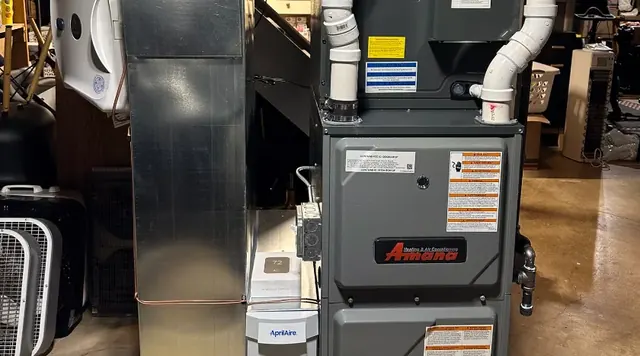
An Amana gas furnace with an AprilAire air filter, installed by our team.
- Design temperatures near 0°F mean long run times and thousands of ignition cycles per winter
- Condensing furnaces vent through the rim joist, where ice, snow and nests block intakes
- Basement furnaces in 1960s to 2000s homes pull in dust, lint and humidity from the space
- Many older Fox Valley homes still run 80% furnaces, where heat exchanger inspection is the whole point of the visit
- A furnace that fails at 10 p.m. in January waits behind every other no-heat call that night
- Most manufacturers expect annual service and can ask for records on a warranty claim
- We service all brands, and we install Amana with AprilAire filtration
Our team holds NATE Ready-to-Work and Amana furnace training, and our qualified and experienced technicians are EPA 608 Universal, NATE certified in gas heating installation and NCI airflow trained. Airflow is where most furnace problems start, so it gets measured on every visit. Concerned about dust or dry air? See indoor air quality and AprilAire filters and humidifiers.
One Plan. Furnace and AC Covered. $240 a Year.
The Rest Assured semi-annual maintenance plan gives you a fall furnace tune-up, a spring AC or heat pump tune-up, one free business-hours service call, priority scheduling and 5% off services. Up to $390 in services for $240, and you never have to remember to book.
Tune-up reveals a furnace that is not worth keeping? As a Nicor Gas Contractor Circle Installing Member, we take the instant discount right off your invoice on a replacement: $225 on a furnace rated 97% AFUE or higher, or $150 at 95% AFUE, and $275 or $200 with a qualifying smart thermostat on the same invoice. See CY2026 Nicor Gas instant discounts.
Furnace Maintenance Across the Fox Valley
Based in Elgin, we serve homes throughout Kane, McHenry, DuPage and DeKalb counties.
- Elgin
- South Elgin
- St. Charles
- Aurora
- Bartlett
- Streamwood
- Huntley
- Plato Center
- Sycamore
- Carpentersville
- West Dundee
- East Dundee
- Algonquin
- Gilberts
- Hampshire
- Pingree Grove
- Campton Hills
- Geneva
- Batavia
- Barrington
- Hoffman Estates
- Schaumburg
- Burlington
- Marengo
- Wayne
- Sleepy Hollow
Don’t see your town? Call (847) 224-2420. View all service areas.
Related Guides
Plain-English reading from our blog on this topic.
- When to Schedule Your Fall Furnace Tune-Up in Elgin — September is the month to book a furnace tune-up in the Fox Valley. Here is why, what the fall visit actually covers, and how the semi-annual plan makes it cheaper.
- Carbon Monoxide and Your Furnace: A Fox Valley Homeowner’s Checklist — A calm, practical carbon monoxide checklist for Elgin and Fox Valley homes with a gas furnace: detectors, heat exchangers, venting, and what a combustion test catches.
Furnace Maintenance FAQs
How often should a furnace be serviced in Illinois?
Once a year, in the fall before heating season. Our winters near 0°F put thousands of cycles on a furnace, and most manufacturers expect annual service and can ask for records on a warranty claim.
What does a furnace tune-up include?
Combustion analysis with a flue analyzer, heat exchanger inspection, flame sensor cleaning and signal test, igniter test, manifold gas pressure set to spec, temperature rise and static pressure measurement, testing of the limit, rollout and pressure switches, filter replacement, condensate trap and vent check on condensing furnaces, and a carbon monoxide check. Readings are written on your invoice.
How much does a furnace tune-up cost?
A standalone tune-up is a flat price quoted when you book. The $240 maintenance plan covers both the fall furnace and spring AC or heat pump tune-ups, each up to a $130 value, plus a free business-hours service call, priority scheduling and 5% off services.
When is the best time to schedule a furnace tune-up in Elgin?
September or early October. Once the first freeze hits in late October or November, schedules across the Fox Valley fill with no-heat calls. Plan members get priority scheduling either way.
How long does a furnace tune-up take?
Plan on 60 to 90 minutes. Testing combustion, measuring airflow and inspecting the heat exchanger properly takes time, and a 20-minute visit is not doing those things.
Is a furnace tune-up worth it on a newer furnace?
Yes. Newer condensing furnaces have condensate traps, pressure switches and electronic controls that need checking, and most manufacturers can ask for service records before honoring a parts warranty claim.
Do you service furnaces you didn’t install?
Yes. We maintain all major brands of gas furnaces, including Carrier, Bryant, Lennox, Trane, Goodman, Amana, Daikin, Rheem and York, no matter who installed them.
What is combustion analysis and why does it matter?
A combustion analyzer samples the flue gases and reads oxygen, carbon monoxide, flue temperature and efficiency. It is the only way to know whether the furnace is burning cleanly and safely, and it flags problems like dirty burners, wrong gas pressure or a cracked heat exchanger that you cannot see.
How do you check a heat exchanger for cracks?
By visual and camera inspection of the cells where the design allows, by watching for flame disturbance when the blower starts, and by measuring CO in the flue during the cycle. A crack means the furnace is shut down and replacement is discussed, and we show you the evidence.
Will you replace my furnace filter during the tune-up?
Yes. We replace the filter, or tell you the right size and type if your cabinet takes a media filter we don’t have on the truck. We also measure static pressure to confirm the filter you use isn’t restricting airflow.
What if the tune-up finds a problem?
We show you the reading or the part, explain what it means, and give you a flat-rate price. Small repairs are usually done on the spot with your approval. Nothing is replaced without you saying yes.
Does the maintenance plan cover my air conditioner or heat pump too?
Yes. The $240 plan is semi-annual: a fall furnace tune-up and a spring air conditioner or heat pump tune-up. Homes with a dual-fuel heat pump and furnace get both sides checked.
Can a tune-up lower my gas bill?
Often, yes. Clean burners, correct gas pressure, a clean filter and the right blower speed let the furnace deliver its rated efficiency. A furnace running with high static pressure or low gas pressure burns more to do the same work.
Do I need maintenance if my furnace seems to run fine?
Yes. The two most common no-heat failures, a weak igniter and a dirty flame sensor, both show up in readings before they fail, and a heat exchanger crack has no symptoms until the CO alarm goes off. Running fine today is not the same as safe.
Do you check for carbon monoxide?
Yes. Every tune-up includes CO readings in the flue during combustion analysis and a check around the furnace and at the supply registers. We recommend a working CO alarm on every level of any home with gas appliances.
Should I get my furnace serviced before selling my house?
It is a good idea. A recent tune-up with written test readings answers the inspector’s questions about the furnace, and it is much cheaper than a last-minute repair negotiated off the sale price.
Do I still need a furnace tune-up if I have a heat pump?
If your furnace is the backup for a dual-fuel heat pump, yes. It still has to light reliably on the coldest days, and the switchover point should be checked. We cover both under heat pump maintenance and the plan.
Book Your Fall Tune-Up Before the Rush
Schedule online in a minute, or call and we’ll find a time that works. Plan members go first when the cold snap hits.
Ready to stop remembering? Join the $240 maintenance plan or contact us with questions.
Discount amounts reflect the 2026 Nicor Gas Energy Efficiency Program for qualifying equipment installed January 1 through December 31, 2026, and are subject to change or cancellation due to funding limits. Rest Assured HVAC LLC is an independent contractor and is not affiliated with or endorsed by Nicor Gas.
