
Heat Pump Indoor Unit Installation
Air Handler Installation in Elgin & the Fox Valley
A heat pump system is only as good as the air handler installation behind it. We size it to the house, not the old label, match it to the outdoor unit through AHRI, wire the heat strips on their own circuit, pull a deep vacuum and commission the finished system with real measurements. NATE-certified installation for homes in Kane, McHenry, DuPage and DeKalb counties.
- Manual J load calculation available on request
- AHRI-matched Amana and Daikin systems
- NATE-certified, ComEd Heat Pump-Trained Contractor
- ComEd discounts of $900–$2,000 off the invoice
What an Air Handler Is, and What a Good Installation Has to Get Right
The indoor half of a heat pump system, and the half that most often gets installed badly.
An air handler is the indoor unit of a heat pump system in a home without a gas furnace. It’s a cabinet that holds the blower, the evaporator coil, electric heat strips for backup heat, a filter rack and a condensate drain. The heat pump outside moves heat in or out of the house; the air handler is where that heat meets your ductwork. The two are one refrigerant circuit and are rated together as an AHRI-matched pair.
That makes an air handler installation more than setting a box and hooking up ducts. It has to be sized to the house, matched to the outdoor unit, wired for a heat-strip circuit that can pull a lot of current, connected to a line set that’s been properly evacuated, drained so it never floods, and commissioned so the airflow and charge are actually what the data plate says. Skip any of those and the system runs, but it runs badly, and you pay for it every month.
Our Air Handler Installation Process
Every install follows the same steps, whether it’s a changeout, an addition or a new home.
Step 1
Measuring the house
We measure the house: square footage, insulation, windows, orientation, air leakage. That gives the actual heating and cooling load at Elgin’s design temperatures, near 0°F in winter and humid in summer. We size the equipment to that number, not to the old unit’s label and not to a rule of thumb. When the numbers are borderline, a permit or utility program requires it, or you ask for one, we run a full Manual J load calculation (there may be an additional cost).
Step 2
Equipment selection and AHRI match
We pick an air handler and heat pump that are listed together in the AHRI directory. That’s what the SEER2 and HSPF2 ratings, the manufacturer’s warranty and the ComEd discount all depend on. We install Amana and Daikin, including the Amana S-Series R-32 inverter line.
Step 3
Placement and ductwork
Basement, closet or attic, the air handler needs clearance for service, a level base, and duct transitions that don’t choke the airflow. We fabricate the supply and return transitions to fit, seal them, and check the return is big enough. Undersized returns are the most common airflow problem we find.
Step 4
Electrical
The blower and the heat strips are usually on separate circuits, and the strip kit needs its own breaker sized to its amperage. We confirm the panel has the capacity, run or verify the circuits, and make sure the disconnect is where the code wants it.
Step 5
Refrigerant line set and condensate
New line set sized to the manufacturer’s spec, or an existing set flushed and pressure-tested. The condensate drain gets a trap, a cleanout and a float switch. Attic units get a secondary drain pan with its own switch.
Step 6
Commissioning
Nitrogen pressure test, deep vacuum, weighed-in charge verified by superheat and subcooling, static pressure and airflow measured, heat-strip amp draw on every element, thermostat staging and balance point set. Then we run it in both modes and hand you the numbers.
Every installation is led by a NATE-certified, EPA 608 Universal owner, and our team holds NATE Ready-to-Work and Amana S-Series training. Permits are filed under our own license where required; we’re municipally licensed in Elgin, Aurora, Bartlett, Huntley and Streamwood. Learn more about the Amana S-Series and heat pumps in general.
What a Bad Air Handler Installation Looks Like
We see these on service calls every week. None of them show up on day one. All of them show up on the bill.
- Sized off the old unit. Nobody sized it to the house, so the new system is as oversized as the old one. It short-cycles, never dehumidifies and wears out early.
- Mismatched indoor and outdoor units. A new heat pump on an old coil, or two units that aren’t on the AHRI list together. Lower efficiency than rated, a warranty the manufacturer can deny, no ComEd discount.
- No vacuum, or a short one. Moisture left in the line set turns into acid and kills the compressor in a few years. A deep vacuum takes time, and some crews don’t take it.
- Charged by pressure alone. Without weighing the charge and verifying it with superheat and subcooling, the system is either over- or undercharged. Both cost efficiency and compressor life.
- Heat strips on the wrong breaker. A strip kit wired to a circuit that’s too small trips on the coldest night of the year, which is exactly when you need it.
- No float switch, no secondary pan. An attic air handler with no overflow protection is a ceiling repair waiting to happen.
- Return duct too small. The blower can’t move its rated airflow, static pressure is high, the coil freezes in summer and the strips overheat in winter.
- Thermostat never set up. Default settings that run the electric strips far more than needed. Homeowners pay for this one every month without knowing why.
- No commissioning report. If the installer can’t show you the static pressure, the charge and the amp draws, they didn’t measure them.
If you suspect your current system was installed this way, an air handler tune-up measures all of it and tells you where you stand. Many of these are fixable with an air handler repair visit, without replacing anything.
How Installation Day Goes
Most air handler and heat pump installations are done in one day. Here’s the timeline.
- Before we arrive. You’ve approved a written quote with the equipment model numbers and the ComEd discount on it. The permit is pulled where your town requires one. If the electrical panel needs work, that’s scheduled.
- 8:00. Protect and remove. Floor protection goes down. If there’s existing equipment, we recover the refrigerant with EPA-certified equipment, disconnect power and remove it.
- Mid-morning. Set the air handler. Level base or platform, cabinet set with service clearance, supply and return transitions fabricated and sealed, filter rack installed, condensate drain with trap and float switch.
- Midday. Outdoor unit and line set. Heat pump set on its pad, line set run and brazed with nitrogen flowing to keep the copper clean inside, electrical whip and disconnect installed.
- Early afternoon. Electrical. Heat-strip circuit landed on its breaker, blower circuit, low-voltage wiring to the thermostat and outdoor unit, all connections torqued.
- Afternoon. Pressure test, vacuum, charge. Nitrogen test to confirm no leaks, then a deep vacuum. Once it holds, the charge is weighed in and verified.
- Late afternoon. Commission and walkthrough. Both modes run and measured. Thermostat staging, balance point and aux lockout set. We show you the filter, the drain, the thermostat and the commissioning numbers, register the warranty and clean up.
Attic installations, new electrical circuits and jobs that need significant duct changes can run into a second day. We’ll tell you that up front, not at 4 p.m.
New Construction, Additions and Homes Without Gas
An air handler and heat pump is the right answer for more homes than it used to be.
For new construction and additions without gas service, an air handler paired with a cold-climate inverter heat pump is a complete heating and cooling system in one. Modern units keep heating well below 0°F, so the electric heat strips are true backup rather than the main event. We coordinate with your builder or GC on duct layout, electrical requirements and placement, and we size the system from the plans before the drywall goes up.
For an addition on an existing home, we look at whether the current system can carry the extra load. Often it can’t, and a second small air handler and heat pump for the new space is cleaner than overloading the old one. If ductwork isn’t practical, a ductless mini-split covers the addition without any.
Homes with gas service have a third option: a heat pump paired with a high-efficiency gas furnace instead of an air handler. The furnace acts as the backup heat, and the ComEd and Nicor Gas discounts each apply to their own equipment. See dual fuel.
What Air Handler Installation Costs
How our pricing works, and what’s included in the number.
We don’t publish a total installed price. The right number depends on the size the house needs, the efficiency tier you choose, whether it’s a changeout or a new location, the electrical work the heat strips need, and the ductwork. What we promise is that the quote is free, written, the price you pay, and already has the ComEd discount taken off.
For a qualifying ducted heat pump system, that discount is $900 to $2,000 depending on efficiency tier and heating capacity, up to $2,000 on 2.5 heating tons or more, with another $75 for a qualifying ENERGY STAR smart thermostat we install. No application; it comes off the invoice. The equipment must be AHRI-matched and use a refrigerant at or below 700 GWP, which R-32 does. See ComEd instant discounts.
Financing is available. You can prequalify in about 2 minutes with no impact to your credit score, and on-bill financing is an option for some homeowners. If you’re weighing a new install against fixing what you have, our air handler replacement page covers the repair-vs-replace math.
What Every Air Handler Installation Includes
The equipment matters. The installation matters more.
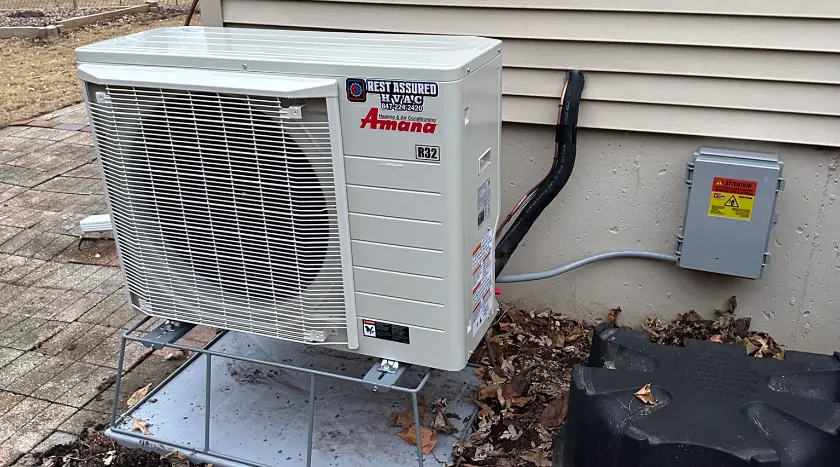
An Amana S-Series R-32 heat pump installed by our team. Its matched air handler indoors is installed and commissioned the same day.
- Sized to your home, not a rule of thumb; Manual J load calculation available on request
- AHRI-matched Amana or Daikin air handler and heat pump
- Duct transitions fabricated and sealed, return sized to the blower
- Dedicated heat-strip circuit sized to the strip kit
- Nitrogen pressure test, deep vacuum, weighed-in charge
- Condensate trap, cleanout and float switch; secondary pan in attics
- Commissioning report with static pressure, charge and amp draws
- Permit filed under our own license where required
- Warranty registered for you
Questions about your specific house? Call (847) 224-2420 or request a free quote. We’ll come out, measure and put it in writing.
Save $900–$2,000 With ComEd Instant Discounts
As a ComEd Heat Pump-Trained Contractor, we take the discount right off your invoice: $900 to $2,000 on a qualifying ducted heat pump system depending on efficiency tier and heating capacity, up to $2,000 on 2.5 heating tons or more. A qualifying ENERGY STAR smart thermostat we install adds $75. No application, no waiting. See ComEd instant discounts.
St. Charles, Geneva and Batavia run their own electric utilities, so ComEd discounts aren’t available there. The installation is the same either way. Request a free quote.
New Air Handler Installation in South Elgin & Bartlett
New construction and additions in South Elgin and Bartlett need an air handler sized to the actual duct system, not a rule of thumb. We size the system to the house so the equipment matches the home, not just the invoice, and run a Manual J load calculation when it’s needed, requested or required.
Air Handler Installation Across the Fox Valley
Based in Elgin, we serve homes throughout Kane, McHenry, DuPage and DeKalb counties.
- Elgin
- South Elgin
- St. Charles
- Aurora
- Bartlett
- Streamwood
- Huntley
- Plato Center
- Sycamore
- Carpentersville
- West Dundee
- East Dundee
- Algonquin
- Gilberts
- Hampshire
- Pingree Grove
- Campton Hills
- Geneva
- Batavia
- Barrington
- Hoffman Estates
- Schaumburg
- Burlington
- Marengo
- Wayne
- Sleepy Hollow
Don’t see your town? Call (847) 224-2420. View all service areas.
Air Handler Installation FAQs
What is an air handler?
An air handler is the indoor unit of a heat pump system. It holds the blower, the evaporator coil, electric backup heat strips, a filter rack and a condensate drain, but no burner or gas line. The heat pump outside moves the heat; the air handler delivers it through your ducts.
What is a Manual J load calculation and why does it matter?
Manual J is the industry method for calculating how much heating and cooling a specific house needs, based on its size, insulation, windows and air leakage at local design temperatures. A Manual J load calculation is available as needed, on request, or where a municipality or utility program requires one, and to verify sizing on a borderline house; it may carry an additional cost.
What does AHRI-matched mean?
The Air-Conditioning, Heating and Refrigeration Institute publishes the tested pairings of indoor and outdoor units. An AHRI-matched air handler and heat pump deliver the rated efficiency, carry the full manufacturer warranty and qualify for the ComEd discount. A mismatched pair may do none of those.
How long does an air handler installation take?
Most air handler and heat pump installations are finished in one day. Attic installations, new electrical circuits or significant duct changes can take a second day, and we’ll tell you that when we quote.
Do the heat strips need their own electrical circuit?
Yes. The electric heat strip kit draws a lot of current and needs a dedicated breaker sized to its amperage, separate from the blower circuit. We confirm the panel has the capacity before installation day.
Where can an air handler be installed?
Basement, utility closet or attic are the usual spots. It needs service clearance, a level base, a condensate drain path and access to the ductwork. Attic units get a secondary drain pan and float switch to protect the ceiling below.
Do I need a permit to install an air handler?
Many Fox Valley municipalities require a mechanical permit for equipment installation and replacement. We file it under our own license where required and handle the inspection.
What does commissioning mean?
Commissioning is measuring the finished system to confirm it performs the way it was designed to: static pressure and airflow, refrigerant charge verified by superheat and subcooling, amp draw on every heat strip, and thermostat staging. You get the numbers in writing.
Can you install an air handler in a new home or addition?
Yes. We size the system from the plans, coordinate duct layout and electrical with your builder, and install and commission the system. For an addition, we’ll tell you whether the existing system can carry it or whether a second small system makes more sense.
How much does air handler installation cost in Elgin?
It depends on the size the house needs, efficiency tier, electrical and duct work and location, so we don’t publish a single number. Quotes are free, written and include the ComEd discount, which is $900 to $2,000 on a qualifying ducted heat pump system.
How much is the ComEd heat pump discount?
Qualifying ducted heat pump systems get $900 to $2,000 off depending on efficiency tier and heating capacity, up to $2,000 on 2.5 heating tons or more. A qualifying ENERGY STAR smart thermostat we install adds $75. It comes straight off the invoice.
I’m in Geneva. Do ComEd discounts apply?
No. St. Charles, Geneva and Batavia run their own municipal electric utilities, so ComEd discounts aren’t available there. Everything else about the installation is the same, and financing is still available.
Will a heat pump and air handler keep my house warm in an Elgin winter?
Yes. Cold-climate inverter heat pumps keep heating well below 0°F, and the air handler’s electric heat strips cover the coldest stretches and defrost cycles. Sizing to the house’s actual heating load is what makes it work.
Who does the installation?
Every job is led by our owner, who is NATE certified in air conditioning installation and EPA 608 Universal certified. Our team holds NATE Ready-to-Work and Amana S-Series training.
Do you register the warranty?
Yes. We register the equipment with the manufacturer for you after installation and give you the documentation.
Can I finance the installation?
Yes. You can prequalify in about 2 minutes with no impact to your credit score, and the ComEd discount lowers the amount you finance.
Get an Installation Quote
Request a free, written quote. We’ll measure the house, size the equipment to it and show you the matched system and the discount before you decide anything.
Request a free quote or see financing options. Explore all heat pump services.
Discount amounts reflect the 2026 ComEd Energy Efficiency Program for qualifying equipment and are subject to change or cancellation due to funding limits. Rest Assured HVAC LLC is an independent contractor and is not affiliated with or endorsed by ComEd.
