
Heat Pump Indoor Unit Service
Air Handler Repair in Elgin & the Fox Valley
Blower won’t start, cold air in heating mode, water on the floor or a breaker that trips when the backup heat kicks in? We diagnose and repair the indoor unit of every major heat pump brand, with a flat-rate price approved before any work begins. Same-day and 24/7 emergency service for homes in Kane, McHenry, DuPage and DeKalb counties.
- 24/7 no-heat and no-cool service
- All brands repaired
- NATE-certified, EPA 608 Universal owner
- Flat-rate price approved before work starts
First, What Is an Air Handler?
Most homeowners have never heard the term until a technician uses it. Here’s the short version.
An air handler is the indoor half of a heat pump system in a home that doesn’t have a gas furnace. It looks like a furnace, usually a tall metal cabinet in the basement, a closet or the attic, but there’s no burner and no gas line inside. Instead it holds four things: a blower that moves air through your ducts, an evaporator coil that heats or cools that air, a set of electric heat strips for backup heat, and a filter rack. A condensate drain carries away the water the coil pulls out of the air in summer.
The heat pump outside does the heavy lifting. It moves heat into the house in winter and out of it in summer. The air handler is where that heat is handed off to your air. When the outdoor unit can’t keep up on the coldest nights, or when it’s in defrost, the heat strips inside the air handler switch on so the air at the registers stays warm. If you own a heat pump and there’s no furnace in the basement, you have an air handler. Some straight-AC homes with electric heat have one too.
A problem that feels like a heat pump problem often lives inside. A blower that won’t start, an iced coil, water on the floor or a breaker that trips when the backup heat kicks in are all air handler repairs.
Signs You Need Air Handler Repair
An air handler usually gives a warning before it quits. Call if you notice any of these.
- No air from the vents. The outdoor unit runs but nothing comes out inside. That’s a blower motor, its ECM control module, a blower capacitor or a control board that isn’t calling the fan.
- Cold air in heating mode. The heat pump is running but the air feels cool, or the house loses ground on a cold night. The heat strips may not be staging in, which points to a sequencer, a relay or a tripped limit switch.
- Breaker trips when the backup heat comes on. Heat strips pull a lot of current. A failing element, a shorted sequencer or a loose lug at the strip kit will trip the breaker. Reset it once. If it trips again, leave it off and call.
- Ice on the indoor coil or the copper line. Low airflow or low refrigerant lets the coil get too cold. Switch to fan-only so the ice thaws before we arrive. Running on ice can flood the compressor.
- Water around the cabinet. A clogged condensate drain, a full pan or a failed condensate pump. If your air handler is in the attic or a finished closet, this one can’t wait.
- System shuts off and won’t restart. Many air handlers have a float switch in the drain pan that cuts power when water backs up. It’s doing its job. The drain still needs clearing.
- Weak airflow at some registers. A dirty blower wheel, a dust-caked coil or a filter that’s collapsed into the rack all choke airflow. So does a duct problem, which we can measure.
- Grinding, squealing or rattling from inside. Bad blower bearings, a loose blower wheel or a panel that’s vibrating. Grinding gets worse quickly.
- Electric bills that jump in winter. If the heat strips are running when the heat pump should be, the bill shows it. A stuck sequencer, a wrong thermostat setting or a failed outdoor unit can all cause it.
In the Fox Valley, air handlers work year-round. The coil cools and dehumidifies from May into September, then the blower and heat strips carry the house through nights near 0°F. Most of the strip-heat failures we see in January first showed up as a tripped breaker in December.
The Most Common Air Handler Failures We See
There are only a handful of parts inside, and a few of them do most of the failing. Here’s what goes wrong and what we do about it.
Most common
Blower motor or ECM module
Newer air handlers use an ECM variable-speed blower. The motor itself is durable, but the control module bolted to its end fails from heat and voltage spikes, and a bad module looks exactly like a dead motor. We test the motor and module separately and replace only the one that failed. Older units use a PSC motor with a run capacitor, a much cheaper fix.
Winter
Heat-strip sequencer or relay
The sequencer staggers the heat strips on so they don’t all start at once. When it sticks open you get cold air on the coldest nights. When it sticks closed the strips run all the time and your electric bill doubles. We check amp draw on each element, replace the sequencer or relay and confirm the strips stage correctly from the thermostat.
Safety part
Limit switch
The high-limit switch shuts the heat strips down if the cabinet gets too hot, usually because airflow dropped. A tripped limit is a symptom. We find out why the air stopped moving, fix that, and replace the switch only if it’s failed for good.
Brains
Control board
The board takes the thermostat call and runs the blower, the strips and the outdoor unit. Power surges, a shorted low-voltage wire or moisture from a leaking coil can take it out. We check the whole circuit first, because a blown 3-amp fuse is a lot cheaper.
Airflow
Frozen coil
Ice on the evaporator coil comes from a dirty filter, a dirty coil, a failing blower or a low refrigerant charge. We thaw it, find the cause and fix the cause. A coil that keeps freezing is telling you something.
Water
Clogged drain or float switch
Algae builds up in the drain line over a summer. When it clogs, the pan fills and the float switch shuts the system down. We clear the line, test the switch and replace a rusted pan or a dead condensate pump.
Bigger job
Leaking evaporator coil
Coils corrode from the inside and leak refrigerant. A slow leak shows up as ice and weak cooling. We confirm it with electronic leak detection and pressure testing. On an older system a coil replacement is where the repair-or-replace talk starts.
Every refrigerant repair is handled by an EPA 608 Universal certified technician. We repair air handlers and heat pumps of every major brand, whoever installed them. If the problem turns out to be outside, our heat pump repair page covers the outdoor unit in the same detail.
What to Expect on an Air Handler Repair Visit
Here’s how a service call with us goes, start to finish.
- You call or book online. Tell us what the system is doing. If the coil is iced, we’ll ask you to switch to fan-only so it’s thawed when we get there. If the breaker trips, leave it off. We’ll let you know when the technician is on the way.
- We listen first. When it started, whether it’s the blower or the heat, and what’s been done before. Intermittent problems are easier to catch with a good description.
- We diagnose the whole system. Thermostat and low-voltage circuit, filter, blower motor and module, static pressure across the coil, heat-strip amp draw on each element, limit and float switches, drain and pan, then refrigerant pressures at the outdoor unit. We don’t stop at the first thing that looks wrong.
- You get a flat-rate price before any work. We show you what failed and why, then give you a written price. If more than one thing needs attention, you get options ranked by what matters most. The repair is quoted flat-rate, and you approve that price before any work.
- We make the repair. Our trucks carry the parts that fail most often: capacitors, sequencers, relays, limit and float switches and common blower motors. Most repairs are done on the first visit. ECM modules and coils are usually in within a day or two.
- We test it under load. We run the system in both modes, confirm the temperature rise or drop across the coil, check amp draws and airflow, and make sure the drain is flowing. You get a summary of what we found and what to watch for.
If the air handler is worth fixing, we fix it. If it isn’t, we’ll explain why and you can get a written free replacement quote separately, with no pressure.
What Air Handler Repair Costs in the Fox Valley
Honest ranges, and how our pricing works.
Every repair starts with a flat diagnostic fee that covers the full system check above. During office hours (9 a.m. to 5 p.m., Monday through Friday) the service call is $130; weekday evenings after 5 p.m. it is $180, and nights, weekends and holidays are $260. Each includes 30 minutes of travel and 30 minutes of diagnostics, and parts are extra. The repair is quoted flat-rate, and you approve that price before any work. Repairs are priced flat-rate, not by the hour. The price you approve is the price you pay.
| Repair | Notes | Typical range |
|---|---|---|
| Blower run capacitor (PSC motor) | Most common on older units | $300–$600 |
| Heat-strip sequencer or relay | Often found after a tripped breaker | $300–$800 |
| Limit switch or float switch | Cause of the trip is fixed too | $300–$600 |
| Condensate drain clearing or pump | Pan replacement is extra | $300–$800 |
| Blower motor (PSC or ECM) | ECM and variable-speed at the top | $800–$1,400 and up |
| Control board | Depends on the model | $600–$1,400 |
| Evaporator coil replacement | Usually the start of a repair-vs-replace talk | Into the thousands |
Capacitors, relays, switches and motors commonly land between $300 and $1,400 in our area. A leaking coil or a refrigerant repair that needs a full recharge can run into the thousands, especially on an R-410A system now that that refrigerant is being phased down and its price is rising. New equipment uses R-32.
Members of our maintenance plan get 5% off repairs, priority scheduling and one free business-hours service call each year. Larger repairs can be financed; you can prequalify in about 2 minutes with no impact to your credit score.
Repair or Replace the Air Handler?
Most air handler repairs are worth making. Here’s how we decide when they aren’t.
If the repair costs more than half of what a new matched system would cost, and the equipment is more than 12 years old, replacement is usually the better use of the money. A sequencer on a 14-year-old air handler is an easy yes. A coil on the same unit usually isn’t.
- Age. Air handlers and heat pumps in northern Illinois typically last 12 to 17 years. Past 15, big repairs rarely pay off.
- Match. The air handler and the outdoor heat pump are designed as a pair. If the outdoor unit is also aging, replacing both as an AHRI-matched system is what makes it eligible for the ComEd heat pump discount.
- Refrigerant. A coil leak on an R-410A system means a coil and a recharge at rising refrigerant prices. On an old R-22 system it almost always means replacement.
- Repair history. A second major repair in two years is a pattern, not bad luck.
- Comfort. If the house has always struggled on the coldest nights or the upstairs never cools, a repair puts you back where you started. A correctly sized new system fixes the underlying problem.
When replacement is the right call we’ll say so. See our air handler replacement page for the math, or how we install a new one. Want to prevent the next repair? Air handler maintenance catches most of what’s on this page before it fails.
What Every Air Handler Repair Includes
A repair done right fixes the fault and the reason behind it.
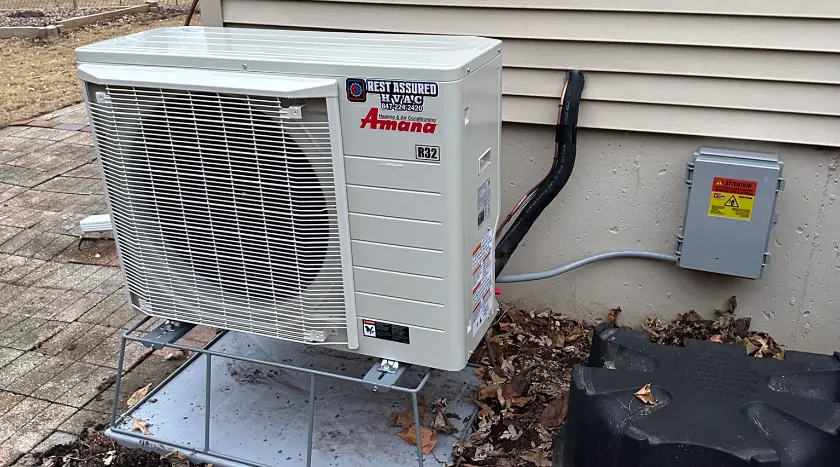
An Amana S-Series R-32 heat pump installed by our team. The air handler is the matching indoor unit; we repair both, on every major brand.
- Full-system diagnostic, indoor and outdoor, not a parts swap
- Written flat-rate price before any work starts
- Correctly rated parts, not universal close-enoughs
- Heat-strip amp draw checked on every element
- Static pressure and temperature split verified after the repair
- Condensate drain, pan and float switch tested
- Clear notes on what we found and what to watch for
Inside or out, we diagnose the whole system. Learn more about heat pumps and the Amana S-Series we install.
Prevent the Next Breakdown for $240 a Year
Most of the repairs on this page show up first as a dirty coil, a weak capacitor, a slow drain or a heat strip pulling the wrong amps, and a tune-up catches them. Our semi-annual maintenance plan includes a spring heat pump tune-up and a fall air handler tune-up (each up to a $130 value), one free business-hours service call, priority scheduling and 5% off repairs. That’s up to $390 in services for $240. See the maintenance plan.
Have a gas furnace instead of an air handler? The blower and coil problems are similar. See furnace repair or AC repair.
Same-Day Air Handler Repair in South Elgin & Bartlett
A dead blower motor or a tripped limit switch doesn’t wait for a convenient day. We keep common air handler parts stocked on the truck, so most South Elgin and Bartlett repair calls are finished same-day instead of scheduled out a week.
Air Handler Repair Across the Fox Valley
Based in Elgin, we serve homes throughout Kane, McHenry, DuPage and DeKalb counties.
- Elgin
- South Elgin
- St. Charles
- Aurora
- Bartlett
- Streamwood
- Huntley
- Plato Center
- Sycamore
- Carpentersville
- West Dundee
- East Dundee
- Algonquin
- Gilberts
- Hampshire
- Pingree Grove
- Campton Hills
- Geneva
- Batavia
- Barrington
- Hoffman Estates
- Schaumburg
- Burlington
- Marengo
- Wayne
- Sleepy Hollow
Don’t see your town? Call (847) 224-2420. View all service areas.
Air Handler Repair FAQs
What is an air handler and how is it different from a furnace?
An air handler is the indoor unit of a heat pump system. It holds the blower, the evaporator coil, electric backup heat strips and the filter, but no burner or gas line. A furnace burns gas to make heat; an air handler moves the heat the outdoor heat pump produces and adds electric heat only when needed.
Why is my heat pump running but no air is coming out of the vents?
The outdoor unit and the indoor blower are controlled separately. When the outdoor unit runs and nothing comes out inside, the blower motor, its ECM control module, a blower capacitor or the control board has failed. It’s one of the most common air handler repairs.
Why does my air handler blow cold air in heating mode?
Usually the backup heat strips aren’t staging in when the heat pump can’t keep up or is defrosting. A stuck sequencer, a failed relay or a tripped limit switch is the usual cause. Sometimes the outdoor unit itself has stopped and the strips are all you have.
Why does the breaker trip when the backup heat comes on?
Electric heat strips draw a lot of current. A failing element, a shorted sequencer or a loose connection at the strip kit will trip the breaker. Reset it once. If it trips again, leave it off and call us.
Why is there ice on my air handler coil?
Ice means the coil is getting too cold, usually from low airflow (a dirty filter, dirty coil or failing blower) or low refrigerant. Turn the system to fan-only to thaw it and have it diagnosed before running it again.
Why is there water around my air handler?
In cooling season that’s condensate from the coil. A clogged drain line, a full pan or a failed condensate pump lets it overflow. Clearing the drain is a quick repair; a cracked pan or bad pump costs a bit more.
My system shut off and won’t restart. What happened?
Many air handlers have a float switch in the drain pan that cuts power when water backs up. Once we clear the drain and the pan empties, the system comes back. If there’s no water, a tripped limit switch or a blown low-voltage fuse is the next thing we check.
How much does air handler repair cost in Elgin?
Most common repairs, such as capacitors, sequencers, switches and blower motors, typically run $300 to $1,400 in our area. A leaking coil or a refrigerant repair can run into the thousands. You get a flat-rate price before any work.
Do you charge a diagnostic fee?
Yes. A flat diagnostic fee covers a full-system check, indoors and out, and the repair is quoted flat-rate for you to approve before any work. Maintenance plan members get one free business-hours service call each year.
Do you offer emergency air handler repair?
Yes. We answer no-heat and no-cooling calls 24/7 at (847) 224-2420. If you have no heat on a night below freezing, call right away.
Do you repair air handlers you didn’t install?
Yes. We repair air handlers and heat pumps of every major brand, no matter who installed them.
Why did my electric bill jump this winter?
If the backup heat strips are running when the heat pump should be carrying the load, the bill shows it. A stuck sequencer, an emergency-heat setting left on at the thermostat or a failed outdoor unit can all cause it. We check strip amp draw and staging on every heating visit.
Is an ECM blower motor expensive to replace?
The motor and its control module are separate parts, and the module fails far more often than the motor. Replacing just the module is much less than a full motor. We test both before replacing anything.
Should I repair or replace my air handler?
If the repair costs more than half the price of a new matched system and the equipment is over 12 years old, replacement usually makes more sense. Small repairs on older units are still worth doing. We’ll give you a straight answer and a price for both.
Can I run my system while I wait for the repair?
If the breaker is tripping, you hear grinding or there’s ice on the coil, shut it off or switch to fan-only. If there’s water in the pan, leave it off. Otherwise running it is usually fine until we arrive.
What should I check before calling for air handler repair?
Confirm the thermostat is in the right mode and set past room temperature, replace its batteries if it has them, check the breakers for both the air handler and the outdoor unit, and make sure the filter isn’t clogged. If the blower still won’t run or the air is still wrong, call us.
No Heat or No Cool? We’re On It.
Call any time for emergency air handler repair, or book a repair or tune-up online in about a minute.
Thinking about replacing? Request a free quote or see financing options. Explore all heat pump services.
