
Hydronic Boiler Installation
Boiler Installation in Elgin & the Fox Valley
We install high-efficiency Laars condensing and combination boilers the way the manufacturer drew them: sized from a heat-loss calculation, piped primary-secondary, vented to clearances and commissioned with a combustion analyzer. Replacement, new construction, additions and radiant.
- NATE-certified gas heating installation
- Manual J load calculation available on request
- Permits filed under our own license
- Nicor Gas discount off the invoice
A Boiler Is Only as Good as the Installation
Two identical boilers can perform completely differently depending on how they were piped, vented, sized and started up. The install is where the efficiency and the lifespan are decided.
A hydronic system is a set of decisions: how big the boiler is, how the water moves, how the air gets out, how the flue gases get out, how the gas gets in and how the controls decide when to fire. Get one of them wrong and the boiler short cycles, the last radiator stays cold, or the heat exchanger fails ten years early. Here is what we check and what we do on every installation, whether it is replacing an old boiler in an Elgin foursquare or heating a new addition in Campton Hills.
- Sizing to the house at Elgin’s near-0°F design temperature, with a Manual J heat-loss calculation available on request or where required
- Radiation survey measuring the connected baseboard, radiators or radiant loops and the water temperature they need
- Boiler selection: heating-only or combi, output range and turndown matched to the load
- Near-boiler piping built to the manufacturer’s diagram, with primary-secondary separation on condensing boilers
- Venting sized and terminated to the manufacturer’s clearances, with condensate drained and neutralized
- Gas piping sized for full input with every appliance running, and leak-tested
- Controls: outdoor reset, zone valves or circulators, thermostats and domestic hot water priority
- Commissioning with a combustion analyzer and a written start-up sheet
- Permit and inspection filed under our own license where required
What Goes Into a Boiler Installation
The parts of the job that decide whether the boiler runs well for twenty years.
Step one
Sizing
We size to the house, not the output of the old boiler. Old boilers were routinely oversized, and an oversized modulating boiler still short cycles on mild days. Then we measure the connected radiation and the water temperature it needs at design conditions. The boiler is chosen to cover the load with room to modulate down. When the numbers are borderline, a permit or utility program requires it, or you ask for one, we run a full Manual J load calculation (there may be an additional cost).
Selection
Heating-only or combi, and turndown
A heating-only condensing boiler suits a house with a good water heater. A combi replaces the water heater and makes hot water on demand, with the larger $500 Nicor Gas discount. Turndown ratio matters: a boiler that can run at a small fraction of its rated input runs longer, quieter cycles in a Fox Valley shoulder season.
Piping
Near-boiler piping done right
Condensing boilers need steady flow through the heat exchanger. We pipe primary-secondary or use a low-loss header, put the expansion tank and air separator on the suction side of the circulator, add a fill valve, relief valve, isolation valves and purge points on every zone, and follow the manufacturer’s piping diagram to the letter.
Venting
Intake, exhaust and condensate
PVC or polypropylene intake and exhaust are sized for the run length, sloped back to the boiler, supported, and terminated with the manufacturer’s clearances from windows, doors, grade and each other. Condensate runs through a neutralizer to a drain or pump. If the old chimney is abandoned, we deal with any appliance still on it.
Gas and electrical
Fuel and power
The gas line is checked for size against the boiler’s full input plus every other appliance, and inlet pressure is verified under load. The boiler gets its own switched circuit. Everything is leak-tested and labeled.
Controls
Zoning, reset and hot water
Zone valves or zone circulators, a relay panel, thermostats, and the outdoor reset sensor are installed and configured. On a combi or a boiler with an indirect tank, domestic hot water priority is set so a shower does not fight the radiators.
Start-up
Commissioning and documentation
Fill, purge, set pressure and expansion tank charge, combustion analysis at high and low fire, adjust to the manufacturer’s targets, set the reset curve, run every zone to temperature, and record it all. You get the start-up sheet, the permit, the warranty registration and a walk-through of the controls.
How Installation Day Goes
Here is the sequence for a typical one-day replacement installation. New construction and radiant jobs follow the same steps spread across the build.
Morning: protect and remove. We lay down floor protection, shut off gas and water, drain the system and disconnect the old boiler and venting. Cast-iron boilers come apart in sections. Old piping we are replacing comes out with it.
Mid-morning: set and pipe. The new boiler is mounted on the wall or set on the floor. Near-boiler piping is built: primary loop, secondary loops, circulators, expansion tank, air separator, fill and relief valves, isolation and purge valves. Gas piping is connected and tested.
Early afternoon: vent and drain. Intake and exhaust are run through the rim joist and terminated. Condensate goes through the neutralizer to a drain or pump. The outdoor reset sensor goes on a north wall. Electrical is connected.
Late afternoon: fill and commission. We fill and purge each zone, set pressure, fire the boiler and run the combustion analysis. Reset curve and zone controls are set. Every zone runs to temperature. Then we clean up, walk you through the controls and hand over the paperwork. Heat is on before we leave.
Most changeouts are done in one day. A combi that removes a water heater, or a job with new zoning, may run two. Need to spread the cost? Prequalify in about 2 minutes with no impact to your credit score.
How Boiler Installation Pricing Works
Quotes are free, written and fixed. We do not publish a single installed price, because the piping, venting and zoning vary too much from house to house.
After a site visit and the heat-loss calculation, you get a written quote that lists the boiler, every piping component, the venting, gas and electrical work, condensate handling, controls, permit, start-up and removal of any old equipment, with the Nicor Gas instant discount shown as a line item. The price does not change once you approve it unless you change the scope.
What moves the number: heating-only versus combi, the boiler’s output, how much near-boiler piping has to be rebuilt, the vent run length and termination, whether an abandoned chimney still serves a water heater, the number of zones, and any new radiation or radiant loops. We explain each line so you can compare it honestly against any other quote you get.
Plan members get 5% off services, and the maintenance plan is the simplest way to keep a new boiler’s warranty and combustion numbers in order. If financing helps, you can prequalify in about 2 minutes with no impact to your credit score, and on-bill financing is also available.
New Construction, Additions and Radiant
Not every boiler installation replaces an old one. Some start from a blank basement wall.
For a new house or an addition, we design the hydronic system from the heat-loss calculation up: baseboard, panel radiators or radiant floor by room, zone layout, supply water temperatures and boiler size. Radiant floors run at low water temperatures where a condensing boiler is most efficient, and each radiant zone gets its own mixing control so the slab or subfloor never sees full boiler temperature. Adding a zone to an existing boiler is common too, as long as the boiler has the capacity, and we confirm that before promising it.
Boiler homes usually have no ductwork, so cooling is a separate conversation. A Daikin ductless mini-split handles it without ducts, and can go in at the same time.
What a Bad Boiler Installation Looks Like
We see these on service calls. Each one costs you gas, comfort or years of boiler life.
- Sized from the old label. A boiler two or three times bigger than the house needs, short cycling on every mild day.
- No primary-secondary piping. The condensing heat exchanger starved for flow whenever only one zone calls.
- Expansion tank on the discharge side of the pump. Pressure swings, air problems and a relief valve that drips.
- No air separator or purge valves. Radiators that gurgle for years because nobody could get the air out.
- Undersized gas line. The boiler cannot reach high fire, and the furnace or water heater starves when it tries.
- Vent terminations too close to a window, the grade or each other. Recirculated exhaust, ice at the intake and lockouts in January.
- No combustion test. The burner was never tuned, and nobody knows what it is putting into the flue.
- Outdoor reset never set up. The boiler runs at full temperature all winter and the efficiency rating on the box never shows up on the bill.
- Warranty never registered. A heat exchanger claim years later gets denied.
If you are replacing an old boiler and want the decision side, the repair-versus-replace math and the discount details are on our boiler replacement page. If your boiler just needs work, see boiler repair.
Why Fox Valley Homeowners Choose Rest Assured for Boiler Installation
Hydronic work is our trade, not a side job. The people who design the system are the ones who pipe it.
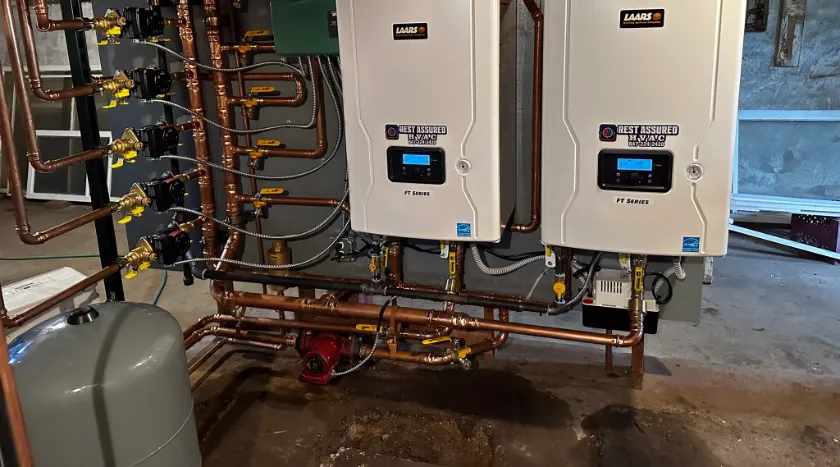
Laars boilers, installed by our team.
- Laars condensing and combination boilers; hot-water, steam and radiant systems
- Owner Jeff Kerley: NATE certified in Gas Heating Installation, EPA 608 Universal, NCI airflow trained
- Team holds NATE Ready-to-Work certification
- Licensed, insured and bonded; permits filed under our own license
- Municipally licensed in Elgin, Aurora, Bartlett, Huntley and Streamwood
- Nicor Gas Contractor Circle Installing Member: $350 or $500 off the invoice
- BBB of Chicago & Northern Illinois Complaint Free Award, 2024 and 2025
After the install, a fall boiler tune-up keeps the combustion numbers where we left them. We also install furnaces, heat pumps and air conditioning.
Save With Nicor Gas Instant Discounts
As a Nicor Gas Contractor Circle Installing Member, we take the discount right off your invoice: $350 on a qualifying 95% AFUE heating boiler, or $500 on a qualifying combination boiler. No forms, no waiting. See Nicor Gas instant discounts.
Quotes are free, written and include the discount. Request a free quote or prequalify for financing in about 2 minutes with no impact to your credit score.
Boiler Installation Across the Fox Valley
Based in Elgin, we serve homes throughout Kane, McHenry, DuPage and DeKalb counties.
- Elgin
- South Elgin
- St. Charles
- Aurora
- Bartlett
- Streamwood
- Huntley
- Plato Center
- Sycamore
- Carpentersville
- West Dundee
- East Dundee
- Algonquin
- Gilberts
- Hampshire
- Pingree Grove
- Campton Hills
- Geneva
- Batavia
- Barrington
- Hoffman Estates
- Schaumburg
- Burlington
- Marengo
- Wayne
- Sleepy Hollow
Don’t see your town? Call (847) 224-2420. View all service areas.
Boiler Installation FAQs
How do you size a boiler?
By sizing to the house and surveying the connected radiation; a Manual J heat-loss calculation is available as needed, on request or where a municipality or utility program requires one, and it may carry an additional cost. The boiler has to be big enough to heat the house on a near-0°F Elgin night and small enough to run steady, efficient cycles the rest of the winter. We do not size from the old boiler’s nameplate.
What brand of boiler do you install?
We install Laars high-efficiency condensing and combination boilers and repair and service every brand. See the boiler services hub for an overview.
How long does a boiler installation take?
A straight replacement is usually one day. A combi installation that also removes the water heater, a job with substantial new near-boiler piping, or a new zone added at the same time can run two days. New-construction and radiant jobs are scheduled around the build.
Do you pull a permit for a boiler installation?
Yes, where the municipality requires one, which is most of the Fox Valley. We file it under our own license, the gas and venting work is inspected, and we meet the inspector. We are municipally licensed in Elgin, Aurora, Bartlett, Huntley and Streamwood.
What is primary-secondary piping and why does it matter?
Modern condensing boilers need a steady flow through their heat exchanger regardless of how many zones are calling. Primary-secondary piping, or a low-loss header, separates the boiler loop from the house loops so the boiler always gets the flow it needs. Skipping it is one of the most common causes of early heat exchanger failure.
What is outdoor reset?
A sensor outside tells the boiler how cold it is, and the boiler lowers its water temperature on mild days. Lower water temperature means more condensing and less gas. We set the reset curve to your radiation at start-up so the house still reaches setpoint on the coldest day.
Can you install a boiler in a new addition or a new house?
Yes. We design and install hydronic heating for new construction and additions, including baseboard, panel radiators and radiant floor zones, and we can add a zone to an existing boiler where it has the capacity.
Can a boiler heat radiant floors?
Yes. Radiant floor loops run at much lower water temperatures than radiators, which is where a condensing boiler is most efficient. Each radiant zone gets its own mixing control or a dedicated low-temperature loop so the floor never sees boiler-temperature water.
Where does a new condensing boiler vent?
Through PVC or polypropylene pipe, usually out the rim joist to a side wall, with the intake and exhaust terminated to the manufacturer’s clearances from windows, doors, grade and each other. If a chimney is no longer used, we cap or address it and make sure any remaining appliance on it drafts safely.
Do you check the gas line?
Yes. We confirm the gas pipe size can deliver the boiler’s full input along with every other appliance, check inlet pressure with the boiler running, and leak-test every joint. An undersized gas line makes a modulating boiler starve at high fire.
What does commissioning include?
Filling and purging every zone, setting system pressure, verifying the expansion tank charge, a combustion analysis with the burner adjusted to the manufacturer’s targets, setting the outdoor reset curve and zone controls, running each zone to temperature, and recording all of it on the start-up sheet you keep.
What does a bad boiler installation look like?
No primary-secondary piping, an expansion tank on the wrong side of the pump, no air separator, undersized gas pipe, a vent run that ignores clearances, no combustion test, and a boiler oversized by a factor of two because the installer copied the old label. Each one shortens the boiler’s life or costs you gas every day.
Are your installers certified?
Owner Jeff Kerley is NATE certified in Gas Heating Installation and Air Conditioning Installation, EPA 608 Universal and NCI airflow trained. The team also holds NATE Ready-to-Work certification. Rest Assured HVAC is licensed, insured and bonded.
Do you register the warranty?
Yes. We register the boiler with the manufacturer after start-up so the full parts and heat exchanger warranty is in effect, and we give you the registration confirmation with your invoice.
Is there a Nicor Gas discount on a new boiler installation?
Yes. $350 on a qualifying 95% AFUE heating boiler or $500 on a qualifying combination boiler, taken off the invoice. See Nicor Gas instant discounts.
Can I add air conditioning to a boiler home?
Yes. Most boiler homes have no ductwork, so a Daikin ductless mini-split is the usual answer. It can be installed alongside the boiler or later.
Plan Your Boiler Installation
Request a free written quote for a replacement, an addition or a new hydronic system. We’ll come out, measure and design it.
Discount amounts reflect the 2026 Nicor Gas Energy Efficiency Program for qualifying equipment installed January 1 through December 31, 2026, and are subject to change or cancellation due to funding limits. Rest Assured HVAC LLC is an independent contractor and is not affiliated with or endorsed by Nicor Gas.
