
24/7 Heat Pump Service
Emergency Heat Pump Repair in Elgin & the Fox Valley
Heat pump down on a January night, or blowing warm air in the middle of a July heat wave? Call (847) 224-2420 any hour. While you wait, this page tells you what counts as an emergency, how to bridge the gap with auxiliary or emergency heat, what to do about an iced-over outdoor unit, and the five things to check that might save you the call.
- 24/7 emergency service, one number: (847) 224-2420
- All heat pump brands repaired
- Flat diagnostic fee, repair priced before work
- ComEd Heat Pump-Trained Contractor
Is This a Heat Pump Emergency?
Some heat pump problems need a truck tonight. Others can wait for a morning appointment at the regular rate. Here’s how we sort them.
Call now
No heat and it’s below freezing
If the heat pump isn’t heating, auxiliary or emergency heat isn’t coming on either, and the house is losing temperature, that’s an emergency. Below freezing, pipes in exterior walls and unheated spaces can freeze within hours. Call right away.
Call now
Burning smell, breaker that trips instantly, or sparking
Shut the system off at the thermostat and the breaker and call. An electrical fault in the air handler, heat strips or outdoor unit is not something to run until morning.
Call now
Water pouring from the air handler
A blocked condensate drain or a frozen coil that’s thawing can put a lot of water on the floor fast. Turn the system off, put a pan under it if you can, and call. In a finished basement or closet this is a damage call, not just a comfort call.
Call now
No cooling, heat wave, and someone vulnerable in the house
An infant, an older adult or someone with a health condition in a 90°F house is an emergency. We treat it that way.
Can wait
Running, but not keeping up
If the house is holding somewhere in the 60s in winter or the 70s in summer, the system is limping but working. Book a next-day heat pump repair at the regular rate and save the after-hours call.
Can wait
Steam off the outdoor unit, or brief frost
In damp cold, a heat pump frosts and runs a defrost cycle: the fan stops, steam rises for a few minutes, heating resumes. That’s normal. A unit that’s a solid block of ice is not; see below.
What to Do Right Now
Before anything else, keep the house safe and buy yourself time.
Switch to emergency heat. Most heat pump thermostats have an “Emergency Heat” or “EM Heat” setting. It shuts the heat pump off and runs the backup heat by itself: electric heat strips in the air handler, or the gas furnace on a dual-fuel system. Backup heat costs more per hour to run, but it keeps the house warm until the technician arrives, and it stops a failing outdoor unit from doing more damage to itself. Auxiliary heat normally comes on by itself when the heat pump can’t keep up; emergency heat is you telling the thermostat to stop trying.
If emergency heat doesn’t work either. Check the breaker for the air handler and the heat strips, which is often a separate, larger breaker. If it’s tripped, reset it once. If it trips again, leave it off and call. If the breakers are fine and there’s still no heat, the problem is in the air handler or the controls, and that’s the emergency call.
Below freezing with no heat at all. Open cabinet doors under sinks on exterior walls. Let faucets on exterior walls drip. Close off unused rooms and keep everyone in one space. Space heaters are fine on their own circuit and away from anything flammable. Never use a gas range, grill or generator indoors for heat.
Summer, and the indoor coil or outdoor unit is iced up. Switch the thermostat from Cool to Off and set the fan to On. The indoor blower will thaw the coil in an hour or two while the compressor rests. Running it iced up can slug the compressor with liquid refrigerant, which turns a cheap repair into a replacement.
Dual-fuel homeowners: smell gas? Leave the house right away, call 911 from outside, and call your gas utility’s emergency line from outside before calling us.
If the Outdoor Unit Is Iced Over
Frost is normal. A cabinet encased in ice, with the fan blades locked or the coil buried, is a defrost failure and it needs attention.
- Switch to emergency heat. This stops the heat pump so it doesn’t run with a blocked coil and lets the backup carry the house.
- Don’t chip the ice. Screwdrivers and hammers bend fins and puncture coils. A punctured coil is a refrigerant leak on top of the original problem.
- Don’t pour hot water on it. It refreezes on the fan and in the base pan, and it can crack a cold coil.
- Clear what’s around it. Snow piled against the unit, a downspout dumping onto it, or a roofline dripping straight into the cabinet all cause ice. Move the snow away and let the unit sit.
- Check the base. If the unit is sitting in a puddle or the base pan drain holes are frozen shut, defrost water has nowhere to go. That’s a mounting problem we fix at the repair.
- Call us. Ice that keeps coming back means a defrost sensor, defrost board, reversing valve or low charge. On inverter systems it can be a board or sensor reporting the wrong coil temperature. We test the defrost cycle rather than just melting the ice and leaving.
Five Things to Check Before You Call
About one call in ten ends here. Worth two minutes.
- Thermostat mode and batteries. Confirm it’s in Heat (or Cool), the setpoint is above (or below) room temperature, and the display is on. A dead battery in a battery-powered thermostat is the most common no-heat we find in November.
- Breakers. The outdoor unit, the air handler and the heat strips can each have their own breaker. Look for any that’s tripped or sitting between on and off. Reset once. If it trips again, stop and call.
- Outdoor disconnect. The gray box on the wall near the outdoor unit. Make sure the pull-out or switch is in, and that it wasn’t knocked loose by a mower or a shovel.
- Filter. A filter so loaded that the air handler can’t breathe will freeze the coil in summer and trip a limit in winter. If you can’t see light through it, replace it and give the system an hour.
- Condensate float switch. Air handlers have a safety switch that shuts the system down when the drain pan fills. If the drain is clogged, the system won’t run at all. Clearing the drain line restarts it; we’ll fix the cause.
If you have an outdoor unit that hums but the fan doesn’t spin, or a system that starts and stops every minute, leave it off. Those symptoms usually mean a failed motor, capacitor or board, and running it makes the repair bigger.
What the Technician Does on Arrival
An emergency call is the same diagnosis as a daytime call, done faster and with a truck stocked for the season.
First five minutes. We confirm what you’re seeing, check the thermostat configuration, and look at the outdoor unit and air handler. If backup heat is available and off, we get it running so the house starts recovering while we work.
Diagnosis. We pull the fault codes from the thermostat and the inverter board, then test the actual failure: capacitors and contactors on conventional units, inverter output on variable-speed units, the reversing valve and defrost control in winter, refrigerant pressures and temperatures, heat strip sequencers and relays, the condensate drain and float switch. Reversing valve and defrost control faults are heat-pump-specific and we see them every winter.
Your price before the work. We tell you what failed and give you a flat price. The repair is quoted flat-rate, and you approve that price before any work. If the failure is a compressor or a major refrigerant leak on an older unit, we say so honestly, get backup heat running for the night and come back with a replacement quote rather than selling you a repair the system won’t outlive.
The repair. Capacitors, contactors, fan motors, defrost sensors, float switches and common boards are on the truck. Compressors and some inverter boards are ordered for your exact model, and we keep backup heat running until they arrive. Before we leave, the system runs through a full heating or cooling cycle with readings recorded, and in winter we force a defrost cycle and watch it complete.
What Emergency Heat Pump Repair Costs
Flat diagnostic fee, then a flat-rate repair price you approve before work starts. During office hours (9 a.m. to 5 p.m., Monday through Friday) the service call is $130; weekday evenings after 5 p.m. it is $180, and nights, weekends and holidays are $260. Each includes 30 minutes of travel and 30 minutes of diagnostics, and parts are extra. The after-hours rate is higher than a daytime call, and you hear it before we dispatch.
After-hours service calls are priced higher than business-hours calls, and we tell you that rate when you phone, before anyone is dispatched. The repair itself is flat-rate. Common heat pump repairs such as capacitors, contactors, fan motors, defrost sensors and float switches typically run $300 to $1,400, similar to air conditioning repairs. Reversing valves, refrigerant leak repair and compressor replacement can run into the thousands, which is where the repair-or-replace conversation starts.
The 50% rule applies even at 2 a.m.: if the repair is half the cost of a new system and the unit is past 10 to 12 years, we’ll recommend getting you through the night on backup heat and quoting a replacement in the morning. A qualifying new ducted heat pump earns a ComEd instant discount of $900 to $2,000 on the invoice, which changes that math. St. Charles, Geneva and Batavia run their own electric utilities, so ComEd discounts aren’t available there.
Members of the $240 maintenance plan get priority scheduling, one free business-hours service call a year and 5% off repairs. Larger repairs can be spread out through financing; you can prequalify in about 2 minutes with no impact to your credit score.
The Cold Snap and the Heat Wave
Heat pumps fail on the days they work hardest, and that’s when every HVAC company in the Fox Valley is busiest.
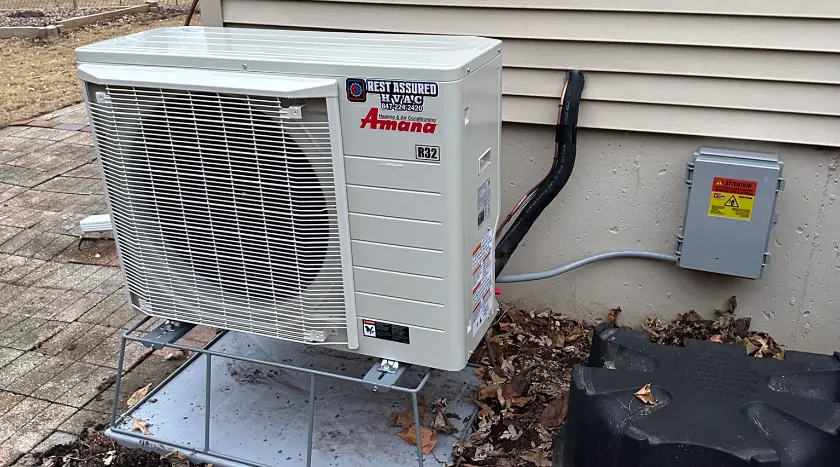
An Amana S-Series R-32 inverter heat pump installed by our team. Set on a riser so defrost water and snow stay clear of the coil, which is the mounting detail that prevents most winter ice calls.
The first cold snap. The first week in October or November when overnight lows hit the 20s is when a heat pump that sat idle all fall reveals a failed defrost board, a stuck reversing valve or heat strips that haven’t been asked to work since March. We stage for it: more trucks, more parts, longer hours. Plan members go to the front of the line.
The heat wave. The first stretch of 90°F days in June or July finds every weak capacitor and dirty coil in the county. Heat pumps that cool are air conditioners in summer, and the failures are the same. See emergency AC repair if your cooling-only system is down.
Avoid both. The fall visit on the maintenance plan tests the defrost cycle, the reversing valve and the heat strips before the cold comes. The spring visit cleans the coil and tests the capacitors before the heat. Most of the emergency calls we run are on systems that skipped one of those.
Skip the Line Next Time: $240 a Year
The semi-annual maintenance plan gives you priority scheduling when the cold snap or heat wave hits, one free business-hours service call, 5% off repairs, and the spring and fall visits (each up to a $130 value) that catch defrost, reversing valve and heat strip problems before they become emergencies. Up to $390 in services for $240.
Not an emergency? Book a regular heat pump repair online at the standard rate. Furnace down instead? See emergency furnace repair.
Emergency Heat Pump Repair Across the Fox Valley
Based in Elgin, we answer emergency heat pump calls throughout Kane, McHenry, DuPage and DeKalb counties, 24 hours a day.
- Elgin
- South Elgin
- St. Charles
- Aurora
- Bartlett
- Streamwood
- Huntley
- Plato Center
- Sycamore
- Carpentersville
- West Dundee
- East Dundee
- Algonquin
- Gilberts
- Hampshire
- Pingree Grove
- Campton Hills
- Geneva
- Batavia
- Barrington
- Hoffman Estates
- Schaumburg
- Burlington
- Marengo
- Wayne
- Sleepy Hollow
Don’t see your town? Call (847) 224-2420. View all service areas.
Emergency Heat Pump Repair FAQs
Do you offer 24/7 emergency heat pump repair?
Yes. Call (847) 224-2420 any hour. Tell us the symptom, whether backup heat is working and how cold the house is, and we’ll tell you how the call is priced before anyone is dispatched.
What counts as a heat pump emergency?
No heat below freezing with no backup heat working, a burning smell or repeatedly tripping breaker, water pouring from the air handler, or no cooling in a heat wave with a vulnerable person in the house. A system that’s running but not keeping up can usually wait for a next-day repair.
What is emergency heat on my thermostat?
A setting that shuts the heat pump off and runs only the backup heat: electric heat strips, or the furnace on a dual-fuel system. Use it when the heat pump has failed. It costs more per hour but keeps the house warm until the technician arrives.
What’s the difference between auxiliary heat and emergency heat?
Auxiliary heat comes on automatically alongside the heat pump when it can’t keep up. Emergency heat is a manual setting that runs the backup by itself with the heat pump off. Switch to emergency heat when the outdoor unit has failed or is iced over.
My outdoor unit is a block of ice. What do I do?
Switch to emergency heat so the heat pump stops running, don’t chip the ice or pour hot water on it, clear snow away from the unit and call us. Ice that keeps coming back is a defrost, reversing valve or refrigerant problem.
Is steam coming off my heat pump normal?
Yes. In damp cold the coil frosts and the unit runs a defrost cycle: the fan stops, steam rises for a few minutes, then heating resumes. A cabinet encased in solid ice is a different problem.
My heat pump is blowing cool air in heat mode. Is it broken?
Maybe not. Heat pump supply air is around 90°F to 100°F, which feels cool against your hand but heats the house. If the house is losing temperature, or the air is room temperature or colder, the reversing valve, charge or compressor may have failed.
What should I check before calling?
Thermostat mode and batteries, breakers for the outdoor unit, air handler and heat strips, the outdoor disconnect, the filter and the condensate float switch. If a breaker trips again after one reset, leave it off and call.
Do you charge extra for after-hours calls?
Yes. After-hours service calls are priced higher than business-hours calls, and we tell you the rate when you phone, before dispatch. The diagnostic fee is flat, and the repair itself is quoted flat-rate for you to approve before any work.
How much does an emergency heat pump repair cost?
Common repairs such as capacitors, contactors, fan motors, defrost sensors and float switches typically run $300 to $1,400. Reversing valves, refrigerant leaks and compressors can run into the thousands. You approve the price before any work.
What if the part isn’t on the truck?
We get backup heat or fan-only cooling running so the house is livable, order the part for your exact model and return as soon as it arrives. Common parts are stocked year-round.
Will you repair a heat pump you didn’t install?
Yes. We repair all major brands, including conventional and inverter heat pumps and dual-fuel systems, regardless of who installed them.
Can frozen pipes really happen from a heat pump failure?
Yes. With no heat below freezing, pipes in exterior walls and unheated spaces can freeze within hours. Run emergency heat if you have it, open cabinets under sinks on exterior walls and let those faucets drip until we arrive.
Should I repair or replace after an emergency failure?
If the repair is half the cost of a new system and the unit is past 10 to 12 years, replacement usually wins. We’ll get you through the night on backup heat and quote a replacement, with the ComEd discount included, in the morning.
How do I avoid an emergency next winter?
A fall tune-up that tests the defrost cycle, reversing valve and heat strips catches most winter failures early. The $240 maintenance plan covers it and gives you priority scheduling during the cold snap.
My AC-only system is down in a heat wave. Is this the right page?
Call the same number. For cooling-only systems, our emergency AC repair page covers what to check and what to expect.
Heat Pump Down? Call Now.
Any hour, any brand. Switch to emergency heat, check the breakers and call (847) 224-2420. Not an emergency? Book a regular repair online.
Book a non-emergency heat pump repair, compare replacement or learn more about heat pumps.
Discount amounts reflect the 2026 ComEd Energy Efficiency Program for qualifying equipment and are subject to change or cancellation due to funding limits. Rest Assured HVAC LLC is an independent contractor and is not affiliated with or endorsed by ComEd.
