
Gas Furnace Installation
Furnace Installation in Elgin & the Fox Valley
A furnace is only as good as the installation behind it. We size every furnace to the house, not the old label, match the equipment, pull the permit, vent and pipe it to code, and commission it with instruments before we leave. Owner Jeff Kerley is NATE certified in Gas Heating Installation, and it shows in the work.
- NATE certified in Gas Heating Installation
- Manual J load calculation available on request
- Permits filed under our own license
- Commissioned with combustion analysis and written readings
When You Need a Furnace Installation
Installation is the work itself: sizing, setting, venting, piping, wiring and commissioning a gas furnace. It applies whether the furnace is going into a new space or taking the place of an old one.
- New construction or a major addition. A new home or a large addition needs a furnace sized to the finished envelope, with ductwork designed to reach every room, not a guess based on square footage.
- Finishing a basement or converting an attic. Added conditioned space changes the heating load and often needs a second zone or a second system.
- Converting from a boiler, electric baseboard or an old oil furnace. A first forced-air system means new ductwork, a new gas line and a vent path that doesn’t exist yet.
- Adding a heat pump with a furnace as backup. A dual-fuel install pairs a cold-climate inverter heat pump with a matched furnace and a control that picks the cheaper heat source.
- Replacing a furnace that was never installed right. Undersized returns, improper venting or a furnace two sizes too big are problems a new box on the same mistakes won’t fix.
- Relocating the furnace. Moving a furnace out of a bedroom closet, a crawlspace or the middle of a basement you want to finish.
- Switching from 80% to condensing. A 95% or 97% furnace needs PVC intake and exhaust, a condensate drain, and often changes to the water heater’s flue.
- A straightforward changeout. Swapping a tired furnace for a new one on the same spot. The decision side of that is on our furnace replacement page. This page covers how the work is done.
Smell gas? Leave the house right away, call 911 from outside, and call your gas utility’s emergency line from outside before calling us.
How We Size and Select Your Furnace
The furnace on the quote is the result of measurements, not the size the last one was.
Step 1
Measuring the house
We measure the house: square footage by room, ceiling heights, window area and orientation, insulation levels, air leakage and the basement. From that we work out the heat your home actually loses on the coldest day at Elgin’s design temperature near 0°F, in BTUs per hour. That number, not the old furnace’s label, sets the size. When the numbers are borderline, a permit or utility program requires it, or you ask for one, we run a full Manual J load calculation (there may be an additional cost).
Step 2
Right-sizing, not oversizing
Oversized furnaces are the most common mistake we find in Fox Valley basements. They short cycle, overshoot the thermostat, leave upstairs rooms cold and wear out sooner. A furnace sized to the load runs longer, gentler cycles and keeps the house even. Two-stage and modulating models give us more room to hit the number precisely.
Step 3
Equipment selection
Single-stage, two-stage or modulating burners. PSC, constant-torque or variable-speed ECM blower. 80%, 95% or 97% AFUE. Upflow, downflow or horizontal for your basement, closet or attic. We walk through what each choice means for comfort, gas use, noise and the Nicor Gas discount, and we quote the option we would put in our own house alongside any budget option you ask for.
Step 4
AHRI matching
When the furnace pairs with an AC or heat pump coil, the furnace blower, the indoor coil and the outdoor unit must be an AHRI-certified match. That is what makes the system deliver its rated efficiency, keeps the manufacturer’s warranty valid, and is required for ComEd heat pump discounts. We provide the AHRI certificate number on the quote.
Step 5
Ductwork and static pressure
We measure the existing ducts and calculate whether the return can supply the airflow the new furnace needs. Many 1960s to 2000s homes have returns sized for a smaller, slower blower. Where needed, we add return air, enlarge the filter cabinet or correct the transitions so the furnace isn’t fighting its own ductwork. Target: total external static pressure inside the manufacturer’s rating.
Step 6
Venting, gas and condensate plan
Condensing furnaces vent through PVC, usually out the rim joist, with terminations placed for clearance from windows, grade, snow depth and the gas meter. We plan the gas line size and drip leg, the condensate route to a floor drain or pump, and whether the water heater flue needs to be resized once the furnace leaves the chimney.
We install Amana and Daikin gas furnaces and pair them with AprilAire media filters and humidifiers. For dual-fuel, the furnace is matched to an Amana S-Series R-32 inverter heat pump. Every quote is free and written, and it includes the Nicor Gas discount. Request a free quote.
How Installation Day Goes
Most single-furnace installations take one working day. Here is what happens in it.
Before we arrive. The permit is filed under our license where your municipality requires one, the equipment is confirmed against the AHRI match and the quote, and you get a call with the arrival window. Clear a path from the door to the furnace if you can.
Protection and removal. Floor runners go down from the entrance to the mechanical room. Gas and power are shut off and locked out. The old furnace, if there is one, is disconnected, and the old venting, transitions and condensate line come out with it.
Setting the furnace. The new furnace is set on a level base with a vibration pad where needed, oriented upflow, downflow or horizontal per the plan, and positioned for the service clearances printed on the door so the next technician can actually work on it.
Ductwork. New sheet metal supply and return transitions are fabricated to fit, sealed with mastic, and a properly sized filter cabinet is installed on the return side. If the plan called for added return air or a new drop, that happens now.
Venting. On a condensing furnace, Schedule 40 PVC intake and exhaust are run with the correct slope back to the furnace, supported every few feet, and terminated through the rim joist with the manufacturer’s clearances from grade, windows and each other. On an 80% furnace, the metal vent connector and chimney liner are sized for the new input and any shared water heater.
Gas and electrical. The gas line gets a new shutoff, drip leg and flex connector, and every joint is leak tested. A dedicated circuit and service switch are confirmed or installed, and the furnace is grounded and polarized correctly, which matters for flame sensing on modern controls.
Condensate. The trap, drain and, if needed, a condensate pump are installed with a route to a floor drain, with a neutralizer where the drain requires it. A plugged or frozen condensate line is one of the top reasons a condensing furnace shuts down in January, so this gets done right.
Thermostat and controls. The thermostat is installed or replaced, staging is configured for two-stage or modulating furnaces, and on dual-fuel systems the switchover point between heat pump and furnace is set. A qualifying ENERGY STAR smart thermostat on the same invoice raises the Nicor Gas discount.
Commissioning. This is the part most installs skip. We set manifold gas pressure with a manometer, run a combustion analysis and record oxygen, CO and efficiency, set blower speeds to hit the rated temperature rise, measure total external static pressure, and test the limit, rollout and pressure switches. Those readings go on your invoice. A furnace that isn’t commissioned is just a furnace that’s plugged in.
Walkthrough and paperwork. We show you the thermostat, the filter, the shutoffs and what normal operation looks and sounds like. The warranty is registered in your name. The permit inspection is scheduled where required, and the Nicor Gas discount appears as a line item on the invoice.
What a Bad Furnace Install Looks Like
We see the same shortcuts in basements across the Fox Valley. Here is what to look for in any quote or finished job.
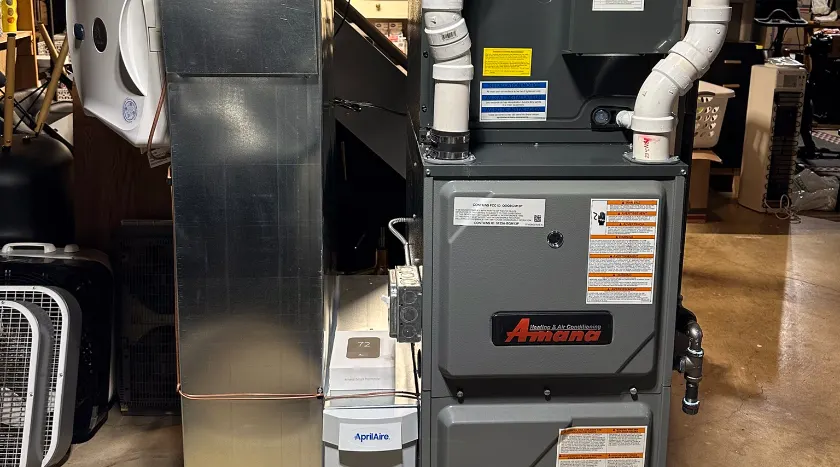
An Amana gas furnace with an AprilAire air filter, installed by our team.
- Not sized to the house, just “the same size as the old one” or a rule of thumb per square foot
- A return duct or filter cabinet too small for the new blower, so it runs loud and trips the limit
- PVC venting with no slope, sagging joints, or terminations buried under snow line
- Gas pressure never checked, blower speed left at factory default, no combustion readings
- Condensate draining into a bucket, or a pump with no overflow safety
- Mismatched furnace and coil that is not an AHRI-certified pairing
- No permit pulled, which becomes your problem when you sell the house
- The water heater left on an oversized chimney after the furnace moved to PVC
- No warranty registration, leaving you with the shorter unregistered term
Our crew is trained to avoid every one of these. Jeff Kerley is NATE certified in Gas Heating Installation and Air Conditioning Installation, EPA 608 Universal and NCI airflow trained; the team holds NATE Ready-to-Work and Daikin/Amana furnace and S-Series training. We are Amana Champions Club 2024 and 2025 and Daikin Inverter Champion 2024. Already have a furnace that was installed badly? Some of it can be corrected with a repair visit, and a tune-up will tell you how bad it is.
What Furnace Installation Costs
One written price, discount included, no surprise add-ons.
Installation pricing depends on the furnace’s size, stage and efficiency, the venting and condensate work, ductwork changes, gas line work, the thermostat, and your town’s permit and inspection fees. New-construction and conversion installs that need ductwork are priced from the duct design. We don’t publish a single installed price, because a furnace in a finished basement with a long vent run is a different job than the same furnace next to the rim joist.
What you get instead is a free in-home visit, a written quote that lists the exact model numbers and AHRI match, and the Nicor Gas instant discount already subtracted: $225 on a furnace rated 97% AFUE or higher, or $150 at 95% AFUE, and $275 or $200 with a qualifying smart thermostat on the same invoice. See Nicor Gas instant discounts.
Financing: prequalify in about 2 minutes with no impact to your credit score. On-bill financing is also available for qualifying equipment. After the install, the $240 maintenance plan keeps the furnace commissioned the way it left our hands, with a fall tune-up, a spring AC or heat pump tune-up, priority scheduling and 5% off services.
Installation or Replacement? And Where a Heat Pump Fits
Same crew, same standards. The words mean slightly different things.
Replacement is the decision: is your old furnace worth keeping, and what changes with a new one? Our furnace replacement page covers the 50% rule, age thresholds, the efficiency jump and disposal of the old unit.
Installation is the craft: the sizing, the equipment match, the venting, the gas and condensate work, and the commissioning readings. Whether the furnace is new to the house or taking the old one’s place, this is the part that determines how it runs for the next 15 to 20 years.
Dual-fuel is where the two meet with a heat pump. In northern Illinois a cold-climate inverter heat pump handles most of the heating season and the gas furnace takes over on the coldest days. The furnace and heat pump are installed as one matched, AHRI-certified system, and ComEd and Nicor Gas discounts each apply to their own equipment. We are a ComEd Heat Pump-Trained Contractor. See heat pump installation and our heat pump hub, or all furnace services.
Save With Nicor Gas Instant Discounts
As a Nicor Gas Contractor Circle Installing Member, we take the discount right off your invoice: $225 on a furnace rated 97% AFUE or higher, or $150 at 95% AFUE. Add a qualifying smart thermostat on the same invoice and it’s $275 or $200. See Nicor Gas instant discounts.
Installing a heat pump at the same time? Qualifying ducted heat pumps earn $900 to $2,000 from ComEd, off the invoice, on top of the furnace discount. See ComEd instant discounts. Note that St. Charles, Geneva and Batavia run their own electric utilities, so ComEd discounts aren’t available there.
Furnace Installation Across the Fox Valley
Based in Elgin, we serve homes throughout Kane, McHenry, DuPage and DeKalb counties.
- Elgin
- South Elgin
- St. Charles
- Aurora
- Bartlett
- Streamwood
- Huntley
- Plato Center
- Sycamore
- Carpentersville
- West Dundee
- East Dundee
- Algonquin
- Gilberts
- Hampshire
- Pingree Grove
- Campton Hills
- Geneva
- Batavia
- Barrington
- Hoffman Estates
- Schaumburg
- Burlington
- Marengo
- Wayne
- Sleepy Hollow
Don’t see your town? Call (847) 224-2420. View all service areas.
Furnace Installation FAQs
How long does a furnace installation take?
Most single-furnace installations are finished in one working day, including commissioning and the walkthrough. Dual-fuel systems, relocations, conversions from a boiler or new ductwork can add a day or more.
What is a Manual J load calculation and why does it matter?
Manual J is the ACCA method for calculating how much heat your home loses on the design day, based on its size, insulation, windows, orientation and air leakage. A Manual J load calculation is available as needed, on request, or where a municipality or utility program requires one, and to verify sizing on a borderline house; it may carry an additional cost.
What size furnace does my house need?
The size comes from the house itself, not from the old furnace’s label or square footage alone. Two similar-sized homes in Elgin can need different furnaces depending on insulation, windows and basement. We measure and calculate before quoting.
Do you pull permits for furnace installation?
Yes. Many Fox Valley municipalities require a mechanical permit for a furnace installation or replacement. We are municipally licensed in Elgin, Aurora, Bartlett, Huntley and Streamwood and file permits under our own license wherever required, and we schedule the inspection.
What does NATE certified mean?
NATE, North American Technician Excellence, is the leading independent certification for HVAC technicians. Owner Jeff Kerley holds NATE certifications in Gas Heating Installation and Air Conditioning Installation, and our technicians hold NATE Ready-to-Work credentials along with Daikin and Amana factory training.
What is AHRI matching?
AHRI certifies that a specific furnace, indoor coil and outdoor unit combination delivers its rated efficiency. A matched system keeps the manufacturer’s warranty valid and is required for ComEd heat pump discounts. We put the AHRI certificate number on your quote.
What does commissioning a furnace involve?
Setting manifold gas pressure with a manometer, running combustion analysis, setting blower speed to the rated temperature rise, measuring static pressure, and testing every safety switch. The readings go on your invoice so there is a record of how the furnace was left.
Can you install a furnace in a new addition or new construction?
Yes. We size the equipment and design the duct system from the plans, coordinate with your builder on rough-in, and install and commission the furnace once the space is closed in.
What venting does a high-efficiency furnace need?
A 95% or 97% condensing furnace vents through PVC pipe, usually out the rim joist, with a separate intake for combustion air and a drain for the condensate. If the old furnace shared a chimney with the water heater, that chimney is relined or resized so the water heater vents safely alone.
Can a furnace be installed in a closet, crawlspace or attic?
Yes, with the right orientation and clearances. We install upflow, downflow and horizontal configurations, and we design the venting, condensate route and service access around the space.
Do you install furnaces with heat pumps for dual-fuel?
Yes. We pair Amana and Daikin furnaces with cold-climate inverter heat pumps like the Amana S-Series R-32 and set the switchover so the cheaper fuel runs at each temperature. See heat pump installation.
What brands of furnace do you install?
We install Amana and Daikin gas furnaces, with AprilAire filtration and humidification options. We repair and service all major brands.
How much does a furnace installation cost?
It depends on the furnace, the venting, ductwork and gas line work, and your town’s permit, so we don’t publish one price. Quotes are free, written, and include the Nicor Gas instant discount, and financing is available with a 2-minute prequalification and no credit impact.
Do you register the warranty?
Yes. We register the furnace in your name at installation so the full registered parts and heat exchanger warranty terms apply from day one. Unregistered equipment often defaults to a shorter term.
Do I need a new thermostat with a new furnace?
Not always, but a two-stage or modulating furnace performs best with a thermostat that can control its stages, and a qualifying ENERGY STAR smart thermostat on the same invoice raises the Nicor Gas discount to $275 or $200. We’ll show you the options.
Will a new furnace work with my existing ductwork?
Usually, with some changes. Many older Fox Valley homes have return ducts and filter cabinets sized for a smaller blower. We measure static pressure and add return air or enlarge the filter cabinet where the numbers call for it, so the furnace can deliver its rated airflow.
What should I do to prepare for installation day?
Clear a path from the door to the furnace and a few feet around it, move anything stored on top of or against the old unit, and plan for the heat to be off for most of the day. We handle the rest, including the old furnace and the cleanup.
Can I finance a new furnace installation?
Yes. Prequalify in about 2 minutes with no impact to your credit score. The Nicor Gas discount lowers the amount you need to finance.
Installed Right the First Time
Request a free written quote with the Nicor Gas discount already figured in, or call to schedule an in-home visit.
Request a free quote, see financing options, or contact us with questions.
Discount amounts reflect the 2026 Nicor Gas Energy Efficiency Program for qualifying equipment installed January 1 through December 31, 2026, and are subject to change or cancellation due to funding limits. Rest Assured HVAC LLC is an independent contractor and is not affiliated with or endorsed by Nicor Gas.
Discount amounts reflect the 2026 ComEd Energy Efficiency Program for qualifying equipment and are subject to change or cancellation due to funding limits. Rest Assured HVAC LLC is an independent contractor and is not affiliated with or endorsed by ComEd.
