
Heat Pump Service
Heat Pump Maintenance & Tune-Ups in Elgin & the Fox Valley
A heat pump is the only piece of HVAC equipment in your house that works every month of the year. It cools you in July and heats you in January, and it never gets the eight-month rest an air conditioner gets. That’s why it needs a spring visit and a fall visit, and why our $240 maintenance plan covers both. We tune up every major brand, including cold-climate inverter systems.
- Spring and fall visits, both covered by the $240 plan
- Defrost, reversing valve and backup heat tested
- Refrigerant charge verified, not guessed
- ComEd Heat Pump-Trained Contractor
Signs Your Heat Pump Is Overdue for a Tune-Up
A heat pump rarely fails all at once. It loses a little capacity each season until one cold night it can’t keep up. Here’s what to watch for.
- It’s been more than a year. Two visits a year is the standard for a heat pump because it runs in both seasons.
- Auxiliary heat runs more than it used to. A heat pump that’s low on charge or has a dirty outdoor coil loses heating capacity, and the electric strips make up the difference on your ComEd bill.
- Longer run times in summer with less dehumidification. A dirty indoor coil or low airflow means the system runs long but pulls less moisture out of the air.
- Frost that takes a long time to clear. Defrost should finish in a few minutes. If the coil stays half-frosted for an hour, the defrost control or sensor needs a look.
- Ice under or around the outdoor unit. Defrost water should drain away. If it pools and refreezes into the base pan, the unit sits on its own ice by February.
- Cottonwood, leaves or grass clippings on the coil. Fox Valley cottonwood season in June can block a coil in weeks.
- Vibration, rattles or a fan that wobbles. Fan blades out of balance and loose panels get worse, not better.
- Thermostat shows the wrong stage or a fault code. Inverter systems log faults that don’t always shut the unit down.
- Bills creeping up year over year. A neglected heat pump can lose a noticeable share of its efficiency, and you pay for it every month, not just in winter.
What a Heat Pump Tune-Up Includes
Two visits, each built for the season the unit is heading into. Both are up to a $130 value on their own and both are included in the plan.
Fall visit
Defrost cycle check
We force a defrost cycle and time it. The board should shift the reversing valve, shut the outdoor fan off, warm the coil and return to heating within a few minutes. We check the coil sensor’s resistance against the manufacturer’s chart and confirm the termination temperature. A defrost that runs too often wastes heat; one that never runs builds a block of ice.
Fall visit
Reversing valve and backup heat
We cycle the reversing valve between modes and listen for a clean shift, then confirm the auxiliary heat stages on and off the way it should. On a straight electric system that means checking the strip heaters, sequencers and amp draw. On a dual-fuel system with a gas furnace, we verify the balance point and changeover so the furnace takes over at the right temperature and not sooner.
Both visits
Refrigerant charge
We measure suction and liquid pressures, superheat and subcooling, and compare them to the target for the outdoor temperature that day. A heat pump 10% low on charge loses far more than 10% of its heating capacity in cold weather. We don’t top off without finding out why it’s low.
Both visits
Coil cleaning
The outdoor coil gets rinsed from the inside out with coil cleaner so cottonwood, dust and grass don’t insulate it. Indoors we inspect the evaporator coil and the condensate drain, flush the drain line and treat it so it doesn’t clog in August.
Both visits
Electrical and mechanical
Capacitor microfarads compared to the rating, contactor points inspected, wiring connections tightened, fan and compressor amp draws recorded, crankcase heater checked in fall, disconnect and surge protection inspected. On inverter systems we pull the fault log and check the communication wiring.
Both visits
Outdoor unit clearance and drainage
We make sure the unit has clearance on all sides and above, sits level on its riser, and has a clear path for defrost water to drain. In winter, snow and ice packed against the coil starve the unit of air. We show you what to keep clear and what to leave alone.
Both visits
Airflow, filter and thermostat
Filter replaced or checked, blower wheel inspected, static pressure measured if we suspect a duct or filter restriction, and the thermostat’s heat pump settings confirmed so it doesn’t call for auxiliary heat when the heat pump could handle the load alone.
Why a Heat Pump Needs Both the Spring and the Fall Visit
A furnace gets one tune-up because it works one season. A heat pump works two, and the two seasons stress different parts.
Spring is about cooling capacity and moisture. Fox Valley summers are humid, and a heat pump in cooling mode is doing the same job as an air conditioner: pulling heat and water out of the house. Before the season, the outdoor coil needs to be clean, the charge needs to be right and the condensate drain needs to be open. A dirty coil that went unnoticed in April becomes a compressor running hot at 3 p.m. in July. Our AC tune-up page covers the cooling-side details, and everything on it applies to a heat pump too.
Fall is about the parts an AC doesn’t have. Defrost control, reversing valve, crankcase heater, backup heat and the thermostat logic that decides when to use it. None of those get exercised in summer, so a fall visit is the first time they’ve run since March. That’s when a stuck valve or a drifted sensor shows itself, in October, on our schedule, rather than in January at 5°F.
Cold-climate inverter systems need the fall visit most. A modern inverter heat pump like the Amana S-Series is designed to carry the house well below zero without backup. It only does that if the charge is exact, the coil is clean and the defrost logic is working. Small problems cost more on an inverter system because it runs longer hours at lower speed, and any lost capacity shows up directly as auxiliary heat on the bill.
Timing. We do spring tune-ups April through June and fall tune-ups September through November. Plan members get scheduled first, before the first-cold-snap rush that fills our calendar every October.
What to Expect on the Visit
Plan on about an hour, sometimes more for a system with a lot of history. You don’t need to do anything to prepare except clear a path to the indoor unit and the outdoor unit.
1. Indoor first. Thermostat settings, filter, blower, indoor coil, condensate drain and, on a dual-fuel system, a quick look at the furnace. We note anything that looks off before we head outside.
2. Outdoor unit off and open. Power off at the disconnect, panels off, coil rinsed, electrical connections and components tested, fan motor and blades checked, base pan and drainage inspected.
3. Run it. Power back on, amp draws and pressures recorded, superheat and subcooling calculated, defrost cycle forced in fall, reversing valve cycled, backup heat staged. We compare every number to what the manufacturer says it should be.
4. Report. You get the readings and a plain explanation. If a part is weak but working, a capacitor at the low end of its range, say, we tell you and give you a price to replace it now or later. No pressure, and nothing is replaced without your approval. If we find a real fault, plan members get 5% off the repair.
What Heat Pump Maintenance Costs
Two ways to do it. Either way, the price is flat and you know it before we arrive.
$240 / year
Semi-annual maintenance plan
Spring heat pump tune-up and fall heating tune-up (each up to $130 value), one free business-hours service call, priority scheduling and 5% off services. That’s up to $390 in services for $240. One plan covers a heat pump, or a heat pump and a furnace on a dual-fuel system.
One visit
Single tune-up
A one-time spring or fall tune-up at the standard flat rate. Good if you’re selling the house or just want a baseline on a system you inherited. If you decide on the plan afterward, we’ll credit the visit.
Any repairs
Approved before work
A tune-up is a tune-up. If we find a failing part we give you a flat-rate price for it and you decide. Parts and repairs are never added to a maintenance visit without your say-so. Larger repairs can be financed.
A heat pump that’s maintained on schedule tends to last toward the top of its 12-to-15-year range. One that isn’t tends to need a compressor around year eight. Two visits a year is the cheapest insurance on the most expensive appliance in the house.
Maintain It, or Is It Time to Replace?
Maintenance keeps a good system good. It can’t turn an old one new. Here’s where we draw the line.
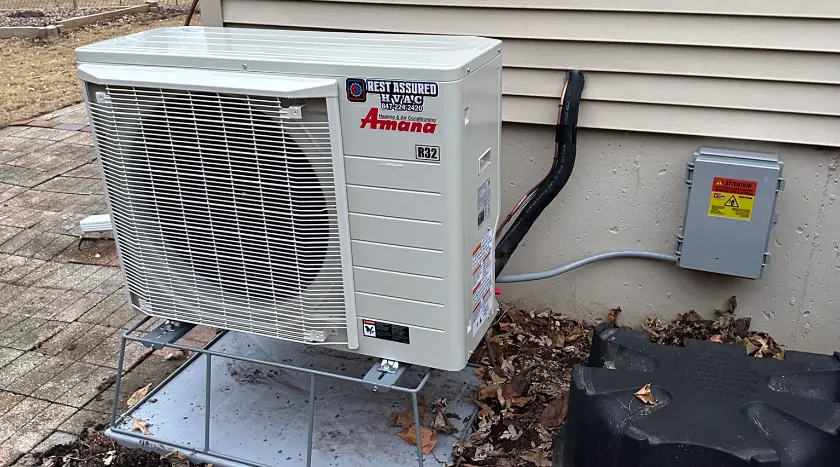
An Amana S-Series R-32 inverter heat pump installed by our team. A new cold-climate system, maintained twice a year, should carry a Fox Valley home through winter with little or no backup heat.
- Under 10 years old and holding charge: maintain it
- R-410A system with a slow leak: maintain it while you plan a replacement
- Over 12 years and needing a compressor or reversing valve: replace it
- Backup heat running most of the winter: a cold-climate inverter replacement will cut the bill
- R-22 system: replace it; refrigerant can’t be sourced economically
If a tune-up turns into a replacement conversation, we’ll walk you through heat pump replacement and the ComEd instant discounts, or through a dual-fuel setup with a new furnace. The installation is done by the same crew that maintains it. Ductless systems have their own page: ductless mini-splits.
Up to $390 in Services for $240 a Year
The semi-annual plan covers a heat pump: a spring cooling tune-up and a fall heating tune-up (each up to $130 value), one free business-hours service call, priority scheduling and 5% off services. If you have a dual-fuel system, the fall visit covers the furnace side too. See the maintenance plan.
Thinking about replacing an aging heat pump instead? ComEd instant discounts of $900–$2,000 on a qualifying ducted heat pump come off the invoice (St. Charles, Geneva and Batavia run their own electric utilities, so ComEd discounts aren’t available there). See ComEd instant discounts or request a free quote.
Heat Pump Maintenance Across the Fox Valley
Based in Elgin, we maintain heat pumps throughout Kane, McHenry, DuPage and DeKalb counties.
- Elgin
- South Elgin
- St. Charles
- Aurora
- Bartlett
- Streamwood
- Huntley
- Plato Center
- Sycamore
- Carpentersville
- West Dundee
- East Dundee
- Algonquin
- Gilberts
- Hampshire
- Pingree Grove
- Campton Hills
- Geneva
- Batavia
- Barrington
- Hoffman Estates
- Schaumburg
- Burlington
- Marengo
- Wayne
- Sleepy Hollow
Don’t see your town? Call (847) 224-2420. View all service areas.
Heat Pump Maintenance FAQs
How often should a heat pump be serviced?
Twice a year: once in spring before cooling season and once in fall before heating season. A heat pump runs year-round, so it needs both visits, unlike a furnace or air conditioner that works one season.
What does a heat pump tune-up include?
Coil cleaning, refrigerant charge verification, defrost cycle test, reversing valve check, backup heat test, electrical testing, condensate drain service, filter and thermostat check, and a written report of the readings.
Does the $240 maintenance plan cover a heat pump?
Yes. The plan includes a spring tune-up and a fall tune-up, which is exactly what a heat pump needs. It also includes one free business-hours service call, priority scheduling and 5% off services.
Is a heat pump tune-up different from an AC tune-up?
The spring visit is nearly identical. The fall visit is different: it tests the defrost control, reversing valve, crankcase heater and auxiliary heat, none of which an air conditioner has.
How long does a heat pump tune-up take?
About an hour for most systems. Dual-fuel systems and inverter systems with fault history can take a little longer.
Should I cover my heat pump in the winter?
No. A heat pump runs all winter and needs airflow through the outdoor coil. Never cover it. Keep snow and ice cleared from around it and off the top, and keep the drain path under it open.
Is it normal for my heat pump to frost over?
A light, even frost that clears during a defrost cycle every 30 to 90 minutes is normal. Thick ice, ice on the fan, or frost that never clears is not, and is one of the things a fall tune-up catches.
Can you maintain a heat pump you didn’t install?
Yes. We maintain all major brands of ducted and inverter heat pumps, no matter who installed them.
Do you service inverter and cold-climate heat pumps?
Yes. We install Amana S-Series inverter heat pumps and are a Daikin Inverter Champion, so we have the tools and training to service variable-speed systems properly.
What filter should I use with a heat pump?
Whatever your system was designed for, changed on schedule. Heat pumps move a lot of air year-round, so a restrictive filter hurts them more than it hurts a furnace. We’ll recommend a filter and a change interval at the tune-up.
Does maintenance keep my warranty valid?
Most manufacturers require regular professional maintenance to honor a parts warranty. Our tune-up records give you documentation if you ever need to make a claim.
Will maintenance lower my ComEd bill?
Usually. A clean coil and correct charge restore lost heating capacity, which means less auxiliary heat. The electric strips cost two to three times as much per hour as the heat pump does, so keeping them off matters.
When should I schedule the fall heat pump tune-up?
September through early November, before the first cold snap. Plan members are scheduled first, ahead of the October rush.
Do you check the furnace on a dual-fuel system?
Yes. The fall visit on a dual-fuel system covers the heat pump and the furnace, including the changeover settings that decide which one runs at a given outdoor temperature.
What should I keep clear around the outdoor unit?
About two feet on all sides and five feet above. Trim shrubs, keep grass clippings and leaves off the coil, and in winter keep snow from drifting against it or piling on top.
Can I do any heat pump maintenance myself?
Yes: change the filter, keep the outdoor unit clear of debris and snow, and rinse the coil gently with a hose in summer. Leave refrigerant, electrical and defrost testing to a technician.
Book Your Heat Pump Tune-Up
Schedule a spring or fall tune-up online, or call to join the $240 plan and get both visits, priority scheduling and 5% off repairs.
Have a question first? Contact us or read about the maintenance plan.
Discount amounts reflect the 2026 ComEd Energy Efficiency Program for qualifying equipment and are subject to change or cancellation due to funding limits. Rest Assured HVAC LLC is an independent contractor and is not affiliated with or endorsed by ComEd.
