
Heat Pump Service
Heat Pump Repair in Elgin & the Fox Valley
Heat pump blowing cold air in January, stuck in defrost, or running on emergency heat around the clock? We diagnose and repair every major brand of ducted and cold-climate inverter heat pump, and we tell you the price before we touch a part. As a ComEd Heat Pump-Trained Contractor, heat pumps are what we work on every day, not a sideline.
- 24/7 emergency heat pump repair
- All brands, including inverter systems
- Flat-rate pricing approved before work starts
- ComEd Heat Pump-Trained Contractor
Signs Your Heat Pump Needs Repair
A heat pump works in both directions, so it can fail in winter or summer. Some of what you see is normal. Some of it isn’t. Here’s how to tell the difference.
- Cold air from the vents in heating mode. Heat pump supply air is cooler than furnace air (often 90–105°F), but it should never feel like air conditioning.
- Auxiliary or emergency heat on constantly. If your thermostat shows AUX or EM HEAT for hours at a time in mild weather, the heat pump itself has quit and the electric strips are carrying the house.
- Outdoor unit encased in ice. A thin frost that clears every 30 to 90 minutes is normal. A solid block of ice on the coil, the fan or the top of the cabinet is not.
- No cooling in summer. The same compressor and refrigerant circuit run both seasons, so a summer failure is a heat pump repair, not a separate problem.
- Stuck in one mode. You switch from cooling to heating (or back) and nothing changes. That points at the reversing valve.
- Short cycling. The outdoor unit starts, runs a minute or two and shuts down again, over and over.
- Loud buzzing, grinding or a scream from the outdoor unit. Failing fan motors, a seized compressor or a bad contactor each make a distinct noise.
- Breaker trips. A heat pump that trips its breaker has an electrical fault, a compressor drawing locked-rotor amps or a shorted heat strip.
- Error codes on the thermostat or an inverter board. Inverter systems log fault codes. Write down the code before you reset it; it tells us where to start.
- ComEd bills up sharply with no change in weather. A heat pump quietly running on backup strips costs two to three times as much per hour as the heat pump does.
Is steam normal? Yes. When a heat pump runs a defrost cycle in cold, damp weather, the outdoor coil warms up and the frost melts off as a cloud of vapor. You may hear a whoosh as the reversing valve shifts. It looks alarming the first winter. It lasts a few minutes and the unit goes back to heating. Water dripping and refreezing under the unit is also normal, which is why we set new units on a riser so the drain path stays clear.
The Most Common Heat Pump Failures We See
Every part of an air conditioner is inside a heat pump, plus the parts that let it run backwards in winter. Those extra parts are where heat-pump-specific repairs come from.
Heat pump specific
Reversing valve stuck or leaking
The reversing valve is the four-way valve that flips the refrigerant flow between heating and cooling. Its solenoid can burn out, the slide can stick between positions, or it can leak internally. Symptoms: stuck in one mode, warm air in cooling, weak heat in both modes. A failed solenoid is a quick fix. A stuck or leaking valve body means recovering the refrigerant, brazing in a new valve and recharging.
Heat pump specific
Defrost board or sensor failure
The defrost control board reads an outdoor coil sensor and decides when to run defrost. When the sensor drifts or the board fails, the unit either never defrosts and builds solid ice, or defrosts constantly and never makes real heat. We test the sensor resistance against the manufacturer’s chart and replace the board or sensor, not both, unless both have failed.
Heat pump specific
Auxiliary heat running constantly
Backup electric heat is supposed to help during defrost and on the coldest days. If it’s on all the time, the cause is usually a thermostat wired or configured wrong, a failed outdoor unit, low refrigerant, or a balance point set too high. On a dual-fuel system with a gas furnace as backup, the same problem shows up as the furnace doing all the work. See our furnace repair page if the furnace side is the one acting up.
Inverter systems
Inverter board and communication faults
Variable-speed heat pumps like the Amana S-Series use an inverter board to drive the compressor and a communication bus between the indoor and outdoor units. Power surges, a corroded connector or a failing outdoor fan can throw fault codes. We read the codes, check DC bus voltage and compressor windings, and replace only what tested bad. Cheap surge protection on the disconnect prevents a lot of these.
Shared with AC
Capacitors, contactors and fan motors
The same weak points as any air conditioner. A swollen run capacitor keeps the compressor or fan from starting. Pitted contactor points chatter or weld shut. A condenser fan motor with bad bearings runs hot and quits on the hottest or coldest days. All are same-day repairs with parts on the truck.
Shared with AC
Refrigerant leaks and low charge
A heat pump low on charge will ice over in winter and cool poorly in summer. We find leaks with electronic detection and nitrogen pressure, repair the leak, pull a vacuum and weigh the charge back in. Older R-410A systems are getting expensive to recharge as that refrigerant is phased down, which is where the repair-or-replace conversation begins.
Shared with AC
Compressor failure
A compressor that won’t start, trips the breaker or has grounded windings is the most expensive repair on the list. On a unit under 10 years old with a parts warranty it can still make sense. On an older unit, replacement usually wins.
What to Expect on a Heat Pump Repair Visit
You get a real diagnosis, a written price and the choice to proceed. Here’s how the visit goes.
1. We listen first. When did it start, what did the thermostat show, did anything change (a power outage, a new thermostat, a storm)? Fault codes and what you saw outside save time.
2. Thermostat and indoor side. We confirm the call for heat or cooling is reaching the equipment, check the filter, the blower and the indoor coil, and make sure the air handler or furnace is doing its part. On a dual-fuel system we check the changeover settings so the furnace and the heat pump aren’t fighting each other.
3. Outdoor unit. Power at the disconnect, contactor and capacitor readings, fan and compressor amp draw, reversing valve operation in both modes, defrost sensor and board. On inverter systems we pull the fault history and check the inverter and communication wiring.
4. Refrigerant circuit. Suction and liquid pressures, superheat and subcooling, corrected for outdoor temperature. In cold weather the numbers are different from summer, and we know what they should be. Guessing here is how heat pumps get overcharged.
5. The price, in writing. We show you what failed, explain the fix, and give you a flat price. Nothing is replaced until you approve it. If the repair is large relative to the unit’s age, we’ll give you a replacement number too so you can compare.
6. Repair and verify. We make the repair, run the system in both heating and cooling, watch a full defrost cycle if conditions allow, and confirm temperatures and amp draws before we leave.
What Heat Pump Repair Costs
We charge a flat diagnostic fee to come out and find the problem. During office hours (9 a.m. to 5 p.m., Monday through Friday) the service call is $130; weekday evenings after 5 p.m. it is $180, and nights, weekends and holidays are $260. Each includes 30 minutes of travel and 30 minutes of diagnostics, and parts are extra. The repair is quoted separately, flat-rate, for you to approve before any work. Every repair is flat-rate and quoted before the work starts, so the price doesn’t change if a part fights us.
| Repair | Typical range in our area |
|---|---|
| Capacitor, contactor, defrost sensor | Low end of the $300–$1,400 range |
| Condenser fan motor, defrost control board | Middle of the range |
| Reversing valve solenoid | Low to middle of the range |
| Reversing valve body replacement | Higher; involves refrigerant recovery and brazing |
| Inverter board | Varies by brand; often covered under the manufacturer’s parts warranty |
| Refrigerant leak repair and recharge | Can run into the thousands on R-410A systems |
| Compressor replacement | Thousands; usually the repair-vs-replace line |
Capacitors, contactors and fan motors commonly land in the $300–$1,400 range, the same as air conditioners. Reversing valve and defrost control work is heat-pump-specific and priced in the same spirit. Refrigerant leak repair and compressor replacement can run into the thousands, and that’s where we sit down and compare repair against a new system with the ComEd discount taken off. Parts warranties matter here: many heat pumps still have manufacturer parts coverage if they were registered, and we check before quoting.
Need to spread the cost? Prequalify in about 2 minutes with no impact to your credit score. Maintenance plan members get 5% off every repair and one free business-hours service call a year.
Repair It, or Replace It?
An honest answer, not a sales pitch. Here’s the math we use.
The 50% rule
Repair cost vs. replacement cost
If a repair costs more than half of what a new system would cost after the ComEd discount, replacement almost always wins. Below that, repair usually makes sense on a unit under 10 years old.
Age
10 to 15 years
Heat pumps run year-round, so they wear faster than an AC that sits idle eight months a year. Past 12 years, a major repair on an R-410A unit is money into equipment on its way out.
Refrigerant
R-22 or R-410A
R-22 systems can’t be recharged economically. R-410A is being phased down and recharges get pricier every year. New equipment uses R-32, which is also what ComEd’s discount requires.
Performance
Backup heat carrying the load
If your old heat pump gives up above 25°F and the strips run the rest of the winter, a cold-climate inverter replacement can cut winter electric use substantially. See heat pump replacement.
If replacement is the right call, we’ll show you both a straight heat pump and a dual-fuel option with a gas furnace, and the installation is done by the same crew that does the repairs. Ductless mini-split repair is covered on its own page: ductless mini-splits.
Keep Repairs Off the Calendar
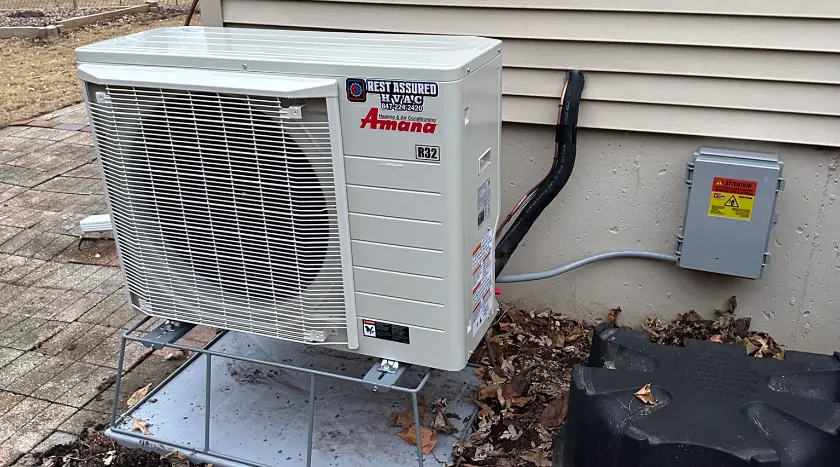
An Amana S-Series R-32 inverter heat pump installed by our team. Cold-climate inverter systems keep heating well below zero, and they need a technician who understands them when something goes wrong.
Most of the repairs on this page show up first as a small sign: a defrost sensor drifting, a capacitor reading low, a coil half blocked with cottonwood fluff. A heat pump runs in both seasons, so it needs both the spring and fall visits, not one or the other.
- Spring visit: cooling mode check, coil cleaning, refrigerant charge, electrical
- Fall visit: heating mode, defrost cycle, reversing valve, backup heat
- 1 free business-hours service call per year
- 5% off repairs and priority scheduling during the first cold snap
Maintenance Plan Members Come First
The $240-a-year plan covers a heat pump: a spring cooling tune-up and a fall heating tune-up (each up to a $130 value), one free business-hours service call, priority scheduling and 5% off repairs. That’s up to $390 in services for $240. See the maintenance plan.
Replacing instead of repairing? ComEd instant discounts of $900–$2,000 on a qualifying ducted heat pump come right off your invoice. See ComEd instant discounts.
Heat Pump Repair Across the Fox Valley
Based in Elgin, we repair heat pumps throughout Kane, McHenry, DuPage and DeKalb counties.
- Elgin
- South Elgin
- St. Charles
- Aurora
- Bartlett
- Streamwood
- Huntley
- Plato Center
- Sycamore
- Carpentersville
- West Dundee
- East Dundee
- Algonquin
- Gilberts
- Hampshire
- Pingree Grove
- Campton Hills
- Geneva
- Batavia
- Barrington
- Hoffman Estates
- Schaumburg
- Burlington
- Marengo
- Wayne
- Sleepy Hollow
Don’t see your town? Call (847) 224-2420. View all service areas.
Heat Pump Repair FAQs
Why is my heat pump blowing cold air in the winter?
The most common causes are a unit in defrost mode (normal for a few minutes), a stuck reversing valve, low refrigerant, or a thermostat calling for the wrong mode. If the air stays cold for more than 10 minutes and the auxiliary heat isn’t picking up, call us.
Is it normal for my heat pump to have steam coming off it?
Yes. During a defrost cycle the outdoor coil warms up and melts frost, which rises as vapor. It usually lasts 2 to 10 minutes and the unit returns to heating on its own.
My outdoor unit is covered in ice. What should I do?
A light frost is normal. A solid block of ice on the coil or fan is not, and running it that way can damage the fan and compressor. Switch the thermostat to emergency heat and call us. Do not chip at the ice.
What does AUX or EM HEAT on my thermostat mean?
Auxiliary heat is your backup electric strips (or gas furnace on a dual-fuel system) helping the heat pump. It’s normal briefly during defrost and on the coldest days. If it’s on for hours in mild weather, the heat pump has a problem.
Why is my heat pump running all the time?
Heat pumps are designed to run long cycles, and inverter models run almost continuously at low speed by design. If a single-stage unit never shuts off and the house isn’t reaching setpoint, suspect low refrigerant, a dirty coil or a reversing valve leaking internally.
Can you repair a heat pump you didn’t install?
Yes. We repair all major brands of ducted and inverter heat pumps, no matter who installed them.
Do you fix inverter and variable-speed heat pumps?
Yes. We are a Daikin Inverter Champion and install Amana S-Series inverter heat pumps, so we carry the tools and training to diagnose inverter boards and communication faults.
How much does a heat pump repair cost?
Common repairs like capacitors, contactors, fan motors and defrost sensors typically run $300 to $1,400. Reversing valve replacement, refrigerant leaks and compressors cost more. Every repair is quoted flat-rate before we start.
Is there a diagnostic fee?
Yes. We charge a flat diagnostic fee to find the problem, then quote the repair flat-rate for you to approve before any work. Maintenance plan members get one free business-hours service call per year.
Do you offer 24/7 emergency heat pump repair?
Yes. No-heat and no-cooling calls are answered around the clock at (847) 224-2420.
Should I turn my heat pump off if it’s not working?
If it’s iced over or making a grinding noise, yes, switch to emergency heat and shut the outdoor unit off at the breaker. For a unit that’s just underperforming, leave it in emergency heat so the house stays warm until we arrive.
What is a reversing valve and why does it fail?
It’s the valve that switches the refrigerant flow so the same system can heat or cool. The solenoid coil can burn out, or the slide inside can stick or leak. Symptoms are being stuck in one mode or weak performance in both.
Should I repair or replace my heat pump?
If the repair costs more than half the price of a new system after the ComEd discount, or the unit is over 12 years old and needs a compressor or refrigerant work, replacement usually wins. We give you both numbers.
Does a heat pump repair hurt my ComEd discount?
No. ComEd instant discounts apply to new qualifying heat pump equipment, so they only come into play if you decide to replace. Repairs don’t affect eligibility.
Can a bad thermostat make my heat pump run on emergency heat?
Yes. A thermostat that isn’t configured for a heat pump, or is wired with the O/B terminal wrong, can call the backup heat all the time. We check the thermostat setup on every repair visit.
Do you repair heat pumps in St. Charles, Geneva and Batavia?
Yes. We repair heat pumps throughout the Fox Valley. Those three towns run their own electric utilities, so ComEd discounts don’t apply there if you replace, but repair service is the same everywhere.
Heat Pump Not Keeping Up? Call Us.
Call any time for emergency heat pump repair, or book a repair or tune-up online. We’ll tell you what’s wrong and what it costs before we fix it.
Ready to replace instead? Request a free quote or see financing options.
Discount amounts reflect the 2026 ComEd Energy Efficiency Program for qualifying equipment and are subject to change or cancellation due to funding limits. Rest Assured HVAC LLC is an independent contractor and is not affiliated with or endorsed by ComEd.
