
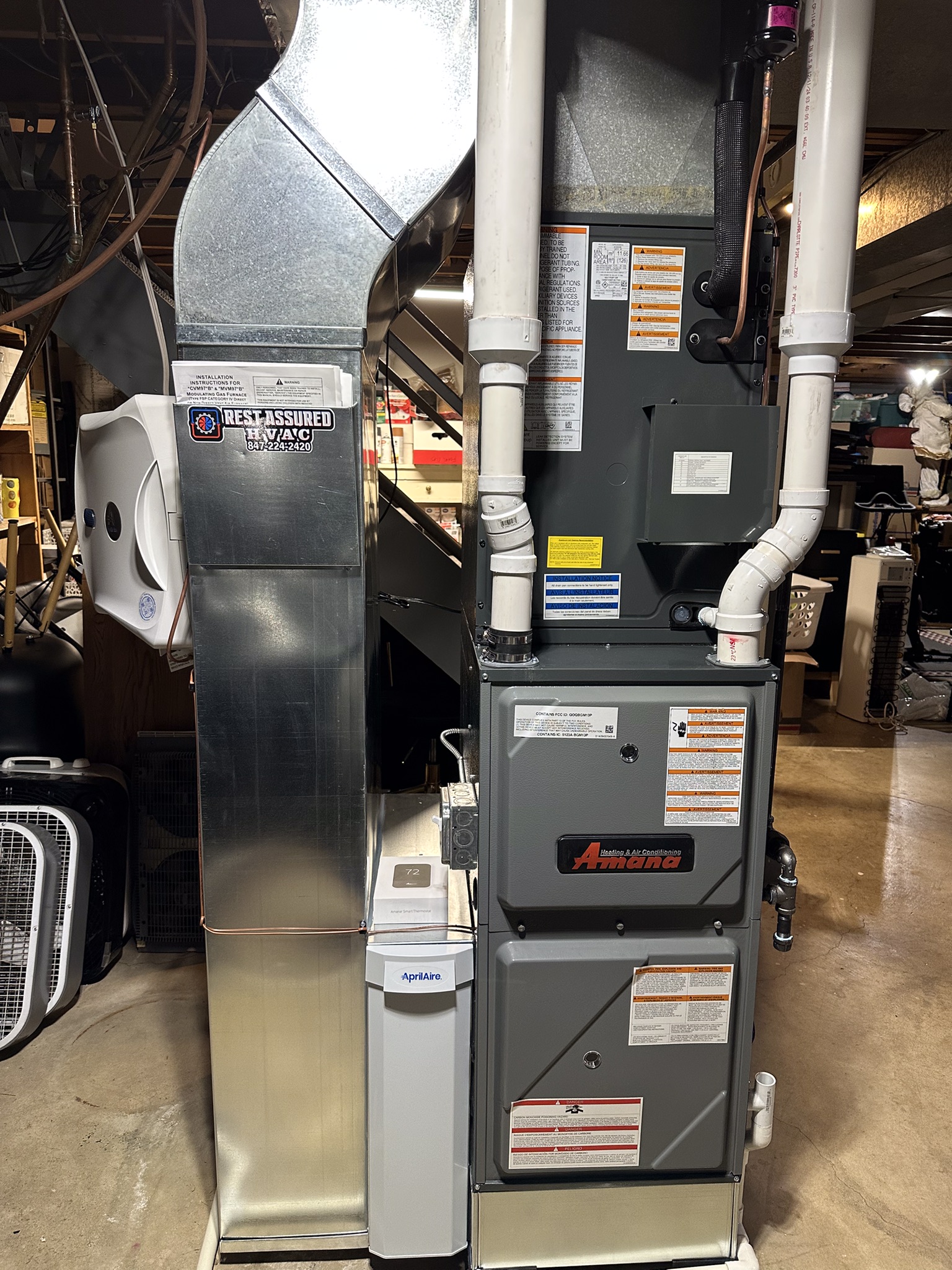
Most furnace repairs in the Elgin area typically run between about $300 and $1,800, parts and labor, with the cheapest fixes (a flame sensor, an igniter, a capacitor) at the bottom and blower motors, inducer assemblies and control boards toward the top. You pay a flat diagnostic fee to find the problem, then approve a flat-rate repair price before any work starts. During office hours (8 a.m. to 5 p.m., Monday through Friday) the service call is $130; weekday evenings after 5 p.m. it is $180, and nights, weekends and holidays are $260. Each includes 30 minutes of travel and 30 minutes of diagnostics, and parts are extra. Here is how that breaks down, what pushes a repair up the range, and when the smarter money goes toward a new furnace instead.
What the Diagnostic Fee Covers
Every furnace repair visit starts with a flat diagnostic fee. It covers the trip to your home and the time it takes a technician to find the actual fault, not the first thing that looks suspicious. On a typical no-heat call that means reading the fault code, watching a full ignition sequence, checking the filter and airflow, and testing the igniter, flame sensor, pressure switch, capacitor and gas valve.
When the cause is confirmed, you get a flat-rate repair price in writing. You approve it before we touch a part. If you decide not to repair, the diagnostic fee is all you owe, and you keep the written findings so you can make a replacement decision with real information. The diagnostic fee and the repair are two separate line items; we quote them that way so there are no surprises on the invoice.
Calls outside business hours are handled 24/7 through our emergency furnace repair service, and they are priced higher than a daytime visit. We tell you that price before anyone is dispatched, so you can decide whether tonight or tomorrow morning makes more sense.
The Most Common Furnace Repairs and Where They Fall
After enough winters in Kane, McHenry, DuPage and DeKalb counties, the same handful of parts show up on most invoices. The table shows where each one typically lands inside the $300–$1,800 range. Exact pricing depends on your furnace’s brand, model and age, which is why the number you approve is specific to your equipment.
| Repair | What it does | Where it falls |
|---|---|---|
| Flame sensor | Proves the burners lit so the gas valve stays open | Lower end |
| Hot surface igniter | Glows to light the burners on each cycle | Lower end |
| Run capacitor | Gives the blower or inducer motor its starting kick | Lower end |
| Pressure switch | Confirms the inducer is drafting before gas flows | Lower to middle |
| High limit switch | Shuts the burners off if the furnace overheats | Lower to middle |
| Inducer motor | Pulls combustion air through the heat exchanger and out the vent | Middle to upper |
| Control board | Runs the ignition sequence and every safety check | Middle to upper |
| Blower motor | Moves heated air through the ductwork | Upper end |
| Heat exchanger | Separates combustion gases from the air you breathe | Usually replacement |
A cracked or leaking heat exchanger is the one item that rarely makes sense to repair. The part is expensive, the labor is most of a day, and a furnace old enough to crack one is usually old everywhere else. That is the point where the conversation turns to furnace replacement.
What Pushes a Repair Toward the Top of the Range
Two furnaces with the same failed part can land at very different prices. These are the factors that move the number.
Biggest factor
Age of the furnace
A 20-year-old furnace often needs a part that is discontinued or only available from a single supplier. Sourcing takes longer and costs more, and one worn part is frequently sitting next to two others that are about to go. Newer furnaces use common, stocked parts.
Timing
Parts availability
Igniters, flame sensors, capacitors, pressure switches and limits ride on the van, so those repairs are usually finished the same visit. A brand-specific control board, inducer assembly or variable-speed blower module may be a special order, which adds a day or two and often adds cost.
Design
80% vs 90%+ furnaces
Older 80% AFUE furnaces are simpler: fewer sensors, metal venting, no condensate system. Condensing furnaces at 90%+ add a second heat exchanger, a condensate trap and drain, and more sophisticated controls. More parts means more things to diagnose, and some of those parts cost more.
Motor type
Standard vs variable-speed blowers
A single-speed PSC blower motor is an inexpensive, widely available part. An ECM or variable-speed blower delivers better comfort and efficiency, but its motor and module cost considerably more when they fail, which is why blower repairs span from the middle of the range to the top.
Schedule
After-hours calls
A no-heat call at 11 p.m. in January is priced higher than the same repair at 10 a.m. on a Tuesday. We quote the after-hours price before dispatch. If the house is holding temperature and no one is at risk, waiting for business hours is a legitimate way to save money.
The 50% Rule, and How the CY2026 Nicor Gas Discount Changes It
The rule of thumb we use is simple: if a repair costs more than half of what a new furnace would cost, replacement almost always wins. Below that line, age breaks the tie. A furnace under 10 years old gets repaired. A furnace between 10 and 15 gets the inexpensive repairs, but a big-ticket blower or board deserves a replacement quote alongside the repair price. Past 15 years, and certainly past 20, most large repairs are money spent on borrowed time.
The CY2026 Nicor Gas instant discount tilts that math a little further toward replacement when the repair is large. A qualifying furnace rated 97% AFUE or higher earns $225 off the invoice, and a 95% AFUE furnace earns $150. Add a qualifying smart thermostat on the same invoice and those numbers become $275 and $200. The discount is taken right off the invoice with no application to fill out. Details are on our Nicor Gas instant discounts page.
Put the two together. Say the repair quote on a 17-year-old 80% furnace lands near the top of the range. Half of a new-furnace price is the benchmark, but the discount effectively lowers the replacement side of the comparison before you ever count the gas savings from moving to a condensing furnace. Replacement quotes are free and written, and they include the discount, so you can put both numbers side by side.
- Repair when: the furnace is under 15 years old, the fix is a common part, and it has not had a string of other failures.
- Get both quotes when: the repair is a blower, inducer assembly or control board on a furnace 12 years or older.
- Replace when: the heat exchanger has failed, the repair passes the 50% line, or the furnace is 20+ and needs anything expensive.
Paying for It: Financing and the Maintenance Plan
A furnace does not fail on a convenient schedule. If a large repair or a replacement lands at a bad moment, you can prequalify for financing in about 2 minutes with no impact to your credit score, and spread the cost over monthly payments instead of taking it out of one paycheck.
The cheaper move is to make the repair less likely in the first place. Our semi-annual maintenance plan is $240 a year and includes a fall furnace tune-up and a spring AC or heat pump tune-up, each up to a $130 value, plus one free business-hours service call, priority scheduling during the first cold snap, and 5% off services. That is up to $390 in services for $240. A tune-up catches a weak igniter, a dirty flame sensor or a capacitor drifting out of spec in October, when the fix is a scheduled visit instead of a no-heat call in January.
Not Sure Whether to Repair or Replace?
We will fix almost any furnace, and we will tell you when we would not. If your repair quote lands near the 50% line, ask for a free written replacement quote on the same visit. It includes the CY2026 Nicor Gas discount and a real efficiency comparison against the furnace you have.
Start with our furnace repair and replacement overview to see how both paths work.
Furnace Repair Cost FAQs
How much does furnace repair cost in Elgin, IL?
Most common furnace repairs in our area typically run between about $300 and $1,800, parts and labor. Flame sensors, igniters and capacitors sit at the low end; blower motors, inducer assemblies and control boards at the high end. You approve a flat-rate price in writing before any work starts.
What does the furnace diagnostic fee cover?
It is a flat fee that covers the trip to your home and the time to find the actual problem. The repair is quoted separately, flat-rate, for you to approve. If you decline the repair, the diagnostic fee is all you owe.
Does an after-hours furnace repair cost more?
Yes. Calls outside business hours are priced higher than a daytime visit, and we quote that price before anyone is dispatched. If your home is holding temperature safely, waiting for business hours is a fair way to save money.
Which furnace repairs are the most expensive?
Blower motors, especially variable-speed ECM models, complete inducer assemblies and control boards are the most expensive common repairs. A cracked heat exchanger costs more than most of these and usually means replacement instead.
When should I replace my furnace instead of repairing it?
When the repair costs more than half of what a new furnace would cost, when the heat exchanger has failed, or when the furnace is 20 or more years old and needs an expensive part. The CY2026 Nicor Gas instant discount of $225 or $150 on a qualifying high-efficiency furnace makes replacement cheaper than it looks.
Can I finance a furnace repair or replacement?
Yes. You can prequalify in about 2 minutes with no impact to your credit score, and spread the cost of a large repair or a new furnace over monthly payments.
Get a Real Number, Not a Guess
Call for a diagnostic visit in Elgin and the Fox Valley, or book online and we’ll confirm your arrival window. You approve the price before we start.
Furnace past its prime? Request a free replacement quote or see financing options.
Discount amounts reflect the 2026 Nicor Gas Energy Efficiency Program for qualifying equipment installed January 1 through December 31, 2026, and are subject to change or cancellation due to funding limits. Rest Assured HVAC LLC is an independent contractor and is not affiliated with or endorsed by Nicor Gas.
Share this post
