Book your fall furnace tune-up in September, or early October at the latest. The first real cold snap in the Fox Valley usually lands in October, and the week it does, every furnace that sat idle since April gets switched on at once. The ones that fail fill our schedule with no-heat calls, and tune-ups get pushed. Booking now means your furnace gets a full inspection on a mild day, when a small problem is a cheap fix instead of a cold night.
Why September Beats October for a Furnace Tune-Up
It comes down to the calendar. Elgin winters run to design temperatures near 0°F, and furnaces here work hard from November through March. But the crunch starts earlier than that. When the first overnight low drops into the 30s, thermostats across Kane, McHenry, DuPage and DeKalb counties call for heat on the same morning. A furnace that has been off for five months either lights or it doesn’t, and the ones that don’t become emergency calls.
During that rush, furnace repair and no-heat calls take priority over maintenance, which is how a tune-up booked in mid-October ends up happening in November. In September the schedule is open, the weather is mild enough that a shutdown for testing costs you nothing, and if we find a part that is on its way out, you have weeks to deal with it instead of hours.
A tune-up is also where we catch the cracking igniter or coated flame sensor that becomes the first-cold-snap breakdown. Found in September, that’s a planned, business-hours repair. Found on a 28°F night in late October, it’s an emergency furnace repair call, which is priced higher than a daytime visit.
What the Fall Furnace Tune-Up Covers
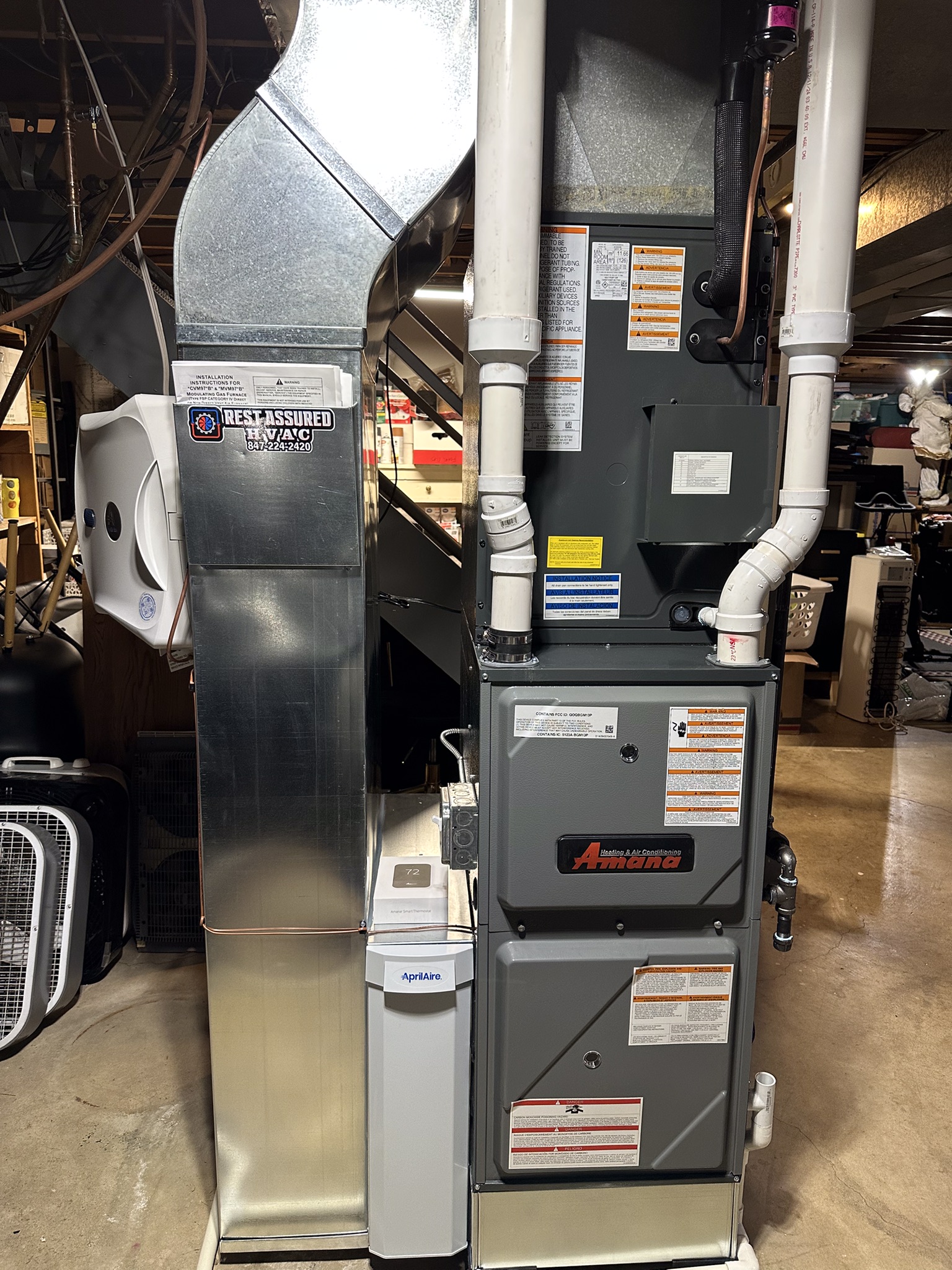
A tune-up is not a filter change and a thumbs-up. Here is what a technician does on a typical gas furnace in a Fox Valley basement, whether it’s an 80% unit from the 1990s or a 96% condensing furnace vented through the rim joist.
- Full ignition sequence. We watch the furnace start from a cold call: inducer, pressure switch, igniter, gas valve, flame proof, blower. Any hesitation in that sequence points at a part that will fail first.
- Flame sensor cleaned and tested. A thin oxide coating is the most common cause of a furnace that lights, runs for a few seconds and shuts down. Cleaning it is routine; measuring the flame signal tells us if it needs replacement.
- Hot surface igniter inspected. Igniters are brittle and fail without warning. We look for hairline cracks and check the resistance so a weak one gets replaced before it strands you.
- Heat exchanger inspection and combustion analysis. We inspect the exchanger for cracks and corrosion and run a combustion analyzer on the flue gases. The numbers tell us whether the furnace is burning cleanly and whether carbon monoxide is where it should be, which is in the vent and nowhere else.
- Gas pressure and burner check. Manifold pressure is set to the nameplate, burners are cleaned, and the flame is checked for the steady blue it should have.
- Blower and airflow. The blower wheel is checked for buildup, the capacitor is tested under load, and we measure static pressure across the furnace so we know the ductwork and filter aren’t choking it.
- Venting and condensate. On 90%+ furnaces the PVC intake and exhaust are checked for slope, blockage and joint integrity, and the condensate trap and drain line are flushed. A blocked trap is a common winter shutdown.
- Filter, thermostat and the humidifier water panel. A fresh filter, a check of the thermostat settings, and if you have a whole-home humidifier, the water panel gets replaced for the season on the same visit.
You get the findings in writing, including the combustion numbers and static pressure, and a clear list of anything that should be repaired now, watched, or left alone. See furnace maintenance for the full scope of the visit.
What a Tune-Up Catches Before It Becomes a Repair
Most of the no-heat calls we run in October and November trace back to a handful of parts, and most of those parts show symptoms before they fail. That is the whole point of doing the visit early.
Caught early
Igniter and flame sensor
The two most common no-heat parts. A tune-up either cleans them or flags them for replacement, at the low end of the repair range, on a day of your choosing.
Caught early
Weak capacitor
A capacitor testing below its rating will start the blower today and won’t next month. Swapping it at the tune-up beats a blower that hums and never spins.
Caught early
Blocked condensate or vent
Condensing furnaces shut down on a flooded trap or a snow-packed intake. Flushing the trap and checking the termination in September prevents the January call.
When a repair is needed, the pricing is straightforward: a flat diagnostic fee to find the problem, then a flat-rate repair price you approve before any work starts. Common furnace repairs in our area typically run $300 to $1,800. On a tune-up, the diagnostic work is already done, so you go straight to the quote.
How the $240 Maintenance Plan Works
If you would rather not think about it every fall, the semi-annual maintenance plan covers both visits for $240 a year: the fall furnace or air handler tune-up and the spring AC or heat pump tune-up. Each visit is up to a $130 value on its own. The plan also includes one free business-hours service call, priority scheduling and 5% off services, which adds up to as much as $390 in services for $240.
| What’s in the plan | What it’s worth |
|---|---|
| Fall furnace or air handler tune-up | Up to $130 |
| Spring AC or heat pump tune-up | Up to $130 |
| One business-hours service call | Included |
| Priority scheduling during the rush | Included |
| 5% off services | Included |
| Plan price | $240 per year |
Priority scheduling is the part plan members notice most in October. When the first cold snap hits and the phone is ringing, plan members move to the front of the line. Signing up in September puts the fall visit on the calendar before the rush rather than during it.
If the Tune-Up Turns Up a Bigger Problem
Sometimes the fall visit finds a cracked heat exchanger, or a furnace past 20 years old that needs a part at the top of the repair range. That is when it’s worth pricing a furnace replacement instead of the repair. A quote is free and written, and a qualifying high-efficiency furnace installed in 2026 gets a Nicor Gas instant discount of $225 at 97% AFUE or higher, or $150 at 95% AFUE, taken off the invoice. Add a qualifying smart thermostat on the same invoice and those become $275 or $200.
September is a good month for that decision too: the old furnace still runs, so there’s no pressure. If you’d rather spread the cost, you can prequalify in about 2 minutes with no impact to your credit score.
Add Humidity and Filtration to the Same Visit
Elgin winters dry a house out. If you’re adding a whole-home humidifier or upgrading to a media air cleaner, the fall tune-up is the natural time to do it, while the furnace is already open and the tech is already there.
See air purifier installation for the filter side of it.
Fall Furnace Tune-Up FAQs
When is the best time to schedule a furnace tune-up in Elgin?
September, or early October at the latest. The first cold snap usually hits in October and fills the schedule with no-heat calls, so tune-ups booked after that get pushed. Booking in September gets you a full inspection on a mild day.
What does a fall furnace tune-up include?
A full ignition test, flame sensor cleaning, igniter and capacitor checks, heat exchanger inspection with combustion analysis, gas pressure and burner adjustment, safety switch testing, blower and static pressure checks, venting and condensate service, a new filter and, if you have a humidifier, a new water panel.
How much does a furnace tune-up cost?
On the semi-annual maintenance plan, both the fall and spring tune-ups are covered for $240 a year, and each visit is up to a $130 value on its own. The plan also includes a free business-hours service call, priority scheduling and 5% off services.
Is a furnace tune-up worth it on an older furnace?
Yes, and arguably more so. Older 80% furnaces have more wear on the igniter, flame sensor and blower, and the heat exchanger inspection matters most on a furnace past 15 years. The visit tells you whether to keep running it or plan a replacement.
What happens if the tune-up finds a problem?
You get a flat-rate repair price in writing to approve before any work starts. Common furnace repairs in our area typically run $300 to $1,800. If the furnace is old and the repair is expensive, we’ll also quote a replacement so you can compare.
Do plan members get priority when it’s cold?
Yes. Priority scheduling is part of the maintenance plan, so when the first cold snap fills the calendar, plan members are scheduled ahead of the queue.
Get on the Calendar Before the Rush
Book your fall tune-up now and your furnace gets checked on a mild September day, not a cold October night. Call or book online in about a minute.
Want both seasons covered? See the $240 maintenance plan or request a free replacement quote.
Discount amounts reflect the 2026 Nicor Gas Energy Efficiency Program for qualifying equipment installed January 1 through December 31, 2026, and are subject to change or cancellation due to funding limits. Rest Assured HVAC LLC is an independent contractor and is not affiliated with or endorsed by Nicor Gas.
Share this post
