
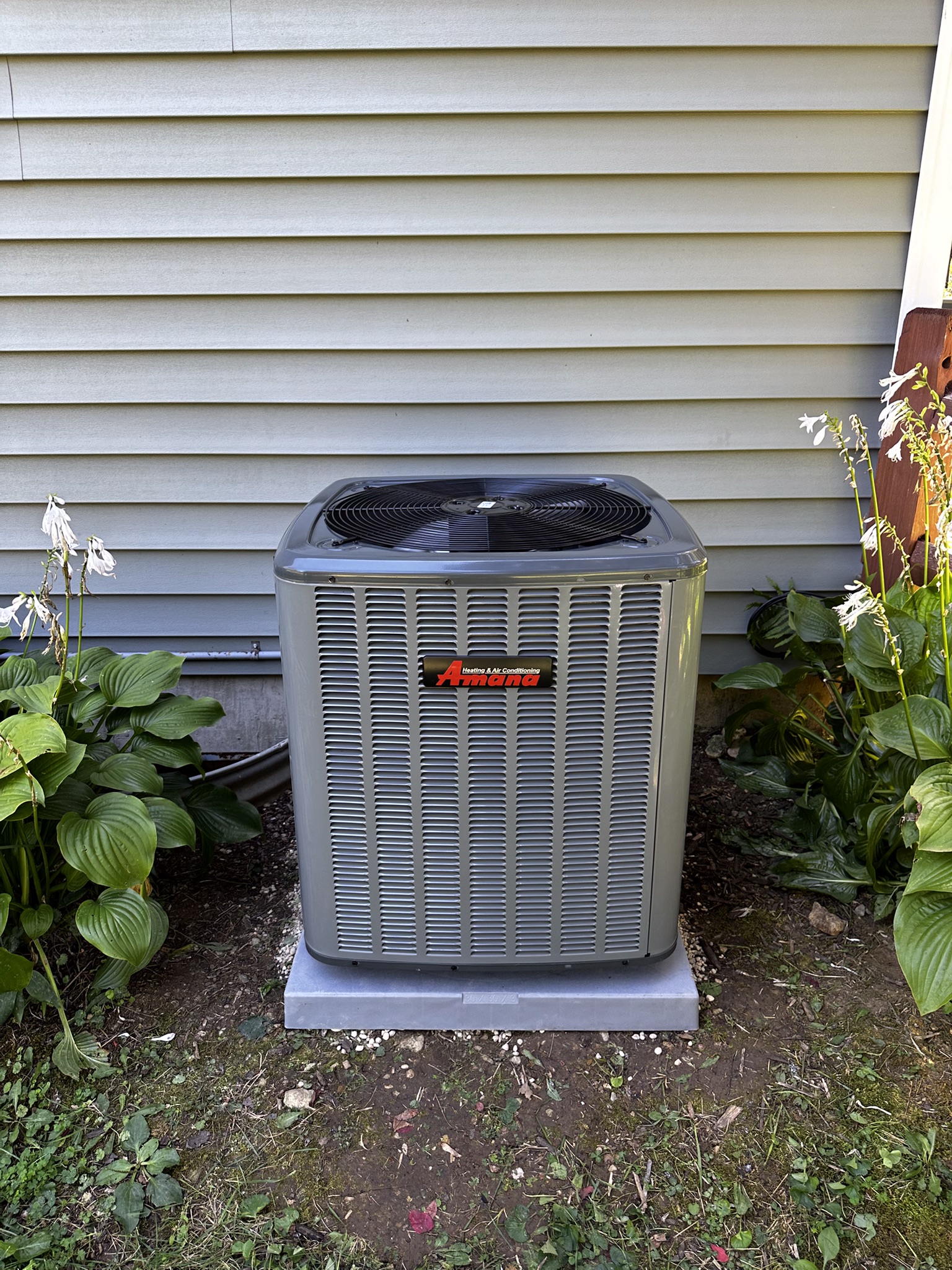
If your air conditioner is 10 or more years old, it almost certainly runs on R-410A, and R-410A is being phased down under federal rules that are pushing its price up every season. Older systems still on R-22 are in a tighter spot: that refrigerant is no longer produced at all. Neither fact means your AC has to go this August. It means that the next refrigerant leak is a decision point rather than a routine repair, and that the replacement side of that decision now includes R-32 equipment and, if you choose a heat pump, a CY2026 ComEd instant discount of $900 to $2,000.
Three Refrigerants, Three Situations
Refrigerant is the working fluid inside the sealed copper loop that carries heat out of your house. It does not get used up. In a system with no leak, the same charge stays inside for the life of the equipment, so the phase-down only matters on the day something leaks. Which refrigerant you have sets how expensive that day is.
| Refrigerant | Typical equipment age | Status in 2026 | What it means at a leak |
|---|---|---|---|
| R-22 | Installed before about 2010; 15+ years old | No longer produced; only reclaimed supply remains | Recharging is expensive and often not worth it on equipment this age; replacement is usually the answer |
| R-410A | Installed roughly 2010 to 2024; most systems 2 to 15 years old | Being phased down; still available, price rising | Small repairs still make sense; a large leak on an older unit starts the repair-vs-replace conversation |
| R-32 | New Amana and Daikin equipment we install | The current refrigerant for new residential systems | Standard supply and pricing for years to come; qualifies for CY2026 ComEd heat pump discounts (GWP under 700) |
You can find yours on the data plate of the outdoor unit; it will say R-22, R-410A (sometimes “Puron”) or R-32. If the unit predates 2010 and the plate is unreadable, assume R-22 until we confirm it.
What Doesn’t Change for an Older AC
Most of what fails on a 10-year-old air conditioner has nothing to do with refrigerant. Capacitors, contactors, condenser fan motors, blower motors, control boards and thermostats fail the same way on an R-410A system as on anything else, and they are repaired the same way. On an AC repair call you pay a flat diagnostic fee to find the fault and approve a flat-rate price before we start; common parts typically run $300 to $1,400 in our area, parts and labor. None of that is affected by the phase-down.
Routine service is not affected either. A tune-up verifies the charge by superheat or subcooling; it does not consume refrigerant. If anything, AC maintenance matters more now, because a leak caught while it is small, with the system still nearly full, is a far cheaper event than a system found empty in August. We also keep servicing R-22 equipment; we just cannot make the refrigerant cheap.
The Leak Is the Fork in the Road
A refrigerant leak on an older system used to be a straightforward call: find it, fix it, recharge, done. The phase-down changes the math on two of those steps. Here is how we walk through it at the kitchen table.
Step 1
Find the leak, not just the symptom
Adding refrigerant without finding the leak is money that evaporates, literally, and at 2026 R-410A prices it is a lot of money. We locate the leak with electronic detection, dye or nitrogen pressure testing before quoting anything. Where the leak is decides everything that follows.
Step 2
Price the repair honestly
A leak at a flare fitting or a Schrader valve is a small repair plus a recharge. A leaking evaporator coil or a condenser coil is a major part plus most of a day’s labor plus a full charge of increasingly expensive refrigerant. On an R-22 system, add reclaimed refrigerant at whatever the market says that week.
Step 3
Apply the 50% rule
If the leak repair plus recharge costs more than half of a comparable new system, replace. Below that, age breaks the tie: under 10 years, repair; 10 to 15, get both quotes side by side; past 15, or any R-22 system, a large leak is almost always the end.
Step 4
Count what a new system brings
A 2010 air conditioner at 13 SEER is doing real work against a modern 15 to 18 SEER2 system on R-32. Lower cooling bills, better dehumidification from a two-stage or variable-speed unit, and a refrigerant that will be standard and affordable for the equipment’s whole life all belong on the replacement side of the ledger.
What we will not do is tell you a working system has to be replaced because of a rule. If your 12-year-old R-410A system is charged, tight and cooling, run it. Our AC replacement page lays out the signs that it is actually time.
The Option Nobody Had 10 Years Ago: A Heat Pump
When an older AC does reach the end, you are replacing the outdoor unit and usually the indoor coil anyway. That is the moment to ask whether the outdoor unit should be a heat pump instead of a straight air conditioner. A heat pump cools exactly like an AC in summer, and in the other three seasons it heats by reversing the cycle. Modern cold-climate inverter models like the Amana S-Series R-32 heat pump keep heating well below zero, and paired with your existing gas furnace as a dual-fuel system, the heat pump carries the mild and cold months while the furnace takes over on the coldest nights.
The reason to think about it in August is the CY2026 ComEd instant discount. Qualifying ducted heat pumps earn $900 to $2,000 off the invoice depending on efficiency tier and heating capacity, with the full $2,000 available on a ducted heat pump of 2.5 heating tons or more. A qualifying ENERGY STAR smart thermostat installed with it adds $75. There is no application: as a ComEd Heat Pump-Trained Contractor we take it off the invoice. The equipment has to be AHRI-matched and use a refrigerant with a GWP of 700 or less, which is exactly what R-32 is. A straight R-32 air conditioner does not earn this discount; only the heat pump does. Details on our ComEd instant discounts page.
One local caveat: St. Charles, Geneva and Batavia run their own electric utilities, so the CY2026 ComEd discount is not available at those addresses. Everywhere else in our Kane, McHenry, DuPage and DeKalb service area on ComEd power qualifies. See heat pump installation for how the sizing, AHRI matching and commissioning work, and the heat pumps hub for the full lineup.
What to Do This August
Mid August is late in the cooling season, and the last thing most people want is a replacement project in the heat. You usually do not need one. Here is the sensible order of operations.
- Find your refrigerant. Check the outdoor data plate. R-410A systems under 12 years old with no history of leaks can be left alone.
- If it is cooling, keep cooling. A tight system on any refrigerant is fine to run. Schedule a tune-up next spring so the charge is verified before the season starts.
- If it needs refrigerant this month, get the leak found first. Then ask for the repair price and a free written replacement quote on the same visit, so the 50% rule works from real numbers.
- If it is R-22, start planning. Do not wait for the failure. Get a replacement quote this fall, when the schedule is open and you can compare an AC against a heat pump with the CY2026 ComEd discount included.
- Spread the cost if you need to. You can prequalify for financing in about 2 minutes with no impact to your credit score.
Replacement quotes are free, written, and include any instant discount the equipment qualifies for, so an AC and a heat pump can sit side by side on the same page. If you already have a heat pump that is on its way out, heat pump replacement covers the same decision from that side.
Leaking R-410A System? Get Both Numbers Before You Decide
Ask for the leak repair price and a free written replacement quote on the same visit. Our AC replacement and heat pump installation pages explain what each path involves.
Request a free quote or see the CY2026 ComEd heat pump instant discounts that apply to a qualifying R-32 heat pump.
R-410A Phase-Down FAQs
Do I have to replace my R-410A air conditioner?
No. The phase-down affects the supply and price of new R-410A refrigerant, not your right to run the equipment. A tight, working system can be serviced and repaired for years. The phase-down matters when the system leaks and needs a large recharge on top of an expensive repair.
Can I still get R-22 for my old AC?
R-22 is no longer produced; only reclaimed refrigerant is available, and it is expensive. We can still service R-22 equipment, but a significant leak on a system that age almost always makes replacement the better spend.
What refrigerant does new equipment use?
The Amana and Daikin air conditioners and heat pumps we install use R-32, a lower-GWP refrigerant that is now the standard for new residential systems. It qualifies for ComEd’s heat pump instant discount, which requires a refrigerant with a GWP of 700 or less.
Should I replace a leaking AC with a heat pump?
Often, yes, if you are on ComEd power. A qualifying ducted heat pump earns $900 to $2,000 off the invoice and cools exactly like an AC, and paired with your gas furnace as a dual-fuel system it also cuts winter gas use. A straight air conditioner does not earn the discount. St. Charles, Geneva and Batavia have their own electric utilities and are not eligible.
Is it worth recharging an older AC instead of replacing it?
If the leak is small and easy to fix and the system is under about 10 years old, yes. If the repair plus recharge costs more than half of a new system, or the unit is past 15 years or on R-22, replacement is the better use of the money. We give you both prices in writing so you can compare.
How do I know which refrigerant my AC uses?
Look at the data plate on the outdoor unit. It lists the refrigerant as R-22, R-410A (sometimes branded Puron) or R-32. Equipment installed before about 2010 is usually R-22; 2010 to 2024 is usually R-410A.
Find Out What Your AC Is Running On
Call or book online for a leak diagnosis or a free replacement quote in Elgin and the Fox Valley. You approve every price before we start.
Thinking heat pump? See the CY2026 ComEd instant discounts or prequalify for financing.
Discount amounts reflect the 2026 ComEd Energy Efficiency Program for qualifying equipment and are subject to change or cancellation due to funding limits. Rest Assured HVAC LLC is an independent contractor and is not affiliated with or endorsed by ComEd.
Share this post
