
March in Elgin is the in-between month: the furnace is still running most nights, but the first 60°F afternoon is a few weeks away, and the air conditioner has been sitting under a snow pile since October. This is the right time to get the cooling side ready, because the first hot week in May is when every AC in the Fox Valley gets switched on at once and the ones with a problem all call the same day. Here is a spring HVAC checklist you can do yourself in an afternoon, plus the part that needs a technician.
Inside the House: Filter, Thermostat and Vents
- Replace the furnace filter. It has been catching dust through a full heating season, and the same filter handles the air for the AC. A loaded filter is the most common reason a first-of-the-season cooling call ends with a frozen indoor coil. Write the date on the frame.
- Check the thermostat. Replace batteries if it takes them. If you have a smart thermostat, look at its schedule now rather than on the first hot day; the winter setback that saves gas at night will cost you sleep in June if it is still there. Leave the mode on Heat for now, but confirm Cool is available and the fan is set to Auto.
- Open every supply register and clear the returns. Cooling needs more airflow than heating to keep the indoor coil from icing. Move furniture and rugs off floor registers and check that basement registers were not closed for the winter.
- Look at the condensate drain. A 90%+ furnace and an AC share the same drain line in most Fox Valley basements. Make sure the line runs downhill to a floor drain or a condensate pump, the pump’s float moves freely, and there is no water on the floor around the furnace.
- Test the fan. Set the thermostat fan to On for a minute and confirm air moves at the registers in every room. A weak room now will be a warm room in July.
Outside: Give the Condenser Room to Breathe
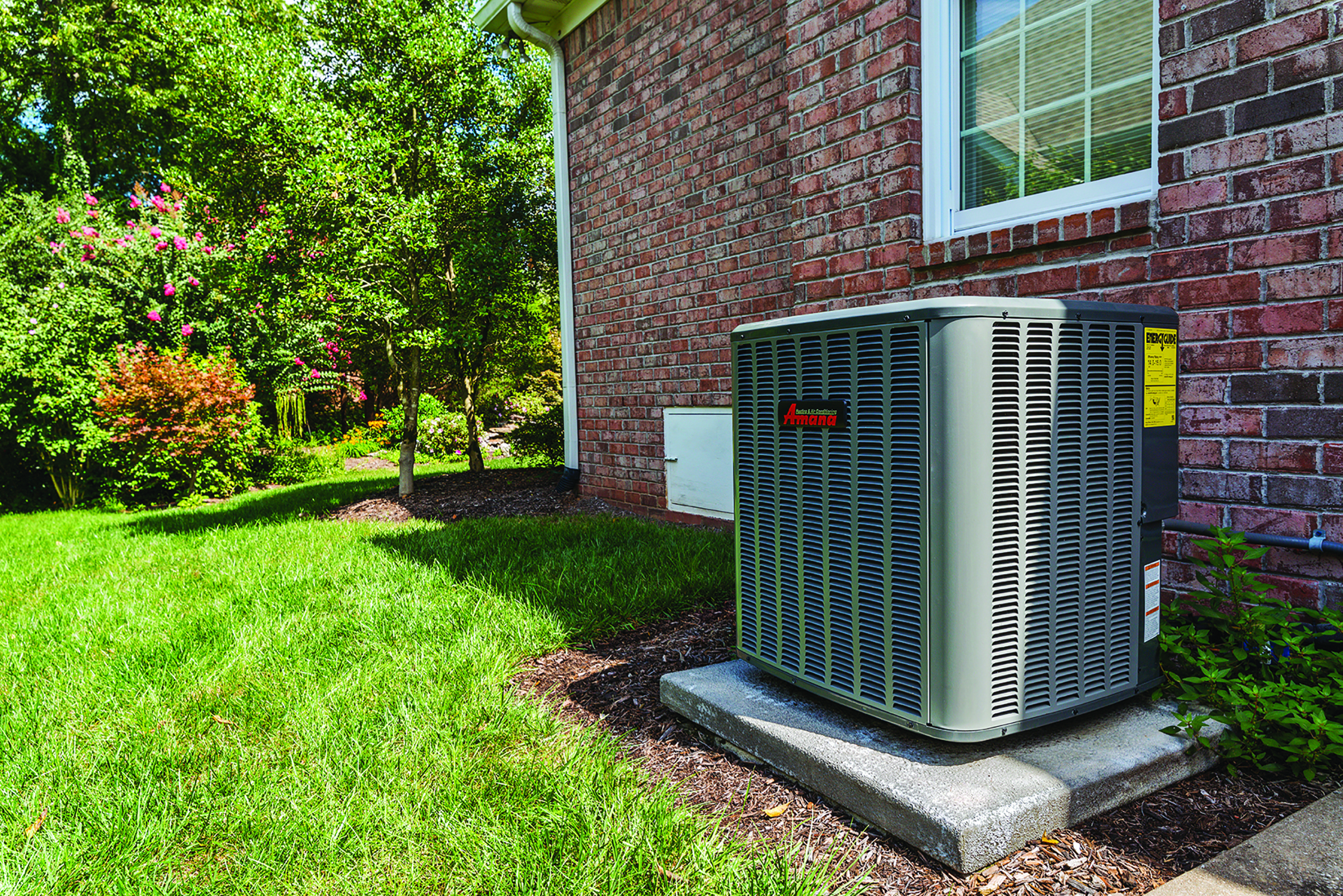
The outdoor unit spent the winter collecting leaves, seed pods and whatever the wind blew against the fence. It needs clear airflow on all sides to reject heat, and a coil packed with debris is the difference between an AC that keeps up on a 92°F day and one that does not.
- Pull the cover off if you used one, and do not run the unit with it on.
- Clear two feet around it. Trim shrubs back, rake out leaves, and move the grill, the garbage cans and the firewood. The top needs open sky, not a deck overhang.
- Rinse the coil gently with a garden hose from the inside out if you can reach it, or from the outside at low pressure. No pressure washer; it folds the aluminum fins flat.
- Check that it sits level. Frost heave can tip a pad over a winter. A unit leaning more than a few degrees puts strain on the compressor and the refrigerant lines.
- Look at the line set and the disconnect. The insulation on the larger copper line should be intact, not chewed or crumbling, and the disconnect box on the wall should be closed and dry.
Test the AC on a Mild Day, Not the First Hot One
Wait for an afternoon above 60°F. Below that, an air conditioner should not be run at all; the oil in the compressor is too thick and the refrigerant pressures are too low, and you can damage the compressor to save yourself a phone call. Once you have a mild day, switch the thermostat to Cool, set it three or four degrees below the room temperature, and let it run for 15 minutes.
Here is what you are listening and looking for. The outdoor fan should start within a minute of the indoor blower, and the air blowing out the top should be noticeably warm. At a supply register, the air should feel cool and dry; a temperature split of roughly 15 to 20 degrees between the return grille and a supply register is healthy. Any of the following means stop and call for AC repair rather than keep testing: a loud hum with no fan movement outside, a clicking or buzzing that repeats every few minutes, ice forming on the larger copper line, water running out of the furnace cabinet, or a breaker that trips. A capacitor that failed over the winter is the classic first-day-of-spring find, and it is a much cheaper repair in March than a compressor that was run against it through June.
If you heat and cool with a heat pump, the outdoor unit has been running all winter, so the test is about confirming it reverses into cooling. The same rules apply, and a spring heat pump tune-up covers the defrost control and reversing valve that a furnace-and-AC home does not have.
Shut the Humidifier Down and Change the Water Panel
If your furnace has a whole-home humidifier, March is the month to take it out of service. Once the AC starts running, the air conditioner is pulling moisture out of the house while the humidifier puts it back in, and the water panel sits wet and idle all summer growing whatever it grows.
- Turn the humidistat to Off or its lowest setting, and set a smart thermostat’s humidifier control to Off if it manages the humidifier for you.
- Close the bypass damper on a bypass model (AprilAire 500, 600 or 700 series), usually a lever marked Summer/Winter on the duct.
- Shut the water supply at the saddle valve or the inline shutoff.
- Replace the water panel. It should be changed once per heating season, and a panel that spent the winter collecting Elgin’s hard-water scale should not sit in the unit until October. We replace it at the fall visit for plan members; if you do it yourself, note the panel number on the old one.
A humidifier that ran all winter without the humidity ever really rising, dripped from the drain line, or left white scale on the furnace cabinet is worth a look; those are the usual humidifier repair calls. If you spent the winter with static shocks, cracked woodwork and dry sinuses, this is also the quiet season to plan a humidifier installation before next fall.
Schedule the Tune-Up Before the May Rush
Everything above is what a homeowner can do. What you cannot do without gauges and a meter is the part that actually prevents a breakdown. A spring AC tune-up cleans the outdoor coil properly, checks the refrigerant charge by superheat and subcooling instead of guessing, tests the capacitor and contactor under load, measures blower amp draw and static pressure, clears the condensate drain and trap, checks the temperature split, and inspects the line set insulation and electrical connections. A capacitor reading 10% below its rating in April is a scheduled part swap; in July it is a no-cool call during a heat wave.
The reason to book it in March or April is scheduling. From the first hot week in May through September, no-cool calls take priority, and tune-up appointments push out. Our semi-annual maintenance plan is $240 a year and includes this spring AC or heat pump tune-up and a fall furnace tune-up, each up to a $130 value, plus one free business-hours service call, priority scheduling and 5% off services. That is up to $390 in services for $240, and plan members get the spring visit booked before the rush by design.
While You’re at It: Air Quality and the Thermostat
Spring is when the house gets opened up and the pollen starts, so it is also the natural moment to look at the indoor air quality side. If you are still running a 1-inch filter, a media air purifier cabinet on the return catches far more at a lower pressure drop and lasts up to a year between changes. If the basement smelled musty last summer, a whole-home dehumidifier is the fix the AC alone cannot provide. And if the thermostat on your wall is a 20-year-old dial, a smart thermostat with a real cooling schedule pays for itself in comfort before the summer is out.
Air Conditioner 15 Years or Older?
If your spring test turns up a weak capacitor, a slow start or refrigerant that needs topping off on an AC from the R-22 or early R-410A era, ask for a free written replacement quote alongside the repair price. Spring is the one season when you can compare both numbers without sweating through the decision.
See how AC replacement works, or start with our air conditioning overview.
Spring HVAC Checklist FAQs
When should I turn my air conditioner on for the first time in spring?
Wait for an afternoon above 60°F. Running an AC in colder weather strains the compressor because the oil is thick and the refrigerant pressures are low. Test it for 15 minutes on a mild day in March or April so a problem shows up before the first hot week.
When should I schedule an AC tune-up in Elgin?
March or April. Once the first hot week hits in May, no-cool calls take priority and tune-ups push out. Maintenance plan members get priority scheduling for the spring visit.
Should I turn my furnace humidifier off in the spring?
Yes. Set the humidistat to Off, close the bypass damper if it has one, shut the water supply, and replace the water panel so it does not sit wet all summer. Turn it back on in the fall with the new panel.
Do I need to change my furnace filter before running the AC?
Yes. The AC uses the same filter and needs more airflow than the furnace did. A filter loaded from a full heating season is the most common reason an indoor coil freezes on the first hot day.
What does a spring AC tune-up include?
Outdoor coil cleaning, a refrigerant charge check by superheat and subcooling, capacitor and contactor testing under load, blower amp draw and static pressure, condensate drain and trap cleaning, temperature split, and an inspection of the line set and electrical connections.
Book Your Spring Tune-Up Now
Call to schedule an AC or heat pump tune-up anywhere in Elgin and the Fox Valley, or book online and we’ll confirm your arrival window before the May rush.
Want both seasons covered? See the semi-annual maintenance plan.
Share this post
