
Central Air Conditioning Service
AC Maintenance & Tune-Ups in Elgin & the Fox Valley
A spring AC tune-up is the cheapest cooling work you’ll ever pay for. We clean the coils, verify the refrigerant charge by superheat and subcooling, test the parts that fail in July and fix small problems before they cost you a compressor. Book a one-time tune-up or join our $240-a-year semi-annual maintenance plan.
- Real tune-up with measurements, not a rinse-and-go
- All brands maintained
- Refrigerant charge verified, not eyeballed
- Plan members get 5% off repairs and priority scheduling
Signs Your AC Is Overdue for Maintenance
Air conditioners don’t ask for attention until they fail. These are the early hints that a tune-up is overdue.
- It’s been more than a year. Manufacturers call for annual service, and most warranties assume it. Cottonwood, grass clippings and pollen pack the outdoor coil every spring.
- The outdoor unit looks furry. A matted coil can’t reject heat. Head pressure climbs, the compressor runs hot and your bill goes up before anything actually breaks.
- Cooling bills are creeping up. A dirty coil, a weak capacitor or a charge that’s a pound low all make the system run longer for the same result.
- The house is cool but sticky. High indoor humidity in July often traces to low airflow or a coil that isn’t running cold enough to pull water out of the air.
- Longer run times than last summer. If the system used to shut off by mid-afternoon and now runs into the evening, something has drifted.
- Weak airflow at the registers. A loaded filter, a dirty blower wheel or a matted indoor coil all show up as airflow first.
- Musty smell when it starts. Biological growth on a wet indoor coil or in a slow drain. It’s also a sign the drain is on its way to clogging.
- Water in the drain pan. Standing water means the condensate line is partly blocked. Fully blocked means a wet basement floor.
- A humming or hard start outdoors. A run capacitor that’s lost capacitance makes the compressor strain on every start. It will fail, usually on the hottest day.
None of these are emergencies today. Every one of them turns into an AC repair if it’s ignored through a Fox Valley summer.
What’s Included in Our Spring AC Tune-Up
A tune-up should produce numbers, not just a checkmark. Here’s what we do and why each step matters.
Outdoor unit
Condenser coil cleaning
We shut off power, remove the top and fan, and wash the coil from the inside out with a coil cleaner and low-pressure water so debris comes out the way it went in. A clean coil drops head pressure, lowers amp draw and is the single biggest efficiency gain in a tune-up. We also straighten fins where we can and clear vegetation to two feet of clearance.
Measured, not guessed
Refrigerant charge check
We connect gauges and a temperature clamp and calculate superheat on fixed-orifice systems or subcooling on TXV systems, then compare to the manufacturer’s target. Charge is adjusted only if the numbers say so. A system that’s low every spring has a leak, and we’ll tell you rather than top it off again.
July’s failures
Capacitor and contactor test
The run capacitor is tested with a meter and compared to its rated microfarads. Anything more than a few percent low gets flagged, because it will fail in the heat. We inspect the contactor for pitting and burned contacts and check for insects nesting inside it.
Water control
Condensate drain service
We flush the drain line, clear the trap, test the float or overflow switch and check the pan for rust. This is the step that keeps water off your basement floor and out of finished ceilings in August.
Indoor unit
Blower and evaporator coil
We inspect the indoor coil for dirt and biological growth, check the blower wheel and motor, measure motor amp draw and confirm the filter is the right size and installed correctly. A dirty blower wheel can cut airflow by a third.
Airflow
Static pressure and temperature split
We measure total external static pressure across the air handler and the temperature drop across the coil. High static tells us the duct system or filter is choking the blower. The split tells us the system is actually moving the heat it should.
Controls
Thermostat and electrical
We verify thermostat calibration and settings, tighten electrical connections at the disconnect and contactor, check the low-voltage wiring and fuse, and record compressor and fan amp draws against the nameplate.
You get a written report with the numbers: static pressure, temperature split, superheat or subcooling, capacitor readings and amp draws. Year over year, those numbers show us what’s changing before it fails.
What to Expect on a Tune-Up Visit
A thorough AC tune-up takes about an hour to an hour and a half. Here’s how it goes.
- Book for a warm day. Refrigerant readings are only meaningful when the outdoor temperature is above about 60°F. We schedule spring tune-ups from April on, and we’ll tell you if a cold snap means we should reschedule.
- We start indoors. Thermostat, filter, blower, indoor coil and drain. We run the system and take airflow and static pressure readings before touching anything outside.
- Outdoor unit next. Power off, cover off, coil cleaned, then electrical tests on the capacitor, contactor and wiring, followed by a visual check of the fan, the compressor terminals and the line set insulation.
- Run and measure. With everything back together, we run the system for 10 to 15 minutes and take refrigerant pressures, line temperatures, superheat or subcooling, amp draws and temperature split.
- We walk you through the results. Everything gets written down. If we find a part that’s weak but not failed, we’ll show you the reading, tell you what it means and quote the repair. You decide. Nothing is replaced without your approval.
If a repair is needed, plan members get 5% off, and the tune-up visit becomes the diagnostic, so there’s no separate diagnostic fee for a repair we find during maintenance.
What AC Maintenance Costs
Two ways to do it: a one-time tune-up, or the plan that covers both seasons.
A standalone spring AC tune-up is a flat price with no surprises. If we find a part that needs replacing, you get a flat-rate quote before any work, and you can say no. Common finds during a tune-up are a weak run capacitor, a pitted contactor or a drain that needs more than a flush, and those typically run $300 to $600 to fix.
$240 / year
Semi-annual maintenance plan
A spring AC or heat pump tune-up and a fall furnace or air handler tune-up, each up to a $130 value. One free business-hours service call. Priority scheduling ahead of non-members during the summer and winter rushes. 5% off repairs and services. That’s up to $390 in services for $240.
One time
Single spring tune-up
Everything listed above, once. A good fit if you’re selling the house, just moved in and want a baseline, or aren’t ready to commit to the plan.
Any brand
Older systems welcome
We maintain every major brand, including older R-22 systems. On those, we’re honest about what maintenance can and can’t do and when it’s time to talk about replacement.
The math is simple. A tune-up costs less than most repairs, and the repairs it prevents, a compressor, a fan motor or a flooded basement, cost far more than a decade of tune-ups.
Maintain, Repair or Replace?
Maintenance keeps a good system good. It won’t turn an old one young.
Regular maintenance is the biggest factor in whether a central AC lasts 10 years or 17 in our climate. But past a certain point, the tune-up report starts telling a different story: capacitors that need replacing every couple of years, a charge that’s low every spring, amp draws creeping up on the compressor. That’s when it’s worth running the numbers on replacement.
- Under 10 years old: maintain and repair. Almost every repair is worth making.
- 10 to 15 years: maintain, and weigh each repair against the 50% rule. If a repair costs more than half of a new system, replacement usually wins.
- Over 15 years, or any R-22 system: keep it maintained if it’s running well, but don’t put major money into it. Get a free replacement quote so you have the number before it fails.
A tune-up on an older system is still money well spent. It’s the difference between a planned replacement in April and an emergency one in the last week of July. And if you replace, a proper installation plus annual maintenance is how the next system reaches the top of its lifespan.
What You Can Do Between Tune-Ups
A few minutes a month keeps the system in the shape we left it.
- Check the filter monthly in summer. Hold it up to a light. If you can’t see through it, change it. A one-inch filter usually lasts one to three months; a four- or five-inch media filter lasts six months to a year.
- Keep two feet clear around the outdoor unit. Trim shrubs, pull weeds and keep the mower discharge pointed away from it. Cottonwood season in June is the worst for coil loading.
- Rinse the outdoor coil. With the power off at the disconnect, a gentle hose spray from the top down between our visits helps. Never use a pressure washer.
- Pour a cup of water down the condensate drain at the start of the season and watch that it flows. If it backs up, call before it overflows.
- Leave the thermostat alone. Big setbacks in summer make the system run flat out to catch up and pull humidity back in. A steady setting or a modest 2 to 3 degree setback is more efficient here.
- Don’t close supply registers to push air to other rooms. It raises static pressure and can freeze the coil. If a room never cools, tell us; that’s a duct or sizing problem we can look at.
If you hear a new noise, see ice or find water, shut the system off and call. Those are the three things that turn into a big repair when the system keeps running.
Why a Real Tune-Up Beats a Quick Look
The difference is in the measurements.
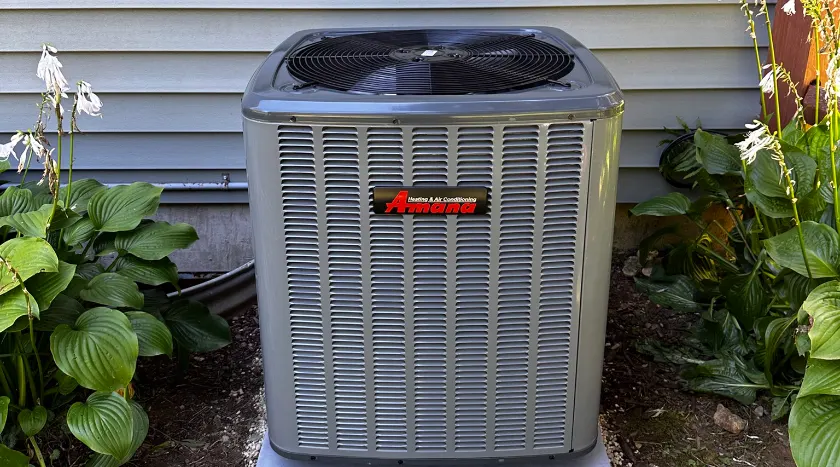
An Amana central air conditioner installed by our team. Annual maintenance is how a system like this reaches the top of its lifespan.
- Coil actually cleaned, not just rinsed from the outside
- Charge verified by superheat or subcooling against the manufacturer’s target
- Capacitor tested against its rating, not just checked for a bulge
- Static pressure and temperature split recorded
- Drain flushed and float switch tested
- Written report with the numbers, compared year to year
- Same team that repairs and installs, with EPA 608 Universal certification
Have a heat pump? The spring tune-up is the same visit. See heat pump maintenance.
Up to $390 in Services for $240 a Year
Our semi-annual maintenance plan covers your spring AC or heat pump tune-up and your fall furnace or air handler tune-up, each up to a $130 value, plus one free business-hours service call, priority scheduling and 5% off repairs. Most members never think about their HVAC again until we call to schedule. Join the maintenance plan.
Have a gas furnace too? The fall visit covers it. See furnace maintenance. Heat pump owners get the same spring and fall coverage. See heat pumps.
AC Maintenance Across the Fox Valley
Based in Elgin, we serve homes throughout Kane, McHenry, DuPage and DeKalb counties.
- Elgin
- South Elgin
- St. Charles
- Aurora
- Bartlett
- Streamwood
- Huntley
- Plato Center
- Sycamore
- Carpentersville
- West Dundee
- East Dundee
- Algonquin
- Gilberts
- Hampshire
- Pingree Grove
- Campton Hills
- Geneva
- Batavia
- Barrington
- Hoffman Estates
- Schaumburg
- Burlington
- Marengo
- Wayne
- Sleepy Hollow
Don’t see your town? Call (847) 224-2420. View all service areas.
AC Maintenance FAQs
How often should I have my AC serviced?
Once a year, in spring before the cooling season. Manufacturers recommend annual service, and most parts warranties assume it. Homes with heavy cottonwood, pets or dusty conditions benefit from a mid-season filter check too.
When is the best time for an AC tune-up in Elgin?
April through early June. Refrigerant readings need outdoor temperatures above about 60°F to be accurate, and booking early gets you ahead of the first heat wave when the schedule fills.
What’s included in your AC tune-up?
Condenser coil cleaning, refrigerant charge check by superheat or subcooling, capacitor and contactor testing, condensate drain flush and float switch test, blower and evaporator coil inspection, static pressure and temperature split measurement, thermostat check and electrical connection tightening, with a written report.
How long does an AC tune-up take?
About an hour to an hour and a half for a typical central system. Systems with heavily matted coils or a clogged drain take a little longer.
How much does an AC tune-up cost?
A one-time tune-up is a flat price. On our semi-annual plan, the spring AC tune-up and the fall furnace tune-up are both included for $240 a year, each valued at up to $130, along with a free service call, priority scheduling and 5% off repairs.
Is the maintenance plan worth it?
For most homes, yes. Two tune-ups alone are worth up to $260, and the free business-hours service call and 5% repair discount add up to $390 in services for $240. Priority scheduling during a July heat wave is the part members value most.
Does maintenance really prevent breakdowns?
It prevents the common ones. A weak capacitor, a dirty coil, a slow drain and a low charge are all caught on a tune-up, and those are behind most of the no-cooling calls we get. It won’t prevent every failure, but it changes the odds a lot.
Will a tune-up lower my electric bill?
Usually. A clean condenser coil and a correct refrigerant charge can cut cooling energy use noticeably compared to a neglected system, and a clean blower and filter reduce run time. The exact savings depend on how dirty the system was to begin with.
Can I clean my own AC condenser coil?
You can rinse the outside of the coil with a garden hose, from the top down, with the power off. A real cleaning means removing the top and washing from the inside out with coil cleaner, which is part of our tune-up. Never use a pressure washer; it bends the fins.
How often should I change the AC filter?
Every one to three months for a standard one-inch filter, and every six to twelve months for a four- or five-inch media filter like an AprilAire. Check it monthly in summer. A clogged filter is the most common cause of a frozen coil.
Do you check refrigerant during a tune-up?
Yes, by measuring superheat or subcooling and comparing to the manufacturer’s target, not just by looking at pressures. If the charge is off, we tell you why. A system that’s low every year has a leak, and we’ll say so rather than top it off.
Do you maintain air conditioners you didn’t install?
Yes. We maintain all major brands, including Carrier, Lennox, Trane, Goodman, Amana, Daikin, Rheem, York and Bryant, and older R-22 systems.
Does my new AC need maintenance to keep the warranty?
Most manufacturers require proof of annual maintenance to honor parts warranty claims. Our written tune-up report is that proof. Keep the reports with your equipment paperwork.
What if you find a problem during the tune-up?
We show you the reading, explain what it means and give you a flat-rate price for the repair before doing anything. Plan members get 5% off. Nothing is replaced without your approval.
Is it too late for a tune-up in July?
No. A mid-summer tune-up still cleans the coil and catches weak parts before August. Booking in spring is better, but a July tune-up beats skipping the year.
Should I maintain an AC that’s 15 years old?
Yes, as long as it’s running well. A tune-up keeps it going and gives you warning when it’s time to plan a replacement instead of facing an emergency. We’ll be honest if we think the money is better spent on a new system.
Do you service heat pumps too?
Yes. A heat pump’s spring tune-up is nearly identical to an AC tune-up, with a few extra checks on the reversing valve and defrost controls. The same plan covers it.
Book Your Spring AC Tune-Up
Book online in about a minute, or call and we’ll get you on the schedule before the heat arrives.
Ready to commit? Join the maintenance plan. Need a repair instead? See AC repair. Explore all air conditioning services.
