
Heat Pump Service
Heat Pump Installation in Elgin & the Fox Valley
A heat pump only performs the way the rating says if it’s sized to the house, matched to the right indoor unit, charged by weight and commissioned in both modes. That’s the work we’re trained for: ComEd Heat Pump-Trained Contractor, Daikin Inverter Champion 2024, NATE certified in air conditioning installation. We install cold-climate inverter heat pumps and dual-fuel systems in existing homes, additions and new construction across the Fox Valley.
- ComEd Heat Pump-Trained Contractor
- Daikin Inverter Champion 2024
- Manual J load calculation available on request
- Amana S-Series R-32 and Daikin inverter systems
Signs You Need a Proper Heat Pump Installation
Most heat pump complaints in our area trace back to how the system went in, not the equipment. Here’s what a poor installation looks like from the living room.
- Backup heat runs constantly below 30°F. A cold-climate unit sized by its heating load shouldn’t need the strips until well below zero. One sized off the old AC’s cooling tonnage usually does.
- Short cycling in summer. An oversized heat pump cools the air fast and shuts off before it pulls the humidity out. Fox Valley summers punish that.
- Icing that never clears. Undercharged systems and units set on the ground with no drainage build ice in the base pan.
- Loud outdoor unit. A unit set on an unlevel pad, against a wall or with the line set rubbing the cabinet transmits noise it shouldn’t.
- Thermostat that doesn’t know it’s a heat pump. Wrong O/B setting, no staging, no outdoor sensor. The system runs, but expensively.
- Furnace and heat pump fighting each other. A dual-fuel system with no balance point set runs both or neither.
- Breaker trips or lights dim on start. The electrical service wasn’t checked before a heat pump with electric backup was added.
- No permit, no inspection, no warranty registration. The manufacturer’s full parts coverage depends on registration within a set window.
- No AHRI match. An outdoor unit paired with whatever indoor coil was on the shelf loses efficiency and won’t qualify for the ComEd discount.
What Goes Into a Heat Pump Installation
Every one of these steps happens on every heat pump we install. Skipping any of them is how a good unit becomes a bad system.
Step 1
Measuring the house
We measure the house: square footage, window area and orientation, insulation, air leakage, ceiling heights, duct location. That produces a heating load and a cooling load in BTUs for an Elgin design temperature near 0°F. We never size off the old unit’s label or a rule of thumb per square foot. When the numbers are borderline, a permit or utility program requires it, or you ask for one, we run a full Manual J load calculation (there may be an additional cost).
Step 2
Sizing to the heating load
Air conditioners are sized to cooling. Heat pumps in northern Illinois are sized to heating, because that’s the bigger number. The heating capacity at 5°F and 17°F decides the model, and it also sets the ComEd tier: a ducted unit of 2.5 heating tons or more in the right efficiency tier earns the full $2,000 discount.
Step 3
Cold-climate rating and equipment selection
We select from cold-climate inverter models that maintain rated capacity at 5°F, such as the Amana S-Series R-32 and Daikin inverter systems. Single-stage heat pumps that give up at 25°F are the wrong tool here.
Step 4
AHRI-matched indoor unit
The outdoor unit and the air handler or coil are selected as a certified AHRI pair so the rated SEER2, HSPF2 and capacity are real. The AHRI certificate goes in your paperwork and is required for the ComEd discount.
Step 5
Electrical capacity
We check the panel, the service size and the available breaker space before quoting. A heat pump with electric backup strips can need a 60-amp circuit for the air handler. Dual-fuel systems with a gas furnace usually need much less. We tell you up front if the panel needs work.
Step 6
Line set, vacuum and weighed charge
R-32 needs the right line set diameter for the run length. If the old line set is undersized or can’t be flushed clean, we replace it. Every system gets nitrogen-purged brazing, a pressure test, a deep vacuum to 500 microns held to prove it’s tight, and refrigerant weighed in to the manufacturer’s spec plus the line-length adjustment.
Step 7
Commissioning
The system runs in cooling and heating while we record static pressure, airflow, temperature split, superheat, subcooling, amp draws and inverter data. On cold days we force a defrost cycle and watch it complete. The numbers go on the commissioning sheet you keep.
Dual-Fuel Setup With a Gas Furnace
Most heat pumps we install in the Fox Valley are paired with a gas furnace. Getting the handoff right is the difference between a system that saves money and one that doesn’t.
The balance point. A dual-fuel system needs an outdoor temperature at which the heat pump stops and the furnace starts. Set it too high and the furnace runs on days the heat pump could handle for less. Set it too low and the heat pump runs at reduced capacity while the house slowly loses ground. We calculate the economic balance point from the heat pump’s capacity curve, your ComEd and Nicor Gas rates and the house’s heat loss, and set it in the thermostat with an outdoor sensor. For most homes here it lands between 15°F and 30°F, and we can adjust it after the first winter.
The furnace side. The heat pump coil sits on top of the furnace, so the furnace blower has to move the right airflow for the heat pump in both modes. We confirm blower speed settings and static pressure. If the furnace is old, replacing it at the same time is often cheaper than doing it in two years, and the Nicor Gas discount applies to the furnace on the same invoice. See furnace installation and furnace replacement.
The thermostat. A dual-fuel system needs a thermostat that supports it, with an outdoor sensor, heat pump staging and a lockout for the furnace. We install and configure qualifying ENERGY STAR smart thermostats, which add $75 to the ComEd discount, and we set the O/B reversing valve terminal correctly, which is the most common wiring mistake we find on other installers’ work.
How Installation Day Goes
A straight heat pump installation is one day. Dual-fuel with a new furnace is a day and a half to two days. Here’s the sequence.
Before we arrive. The permit is filed under our own license where the municipality requires one, the AHRI-matched equipment is on the truck, and you have the written quote with the ComEd discount already taken off. Nothing changes on the day.
Morning. Floor protection down. Old equipment shut down and refrigerant recovered. Old outdoor unit, pad, disconnect and indoor coil or air handler removed. New composite pad or riser set level, high enough that defrost water and snow stay clear of the coil. New outdoor unit set, with clearance on all sides.
Midday. Indoor coil or air handler installed and sealed to the ductwork. Line set run, brazed under nitrogen, pressure tested. Condensate drain with trap and, where needed, a pump. Electrical: disconnect, whip, surge protection, and the air handler or strip heat circuit if applicable. Communication wiring between indoor and outdoor units on inverter systems.
Afternoon. Deep vacuum pulled and held. Refrigerant weighed in. Thermostat installed and configured for heat pump or dual-fuel operation. System commissioned in both modes with readings recorded. Walkthrough: thermostat, filter, what the defrost cycle looks like, what to keep clear outside.
After. Warranty registered with the manufacturer so your coverage starts now. Inspection scheduled where a permit was pulled. Your commissioning sheet, AHRI certificate and permit documents in one packet. The first maintenance visit is the following season, and the $240 plan covers both the spring and fall visits a heat pump needs. If anything ever does go wrong, the crew that installed it is the crew that repairs it.
What a Heat Pump Installation Costs
Every quote is free, written, and includes the ComEd discount. We don’t publish installed prices because the honest number depends on the house.
What moves the price: the heating load and therefore the size of the unit, whether it’s a straight heat pump with an air handler or dual-fuel with a furnace, whether the electrical panel needs a new circuit, whether the line set can be reused, the length of the line set run, and whether the ductwork needs changes to move the airflow a heat pump needs. What doesn’t move it: the day of the week, the season, or how urgent you are.
What comes off: $900–$2,000 in ComEd instant discounts on a qualifying ducted heat pump, $75 more with a qualifying smart thermostat, and the Nicor Gas furnace discount if a new furnace is part of a dual-fuel job. What you can spread out: the rest, through financing you can prequalify for in about 2 minutes with no impact to your credit score.
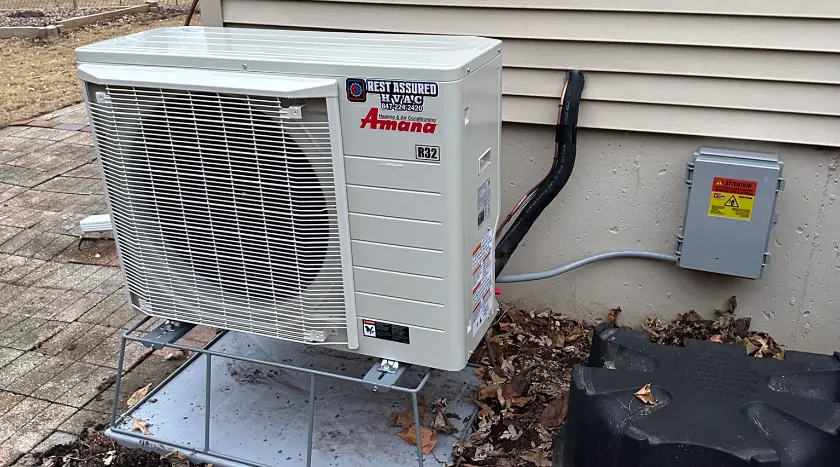
An Amana S-Series R-32 inverter heat pump installed by our team. Set on a riser, clearance on all sides, line set protected, disconnect and surge protection in place.
- Heating and cooling sizing to the house; Manual J load calculation available on request
- AHRI-matched cold-climate inverter heat pump and indoor unit
- New pad or riser, disconnect, whip and surge protection
- Line set sized for R-32, nitrogen-brazed, pressure tested, vacuumed to 500 microns
- Refrigerant weighed in to spec
- Thermostat installed and configured, dual-fuel balance point set
- Permit filed under our own license where required, inspection scheduled
- Commissioning in both modes with a written report
- Old equipment removed, refrigerant recovered, hauled away
- Warranty registration and your ComEd discount on the invoice
Replacing a worn-out heat pump? The repair-or-replace math and the discount details are on our heat pump replacement page. Adding heating and cooling to a room without ducts? See ductless mini-splits.
Who Does the Work
Training matters more on a heat pump than on any other piece of equipment in the house. Here’s ours.
ComEd
Heat Pump-Trained Contractor
We’ve completed ComEd’s heat pump contractor training, which is why we can take the instant discount off your invoice and why our installs are sized and documented the way the program requires.
Daikin
Inverter Champion 2024
Recognized by Daikin for inverter system installation. Inverter heat pumps need their own charging, wiring and commissioning procedures, and we do them on every job. See Daikin.
Amana
S-Series R-32 trained, Champions Club 2024 & 2025
Factory training on the Amana S-Series R-32 inverter heat pump line. See Amana.
NATE
Certified in AC installation
Owner Jeff Kerley holds NATE certification in Air Conditioning Installation and Gas Heating Installation, EPA 608 Universal, and NCI airflow training. The team holds NATE Ready-to-Work. We’re licensed, insured and bonded, and municipally licensed in Elgin, Aurora, Bartlett, Huntley and Streamwood.
ComEd Instant Discounts: $900 to $2,000 Off
As a ComEd Heat Pump-Trained Contractor, we take the discount right off your invoice: $900–$2,000 on a qualifying ducted heat pump depending on efficiency tier and heating capacity, up to $2,000 on a ducted unit of 2.5 heating tons or more. A qualifying ENERGY STAR smart thermostat we install adds $75. Requires AHRI-matched equipment and R-32 refrigerant, which every system we install meets. See ComEd instant discounts.
St. Charles, Geneva and Batavia run their own electric utilities, so ComEd discounts aren’t available there. Dual-fuel with a new furnace? The Nicor Gas discount applies to the furnace on the same job. See Nicor Gas instant discounts.
Heat Pump Installation Across the Fox Valley
Based in Elgin, we install heat pumps throughout Kane, McHenry, DuPage and DeKalb counties.
- Elgin
- South Elgin
- St. Charles
- Aurora
- Bartlett
- Streamwood
- Huntley
- Plato Center
- Sycamore
- Carpentersville
- West Dundee
- East Dundee
- Algonquin
- Gilberts
- Hampshire
- Pingree Grove
- Campton Hills
- Geneva
- Batavia
- Barrington
- Hoffman Estates
- Schaumburg
- Burlington
- Marengo
- Wayne
- Sleepy Hollow
Don’t see your town? Call (847) 224-2420. View all service areas.
Heat Pump Installation FAQs
Does a heat pump work in an Elgin winter?
Yes. Cold-climate inverter heat pumps maintain rated heating capacity at 5°F and keep heating below zero. We size them to the heating load, not the cooling load, so they carry the house on all but the coldest nights.
What is a Manual J load calculation and why does it matter?
It’s the industry-standard calculation of how much heating and cooling a house actually needs, based on its size, windows, insulation and air leakage. A Manual J load calculation is available as needed, on request, or where a municipality or utility program requires one, and to verify sizing on a borderline house; it may carry an additional cost.
Why do you size a heat pump to the heating load instead of cooling?
In northern Illinois the heating load is larger than the cooling load. Sizing to heating keeps backup heat off, and the heating capacity is also what sets the ComEd discount tier.
What is dual-fuel?
A heat pump paired with a gas furnace. The heat pump handles cooling and heating down to a set outdoor temperature, the balance point, and the furnace takes over below it. It’s the most common setup we install here.
What is a balance point and how do you set it?
It’s the outdoor temperature where the furnace takes over from the heat pump. We calculate it from the heat pump’s capacity, your electric and gas rates and the home’s heat loss, then program it in the thermostat with an outdoor sensor. Most homes here land between 15°F and 30°F.
Do I need a new electrical panel for a heat pump?
Not always. A dual-fuel system with a gas furnace usually needs only the outdoor unit circuit. An all-electric system with backup strips can need a 60-amp circuit for the air handler. We check the panel during the quote visit.
What is AHRI matching?
AHRI certifies specific outdoor and indoor unit pairs and their tested efficiency and capacity. We install only certified pairs, so the ratings are real and the system qualifies for the ComEd discount.
Why does the refrigerant charge have to be weighed?
Inverter heat pumps are sensitive to charge. A few ounces off costs capacity and can shorten compressor life. We weigh refrigerant in to the manufacturer’s spec, adjusted for line set length, then verify with superheat and subcooling.
Do you replace the line set?
When it needs it. R-32 needs the right diameter for the run length, and an old line set that can’t be flushed clean contaminates the new system. We check it during the quote visit and tell you either way.
How long does a heat pump installation take?
One day for a straight heat pump installation. A day and a half to two days for dual-fuel with a new furnace, or for jobs that need electrical panel work.
Do you pull a permit for a heat pump installation?
Yes. Many Fox Valley municipalities require a mechanical permit for equipment installation. We file it under our own license where required and schedule the inspection.
Can you install a heat pump in an addition or new construction?
Yes. We do sizing, duct design and equipment selection for additions and new homes. For a room without ductwork, a ductless mini-split is often the better fit.
What brands do you install?
Amana and Daikin, including the Amana S-Series R-32 inverter heat pump and Daikin inverter systems. We’re a Daikin Inverter Champion and hold Amana S-Series training.
Do you register the warranty?
Yes. We register the equipment with the manufacturer after installation so the full parts warranty is in effect, and we give you the confirmation.
Is the installation quote free?
Yes. We visit the home, measure, check the panel and ductwork, and give you a written quote with the ComEd discount included. No charge, no obligation.
Are NATE-certified technicians doing the installation?
Yes. Owner Jeff Kerley is NATE certified in Air Conditioning Installation and Gas Heating Installation, and the team holds NATE Ready-to-Work along with Daikin and Amana factory training.
Does the ComEd discount apply in St. Charles, Geneva or Batavia?
No. Those towns run their own electric utilities, so ComEd programs don’t apply there. We install the same equipment; the invoice just won’t include a ComEd discount.
What happens on the first cold day after installation?
The heat pump runs, and in damp cold weather you’ll see it run a defrost cycle: the outdoor fan stops, steam rises off the coil for a few minutes, then it goes back to heating. That’s normal, and we show you what it looks like at the walkthrough.
Get a Free Heat Pump Installation Quote
We’ll measure the house, size the system to its heating load, and give you a written price with the ComEd discount included. Call or request a quote online.
Request a free quote, see financing options or learn more about heat pumps.
Discount amounts reflect the 2026 ComEd Energy Efficiency Program for qualifying equipment and are subject to change or cancellation due to funding limits. Rest Assured HVAC LLC is an independent contractor and is not affiliated with or endorsed by ComEd.
