Repair it if the fix costs less than half of a new furnace and the furnace is under about 15 years old. Replace it if the furnace’s age multiplied by the repair cost comes out over about $5,000, or if the heat exchanger is cracked. That’s the math we show at the kitchen table on nearly every furnace call, and the rest of this post walks through it.
The Two Rules We Use on Every Furnace Call
Most homeowners just want a straight answer, so we start with two rules of thumb. Neither is perfect, but together they settle the majority of decisions without a spreadsheet.
Rule 1
The 50% rule
If the repair costs more than half of what a comparable new furnace would cost installed, replace. Below half, repairing is usually the better use of money. Furnace repairs in our area typically run $300 to $1,800, so most single repairs pass this test on their own. It’s the second and third repair in a season that fail it.
Rule 2
Age times repair cost
Multiply the furnace’s age in years by the quoted repair price. Over about $5,000, lean toward replacement. A $600 igniter-and-board repair on a 6-year-old furnace scores $3,600: fix it. The same $600 on a 16-year-old furnace scores $9,600: it’s time to talk about a new one.
Rule 3
The one that overrides both
A cracked heat exchanger on any furnace out of warranty means replacement. The exchanger is the part that keeps combustion gases out of your air, and swapping one on an older furnace costs nearly as much as a new unit with none of the efficiency gain.
How pricing works on the repair side: a flat diagnostic fee to find the problem, then a flat-rate repair price you approve before any work starts. After-hours calls are priced higher than business-hours calls and quoted before we dispatch. See furnace repair for the full rundown.
Repairs That Are Cheap Enough to Do on Any Furnace
Some parts are consumables. They wear out on a 4-year-old furnace and a 24-year-old furnace alike, and replacing them doesn’t say anything about the health of the rest of the unit. If one of these is the whole problem, fix it and move on, whatever the age.
- Hot surface igniter. The most common no-heat part in the Fox Valley. It’s brittle, it fails without warning, and it’s a quick swap.
- Flame sensor. A dirty or worn sensor makes the furnace light and shut down seconds later. Often a cleaning; sometimes a replacement. Either way it’s at the bottom of the price range.
- Blower capacitor. A weak capacitor makes the blower hum, start slowly or not start at all. Cheap part, quick fix, and it can save the blower motor if caught early.
- Pressure switch and hose. A cracked hose or a stuck switch stops the ignition sequence. Inexpensive unless the real cause is a blocked vent or a failing inducer.
- Thermostat and wiring faults. Dead batteries, a loose common wire, a mis-set staging option. Not really a furnace repair at all.
A fall tune-up catches most of these before the first cold snap. Our furnace maintenance visit cleans the flame sensor, tests the igniter and capacitor, and checks the pressure switch, and the semi-annual maintenance plan bundles it with the spring AC visit.
Repairs That Tip a 15-Year-Old Furnace Toward Replacement
These are the big-ticket parts. On a furnace under 10 years old they’re still worth fixing, and some may be covered by the parts warranty. On a furnace past 15, each one is a signal that the rest of the unit is at the same point in its life, and the age-times-cost rule usually says replace.
- Blower motor. The biggest labor-and-parts repair short of the exchanger. When the blower on a 15-plus-year furnace goes, the money is better spent on a new variable-speed furnace that moves air more efficiently.
- Inducer motor assembly. The small fan that pulls combustion gases through the exchanger. A noisy or seized inducer on an old furnace often comes with a corroded exchanger behind it.
- Control board. Boards on 15-plus-year furnaces can be hard to source, and a board failure on an otherwise tired unit rarely stays the only problem for long.
- Heat exchanger. Always replace the furnace. A cracked exchanger is a carbon monoxide risk, and we’ll shut the furnace down and show you the crack when we find one. Smell gas? Leave the house right away, call 911 from outside, and call your gas utility’s emergency line from outside before calling us.
The pattern to watch for is stacking: a capacitor this year, an inducer next year, a blower the year after. Three repairs in three winters on a 17-year-old furnace add up to more than the 50% rule allows, and you still have a 17-year-old furnace. That’s when we bring out the furnace replacement numbers.
The Decision Matrix
Here’s the whole thing on one table. Find your furnace’s age, then the column that matches the repair in front of you.
| Furnace age | Small repair | Large repair | Cracked heat exchanger |
|---|---|---|---|
| Under 10 years | Repair | Repair; check parts warranty | Replace, or warranty exchanger swap if covered |
| 10 to 15 years | Repair | Run the 50% rule and age-times-cost | Replace |
| 15 to 20 years | Repair, start planning replacement | Replace | Replace |
| 20+ years | Repair only if you must | Replace | Replace |
Small repair means igniter, flame sensor, capacitor, pressure switch or similar. Large repair means blower motor, inducer assembly or control board. If your furnace is 80% efficiency and 15 years old, slide one row down: the efficiency jump pays for part of the new unit, which changes the math.
The Efficiency Jump From 80% to 95–97%
Most of the furnaces we replace in 1960s to 2000s Elgin homes are 80% AFUE units. That means 20 cents of every gas dollar goes up the metal flue. A condensing furnace at 95% to 97% AFUE captures most of that by pulling extra heat out of the exhaust until water condenses out of it, which is why it vents through PVC pipe out the rim joist instead of the chimney and needs a condensate drain.
In general terms, that’s roughly 15 to 17 cents more of every gas dollar turned into heat in the house. On a furnace that runs hard from November through March, the gas savings are real, and they’re the reason a large repair on an old 80% unit is a weaker bet than the same repair on a 95% unit. Add a variable-speed blower and two-stage or modulating burners and the house is quieter and more even, too. What goes into the install itself is on our furnace installation page.
What a Replacement Day Looks Like
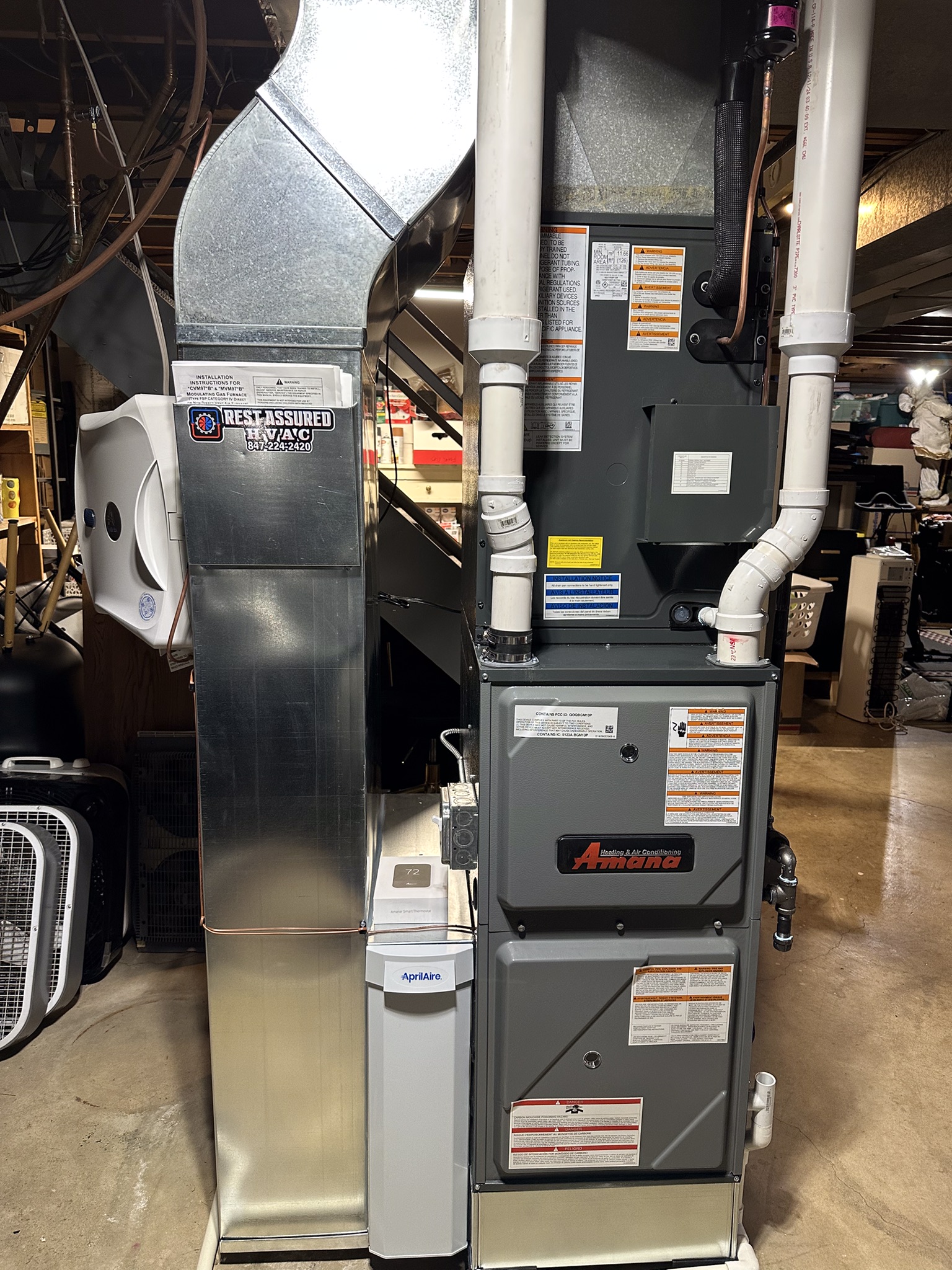
Most furnace replacements are one day. We shut off gas and power, disconnect and haul out the old furnace, and check the ductwork transitions and the filter rack while the basement is open. The new furnace is set and leveled, the gas line and electrical are connected and tested, and on a condensing furnace we run the PVC intake and exhaust through the rim joist and pipe the condensate to a drain or pump.
Then we commission it: measure gas pressure, temperature rise across the exchanger, static pressure and blower speed, and set up the thermostat staging. We pull the mechanical permit under our own license where the municipality requires it and schedule the inspection. You get the paperwork, the AHRI and discount documentation, and a walkthrough of the filter and the thermostat before we leave.
Nicor Gas Instant Discounts: $150 to $275 Off
As a Nicor Gas Contractor Circle installing member, we take the discount straight off the invoice: $225 on a qualifying furnace at 97% AFUE or higher, $150 at 95% AFUE. Add a qualifying smart thermostat on the same invoice and those become $275 and $200. No application. See Nicor Gas instant discounts.
Want to spread the cost? Financing lets you prequalify in about 2 minutes with no impact to your credit score, and on-bill financing is another route for qualifying homeowners. Every replacement quote is free, written, and shows the discount.
Furnace Repair or Replace: FAQs
What is the 50% rule for furnace repair or replacement?
If a repair costs more than half of what a comparable new furnace would cost installed, replace the furnace. Most single repairs in our area, typically $300 to $1,800, pass the test. It’s repeated repairs on an old furnace that fail it.
How does the age-times-repair-cost rule work?
Multiply the furnace’s age in years by the repair quote. Over about $5,000, lean toward replacement. A $600 repair on a 6-year-old furnace is $3,600, fix it. The same repair on a 16-year-old furnace is $9,600, and it’s time to price a new one.
Which furnace repairs are worth doing no matter how old the furnace is?
Igniters, flame sensors, capacitors, pressure switches and thermostat fixes. They’re consumable parts at the low end of the price range, and replacing one doesn’t say anything about the rest of the furnace.
Should I replace a 15-year-old furnace or repair it?
For a small repair, fix it and start planning. For a blower motor, inducer or control board, the age-times-cost math usually says replace, especially on an 80% furnace where the efficiency jump pays for part of the new unit. A cracked heat exchanger means replace regardless.
Can a cracked heat exchanger be repaired?
Not on a furnace out of warranty. The exchanger keeps combustion gases out of your air, and swapping one on an older furnace costs nearly as much as a new furnace with none of the efficiency gain. We shut the furnace down and show you the crack.
How much does a new furnace cost?
We don’t publish installed prices because size, efficiency, venting and ductwork vary house to house. Every quote is free, written, and includes the Nicor Gas discount and financing options, so you can compare it to the repair number directly.
Get the Numbers for Your Furnace
No heat right now? Call for 24/7 emergency furnace repair. Weighing a repair against a new furnace? We’ll give you both prices, side by side.
Request a free quote, see financing options or learn about furnace replacement.
Discount amounts reflect the 2026 Nicor Gas Energy Efficiency Program for qualifying equipment installed January 1 through December 31, 2026, and are subject to change or cancellation due to funding limits. Rest Assured HVAC LLC is an independent contractor and is not affiliated with or endorsed by Nicor Gas.
Share this post
