
Central Air Conditioning Service
AC Repair in Elgin & the Fox Valley
Warm air from the vents, ice on the refrigerant line or an outdoor unit that won’t start? We diagnose and repair central air conditioners of every major brand, with a flat-rate price approved before any work begins. Same-day and 24/7 emergency air conditioning repair for homes in Kane, McHenry, DuPage and DeKalb counties.
- 24/7 emergency AC repair
- All brands repaired
- EPA 608 Universal certified owner on every refrigerant job
- Flat-rate price approved before work starts
Signs You Need AC Repair
An air conditioner rarely quits without warning. If you notice any of these, call before a small fault turns into a compressor.
- Warm air from the vents. The blower runs but the air isn’t cold. That usually points to the outdoor unit, the refrigerant charge or a frozen coil.
- Ice on the coil or the line set. Frost on the copper line at the outdoor unit or ice on the indoor coil means airflow or refrigerant is off. Shut the system off and call us; running it on ice can flood the compressor.
- Tripped breaker. If the AC breaker trips once, reset it. If it trips again, stop. A failing compressor, a shorted fan motor or a bad capacitor pulls too much current.
- Outdoor unit not running. The indoor blower is on but the condenser fan and compressor are silent. Common causes are a failed capacitor, a burned contactor or a tripped high-pressure switch.
- Water around the air handler. A puddle near the furnace or air handler in the basement usually means a clogged condensate drain or a cracked drain pan.
- Short cycling. The system starts, runs a few minutes and shuts off, over and over. That’s hard on the compressor and never gets the humidity out of the house.
- High humidity indoors. The thermostat hits its setpoint but the house feels sticky. Oversizing, low airflow or a low charge can all cause it.
- Loud outdoor unit. Grinding points to fan motor bearings. Buzzing that stops when the unit shuts down is often a contactor or capacitor. A hard-starting compressor makes a loud hum and then clicks off.
- Cooling bills climbing with no change in use. A dirty condenser coil, a weak capacitor or a low charge all make the system run longer for the same result.
- The system won’t turn on at all. Check the thermostat batteries and the breaker first. If both are fine, the fault is usually a safety switch, a low-voltage fuse or a control board.
Elgin summers are humid, and the cooling season here runs from May into September. A system that struggles in June will not get better in July. Most of the repairs we make in August are problems that first showed up in spring.
The Most Common AC Failures We See
Central air is a simple system with a handful of parts that carry most of the load. These are the ones that fail most often in the Fox Valley, and what we do about each.
Most common
Failed run capacitor
The capacitor gives the compressor and condenser fan motor the push they need to start and keep running. Heat and age wear it out. Symptoms are a humming outdoor unit, a fan that won’t spin unless you push it, or a compressor that clicks and quits. We test it under load with a meter and replace it with a correctly rated part, not a close-enough one.
Cheap to fix
Burned contactor
The contactor is the relay that sends power to the outdoor unit when the thermostat calls. The contacts pit and burn over the years, and ants and spiders love to get inside it. A stuck contactor keeps the compressor running with the thermostat off. A failed one means nothing runs. We replace it and check the low-voltage circuit that controls it.
Outdoor unit
Condenser fan motor
The fan pulls air across the outdoor coil to reject heat. When the bearings go, you hear grinding or the fan stalls, head pressure climbs and the compressor overheats and shuts down. We replace the motor and blade set, check the capacitor that runs it and confirm amp draw is within spec.
Diagnosed, not guessed
Refrigerant leak
Low refrigerant is a symptom, not a diagnosis. Topping off a leaking system every spring costs more than fixing it, especially with R-410A prices rising through the phase-down. We find the leak with electronic detection and nitrogen pressure testing, repair it where the fix makes sense, then pull a vacuum and weigh in the charge.
Airflow problem
Frozen evaporator coil
Ice on the indoor coil comes from low airflow or low refrigerant. A clogged filter, a dirty coil, a failing blower motor or closed supply registers can all starve the coil. We thaw it, find the cause and fix the cause. Otherwise the ice comes right back.
Water damage
Clogged condensate drain
A central AC pulls gallons of water out of your air on a humid day. When the drain line clogs with algae or the pan rusts through, that water ends up on the basement floor or in a finished ceiling. We clear the line, test the float switch and replace a pan or condensate pump that’s past saving.
Indoor unit
Blower motor and control board
The furnace or air handler blower moves the cold air. A failed motor, a bad blower capacitor or a control board that won’t call the fan leaves you with a running outdoor unit and nothing at the registers. We diagnose the whole circuit, from the thermostat to the motor, before replacing anything.
Compressor failures happen too, but they are less common than the parts above and usually the result of one of them going unrepaired. A compressor replacement is a large job, and on an older system it’s where the repair-or-replace conversation starts. We’ll walk through it below.
What to Expect on an AC Repair Visit
Here’s how a service call with us goes, start to finish.
- You call or book online. Tell us what the system is doing. If the coil is iced, we’ll ask you to switch the system to fan-only so it’s thawed by the time we arrive. We’ll let you know when the technician is on the way.
- We listen first. When the problem started, what you’ve noticed and what’s been done before all matter. Intermittent problems are easier to catch with a good description.
- We diagnose the whole system. That means thermostat and low-voltage circuit, filter and blower, indoor coil and drain, then the outdoor unit: capacitor, contactor, fan motor, compressor amp draw and refrigerant pressures with superheat and subcooling. We don’t stop at the first thing that looks wrong, because a bad capacitor is often a symptom of a fan motor that’s on its way out.
- You get a flat-rate price before any work. We show you what failed, explain why and give you a written price for the repair. If more than one thing needs attention, you get options ranked by what matters most. The repair is quoted flat-rate, and you approve that price before any work.
- We make the repair. Our trucks carry the parts that fail most often, so the majority of repairs are done on the first visit. Special-order parts are usually in within a day or two.
- We test it under load. After the repair we run the system, verify the temperature drop across the coil, confirm amp draws and pressures, and check the drain. You get a summary of what we found and what to watch for.
You’ll never be pushed into a replacement on a repair call. If the system is worth fixing, we fix it. If it isn’t, we’ll say so and explain why, and you can get a written free replacement quote separately, with no pressure to decide that day.
What AC Repair Costs in the Fox Valley
Honest ranges, and how our pricing works.
Every repair starts with a flat diagnostic fee that covers the full system check above. During office hours (9 a.m. to 5 p.m., Monday through Friday) the service call is $130; weekday evenings after 5 p.m. it is $180, and nights, weekends and holidays are $260. Each includes 30 minutes of travel and 30 minutes of diagnostics, and parts are extra. The repair is quoted flat-rate, and you approve that price before any work. Repairs are priced flat-rate from a book, not by the hour, so a job that takes longer than expected doesn’t cost you more. The price you approve is the price you pay.
| Repair | Notes | Typical range |
|---|---|---|
| Run capacitor | Most common repair; often done same visit | $300–$600 |
| Contactor | Often paired with a capacitor | $300–$600 |
| Condenser fan motor | Includes motor, capacitor and blade check | $700–$1,400 |
| Blower motor (PSC or ECM) | ECM and variable-speed motors at the top | $800–$1,400 and up |
| Condensate drain clearing or pump | Pan replacement is extra | $300–$800 |
| Refrigerant leak repair and recharge | Depends on leak location and refrigerant type | Several hundred to several thousand |
| Compressor replacement | Usually the start of a repair-vs-replace talk | Into the thousands |
In our area, capacitors, contactors and fan motors commonly land between $300 and $1,400. Refrigerant leak repair and compressor replacement can run into the thousands, which is where the repair-versus-replace conversation starts. R-410A is being phased down and its price is rising each year. New equipment uses R-32. That matters if your system needs more than a pound or two of refrigerant.
Members of our maintenance plan get 5% off repairs, priority scheduling in the summer rush and one free business-hours service call each year. Larger repairs can be financed; you can prequalify in about 2 minutes with no impact to your credit score.
Repair or Replace?
Most AC repairs are worth making. Here’s how we decide when they aren’t.
We use the same rule of thumb you’ll find from most honest contractors: if the repair costs more than half of what a new system would cost, and the unit is more than 12 years old, replacement is usually the better use of the money. A $500 capacitor on a 14-year-old system is an easy yes. A $2,500 compressor on the same system is not.
- Age. A central air conditioner in northern Illinois typically lasts 12 to 17 years. Past 15, big repairs rarely pay off.
- Refrigerant type. If your system runs on R-22, it’s at least 15 years old and the refrigerant is no longer produced. A leak on an R-22 system almost always means replacement.
- Repair history. A second major repair in two summers is a pattern, not bad luck.
- Efficiency. A 10 SEER unit from 2005 costs a lot more to run than a new SEER2 system. The savings offset part of the replacement cost every summer.
- Comfort. If the house has always been humid or the upstairs never cools, a repair puts you back where you started. A properly sized new system can fix the underlying problem.
When replacement is the right call, we’ll say so and give you a written quote that includes any ComEd discount if you go with a heat pump. See our AC replacement page for the full breakdown, or read about how we install a new system.
What Every AC Repair Includes
A repair done right fixes the fault and the reason behind it.
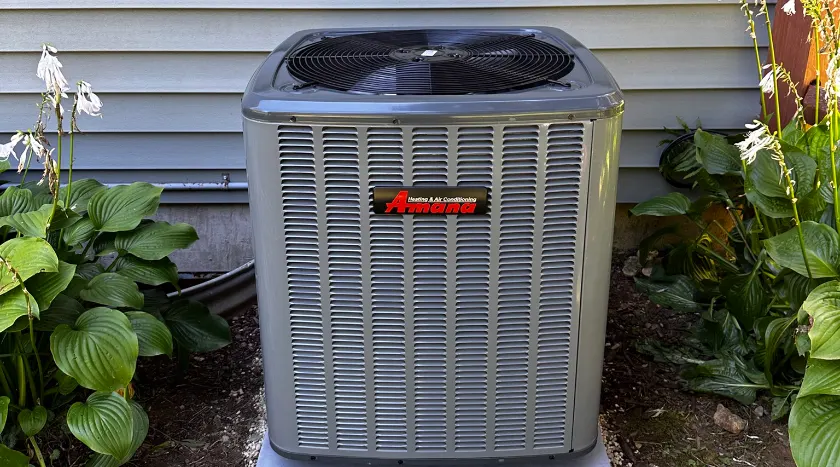
An Amana central air conditioner installed by our team. We repair every major brand, whoever installed it.
- Full-system diagnostic, not a parts swap
- Written flat-rate price before any work starts
- Correctly rated OEM-grade parts, not universal close-enoughs
- Refrigerant charge verified by superheat and subcooling
- Amp draw and temperature split checked after the repair
- Condensate drain and safety switch tested
- Clear notes on what we found and what to watch for
Want to prevent the next one? See our AC maintenance and tune-up service.
Prevent the Next Breakdown for $240 a Year
Most of the repairs on this page show up first as a weak capacitor, a dirty coil or a slow drain, and a spring tune-up catches them. Our semi-annual maintenance plan includes a spring AC or heat pump tune-up and a fall furnace tune-up (each up to a $130 value), one free business-hours service call, priority scheduling and 5% off repairs. That’s up to $390 in services for $240. See the maintenance plan.
Have a heat pump instead of a straight AC? The parts and the failures are similar, with a few extras. See heat pump repair.
AC Repair Across the Fox Valley
Based in Elgin, we serve homes throughout Kane, McHenry, DuPage and DeKalb counties.
- Elgin
- South Elgin
- St. Charles
- Aurora
- Bartlett
- Streamwood
- Huntley
- Plato Center
- Sycamore
- Carpentersville
- West Dundee
- East Dundee
- Algonquin
- Gilberts
- Hampshire
- Pingree Grove
- Campton Hills
- Geneva
- Batavia
- Barrington
- Hoffman Estates
- Schaumburg
- Burlington
- Marengo
- Wayne
- Sleepy Hollow
Don’t see your town? Call (847) 224-2420. View all service areas.
AC Repair FAQs
Why is my AC blowing warm air?
The most common causes are a failed capacitor or contactor at the outdoor unit, a frozen indoor coil, a tripped breaker or a refrigerant leak. Check that the thermostat is set to cool and the outdoor unit is running. If it isn’t, or the copper line is iced, shut the system off and call us.
Why is there ice on my AC line?
Ice on the refrigerant line or indoor coil means the coil is getting too cold, usually from low airflow (a dirty filter, dirty coil or failing blower) or low refrigerant. Turn the system off, set the fan to on to thaw the coil, and have it diagnosed before running it again.
Why does my AC keep tripping the breaker?
A breaker that trips repeatedly means something is pulling too much current: a failing compressor, a shorted fan motor, a weak capacitor or a wiring fault. Reset it once. If it trips again, leave it off and call for repair.
Why is the outdoor unit not running while the inside fan is?
The indoor blower and the outdoor unit are controlled separately. When the outdoor unit is silent, the usual culprits are a failed run capacitor, a burned contactor, a tripped high-pressure switch or a blown low-voltage fuse. These are among the least expensive AC repairs.
Why is there water around my furnace or air handler?
In cooling season, that water is almost always condensate from the indoor coil. A clogged drain line, a rusted pan or a failed condensate pump lets it overflow. Clearing the drain is a quick repair; a cracked pan or bad pump costs a bit more.
What does short cycling mean and is it bad?
Short cycling is when the AC starts, runs a few minutes and shuts off repeatedly. It can be caused by an oversized system, a refrigerant problem, a dirty coil, a thermostat issue or a failing compressor. It’s hard on the compressor and doesn’t dehumidify, so it’s worth fixing.
How much does AC repair cost in Elgin?
Most common repairs, such as capacitors, contactors and fan motors, typically run $300 to $1,400 in our area. Refrigerant leak repairs and compressor replacements can run into the thousands. You get a flat-rate price before any work.
Do you charge a diagnostic fee?
Yes. A flat diagnostic fee covers a full-system check, and the repair is quoted flat-rate for you to approve before any work. Maintenance plan members get one free business-hours service call each year.
Do you offer emergency AC repair?
Yes. We answer no-cooling calls 24/7 at (847) 224-2420. In the summer rush, maintenance plan members get priority scheduling.
Do you repair air conditioners you didn’t install?
Yes. We repair all major brands of central air conditioners, including Carrier, Lennox, Trane, Goodman, Amana, Daikin, Rheem, York and Bryant, no matter who installed them.
Can you just add refrigerant to my AC?
Refrigerant doesn’t get used up. If the system is low, it has a leak. We can add refrigerant to get you through a heat wave, but we’ll find the leak first so you know what you’re dealing with. On an R-22 system, a leak usually means it’s time to replace.
Why does my house feel humid even though the AC is running?
Northern Illinois summers are humid, and an air conditioner has to run long enough to wring the moisture out. Short cycling, an oversized system, low airflow or a low refrigerant charge all leave the house cool but clammy. We check all of them on a repair visit.
Should I repair or replace my air conditioner?
If the repair costs more than half the price of a new system and the unit is over 12 years old, replacement usually makes more sense. Small repairs on older units are still worth doing. We’ll give you a straight answer and a price for both.
Is my R-22 air conditioner still repairable?
Mechanically, yes. Electrical parts like capacitors, contactors and motors are still available. But R-22 refrigerant is no longer produced, so a leak or compressor failure on an R-22 system almost always points to replacement.
How long does an AC repair take?
Most repairs are finished in one to two hours. Our trucks carry the common parts, so the majority are done on the first visit. Refrigerant leak repairs and compressor replacements take longer.
Can I run my AC while I wait for the repair?
If the breaker is tripping, the outdoor unit is making a grinding noise or the line is iced, shut the system off. Running it in that condition risks the compressor. Otherwise, running it is usually fine until we arrive.
What should I check before calling for AC repair?
Confirm the thermostat is on cool and set below room temperature, replace the batteries if it has them, check the breaker, and make sure the filter isn’t clogged. If the outdoor unit still won’t run or the air is still warm, call us.
No Cooling? We’re On It.
Call any time for emergency air conditioning repair, or book a repair or tune-up online in about a minute.
Thinking about replacing? Request a free quote or see financing options. Explore all air conditioning services.
